The China National Space Administration (CNSA) just dropped some new photos of Zhurong. The rover landed on Mars nearly a month ago. These images are stunning. They are also undeniably real.
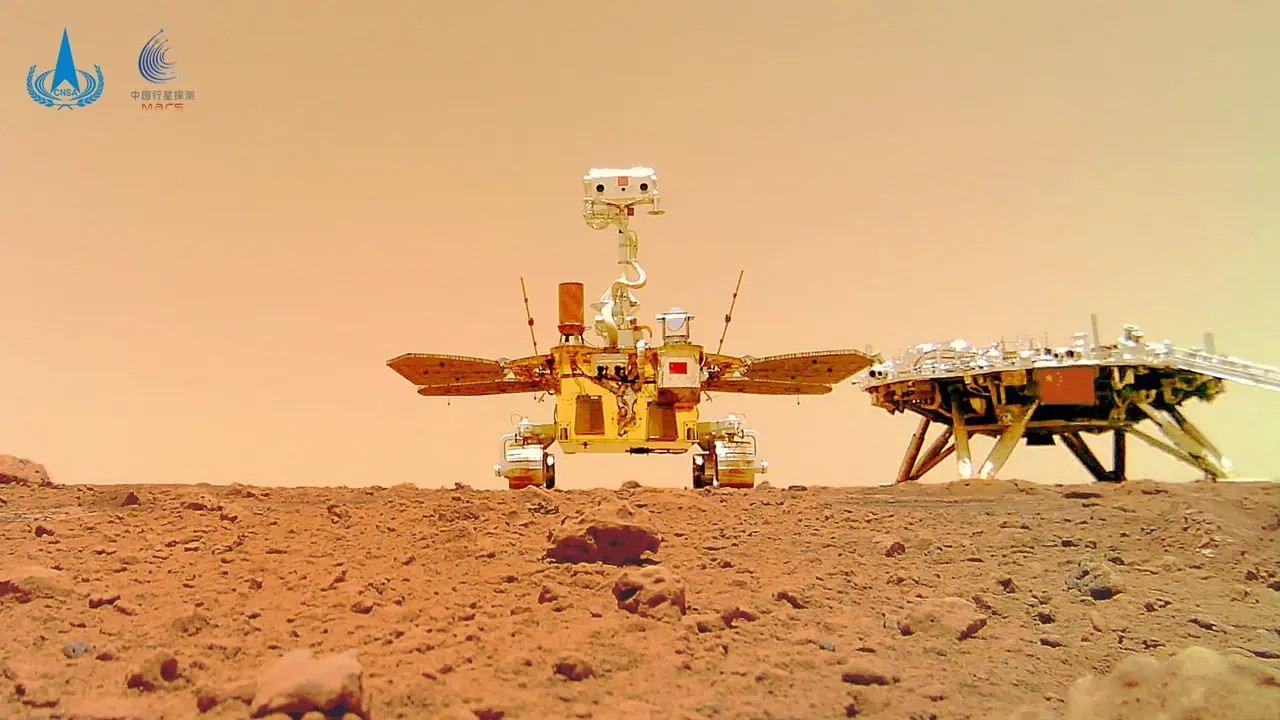
One specific picture has sparked immediate debate online. Skeptics and curious users alike are asking who took it. The image shows Zhurong standing next to its descent stage. The composition looks cinematic. The source? It’s not a distant orbiter. It’s not a third-party probe.
The CNSA explains that Zhurong took the photo itself.
Before driving away, the rover deployed a camera roughly ten meters from the landing platform. It then drove back to pose beside the structure. The rover captured its own portrait.
This isn’t the first time the Chinese mission has captured itself in space. In October 2020, the Tianwen-1 spacecraft released a camera. That device snapped photos of the probe while it was still en route to the Red Planet. Now, we have a ground-level view.
The stakes are high. Zhurong is exploring Utopia Planitia. This vast northern plain is a key target. The rover is hunting for evidence of water or ice. Finding these traces could answer one of the biggest questions in planetary science. Did Mars ever harbor life?
These photos are more than just a vanity project. They are proof of complex engineering. They show a machine that can navigate, deploy hardware, and document its own presence in an alien environment. The skepticism on social media highlights how hard it is to believe that a country achieved this. But the data is there. The camera was placed. The picture was taken.
Zhurong continues its march across the dusty plains. The search for water resumes. The story is just beginning.
The notification banners are always there. White boxes with logos you know by heart. They promise you won’t miss a thing. Science updates. Tech launches. The next big discovery. It’s convenient. You click. You follow. You stay in the loop without opening a browser or checking a feed.
But convenience has a cost.
Algorithms don’t care about depth. They care about retention. They feed you headlines that trigger curiosity or fear. A new study on sleep. A breakthrough in fusion. A gadget that claims to change everything. You tap. You skim. You move on.
This is how modern information consumption works. Fast. Frictionless. Shallow.
The real science rarely makes the cut. The nuance gets stripped away. The uncertainty gets polished into certainty because doubt doesn’t drive clicks. The method section of a paper is boring. The conclusion is not. So that’s what you get.
You get the headline. You get the snippet. You get the summary.
You don’t get the struggle. The failed experiments. The peer review debates. The slow, grinding work of verifying a result that might be wrong. That’s the part that matters. That’s the part that builds trust in knowledge.
Is this a problem?
Depends on what you want. If you want entertainment, it works. If you want understanding, it fails.
The gap between what we know and what we think we know is widening. Not because science is hiding anything. But because the channels we use to access it are optimizing for speed, not truth.
A study published in Nature last week. It showed that social media snippets of scientific abstracts are misinterpreted 40% of the time. Not maliciously. Just because context is missing. Because nuance is hard to compress into a 280-character limit or a 15-second video.
We are drowning in information. Starved for wisdom.
You can choose to dive deeper. To read the full paper. To check the preprint server. To talk to a researcher. It takes time. It’s harder. But it’s the only way to know what’s real.
The algorithms will keep pushing. The notifications will keep coming. You can keep scrolling. Or you can stop. And actually look.