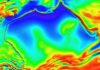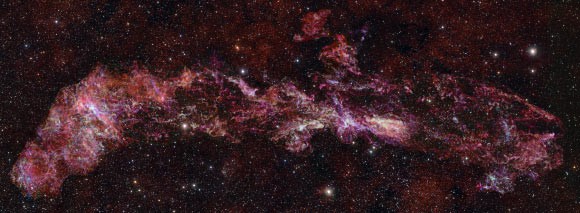
Astronomers using the Atacama Large Millimeter/submillimeter Array (ALMA) have produced the highest-resolution image ever captured of the Milky Way’s central region, offering an extraordinary look at the extreme environment surrounding the galaxy’s supermassive black hole. The breakthrough is not just about sharper visuals; it’s about understanding star formation in conditions unlike anything else in our galactic neighborhood.
Mapping the Galactic Heart
The project, known as the ALMA CMZ Exploration Survey (ACES), meticulously mapped over 650 light-years of the Central Molecular Zone (CMZ). This region is a turbulent hub where gas and dust swirl around the black hole, acting as the primary fuel source for star birth in the galaxy’s core. Unlike visible light, ALMA detects millimeter and submillimeter wavelengths, allowing scientists to peer through the dense gas clouds that obscure our view.
“It’s a place of extremes, invisible to our eyes, but now revealed in extraordinary detail,” explained Dr. Ashley Barnes of ESO. The survey identified dozens of molecules, ranging from simple silicon compounds to complex organic species, providing the most complete inventory of the cold gas in this high-energy zone.
Why This Matters: A Window into Galactic Evolution
The CMZ is unique because it’s the closest galactic nucleus suitable for high-resolution study. By observing star formation in this chaotic environment, researchers can test existing theories under extreme conditions. The region hosts some of the most massive, short-lived stars in the Milky Way, which explode as supernovae or hypernovae, enriching the galaxy with heavy elements.
“We anticipated a high level of detail when designing the survey, but we were genuinely surprised by the complexity and richness revealed in the final mosaic,” added Dr. Katharina Immer, an ALMA astronomer. The resulting data reveals structures ranging from massive gas clouds stretching dozens of light-years to smaller clouds around individual stars.
Echoes of the Early Universe
The conditions in the CMZ closely resemble those found in early galaxies, where star formation occurred rapidly and chaotically. By studying the processes within our own galactic core, astronomers can gain insights into how galaxies evolved in the universe’s infancy. Professor Steve Longmore, the ACES leader, stated, “By studying how stars are born in the Central Molecular Zone, we can also gain a clearer picture of how galaxies grew and evolved.”
The ALMA observations provide an invaluable tool for understanding not only star formation in extreme conditions but also the broader evolutionary history of galaxies.
The new dataset promises to reshape our understanding of galactic nuclei, offering an unprecedented level of detail that will drive future research for years to come.