The Artemis 2 mission, humanity’s first crewed voyage around the moon in over 50 years, launched on April 1st from Florida’s Kennedy Space Center. Unlike previous lunar expeditions where updates were limited to broadcast news and print media, the public now has unprecedented access to track the four astronauts’ ten-day journey in real-time. This marks a significant shift in how space exploration is experienced and shared.
Real-Time Tracking with AROW 🛰️
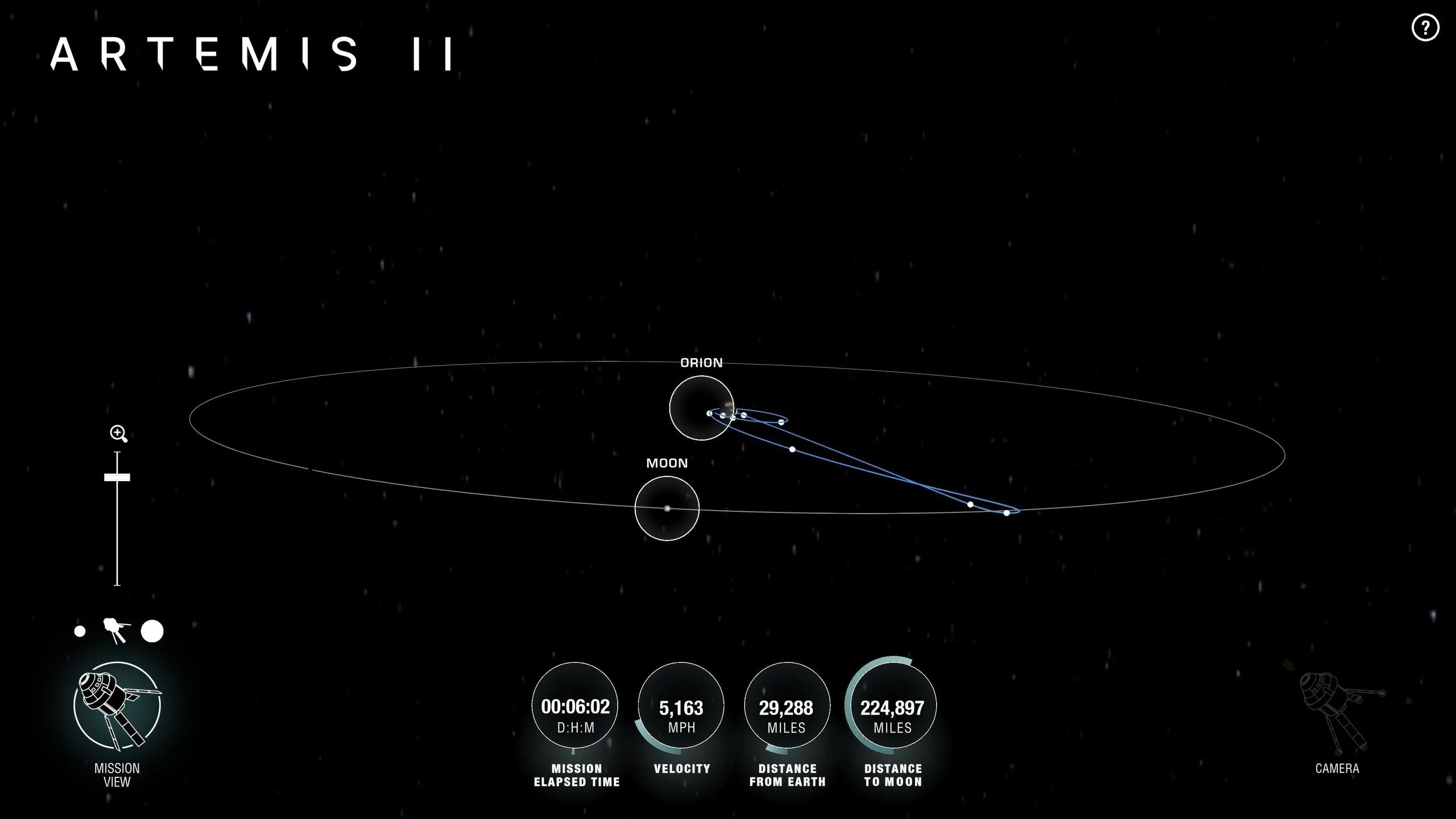
NASA’s Artemis Real-time Orbit Website (AROW) is the key to following the Orion capsule’s progress. AROW displays critical data points, including the spacecraft’s distance from Earth and the moon, mission elapsed time, and current velocity. This live feed begins just one minute after liftoff and continues until Orion’s return to Earth.
The system visualizes data gathered from Orion’s onboard sensors, transmitted directly to Mission Control in Houston. This means you can monitor the crew’s position as accurately as NASA itself. The AROW platform also includes educational resources, such as historical insights into the moon and the Apollo landing sites.
Augmented Reality & Historical Firsts 📱
For those seeking a more immersive experience, NASA’s app features an augmented-reality (AR) tracker. Point your phone at the sky, and the app will superimpose Orion’s real-time position onto your screen, showing how the spacecraft aligns with your location on Earth.
The Artemis 2 crew consists of NASA astronauts Reid Wiseman, Victor Glover, and Christina Koch, alongside Canadian Space Agency astronaut Jeremy Hansen. This mission is historic for multiple reasons: Victor Glover will be the first African-American to venture beyond low Earth orbit (LEO), while Christina Koch will be the first woman to do the same. Jeremy Hansen represents the first non-American to participate in such a deep-space mission.
The Artemis 2 mission demonstrates a commitment to transparency and public engagement in space exploration. By providing real-time data and interactive tools, NASA is inviting the world to join this landmark journey.
The ability to follow the mission in this detail highlights a growing trend: making space exploration more accessible and inclusive than ever before.