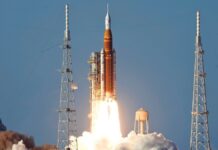
The four astronauts aboard the Artemis II mission have initiated a critical engine burn, propelling their Orion spacecraft beyond Earth’s orbit and setting a course for the moon. This maneuver marks a historic step – the first crewed lunar flyby in over half a century, committing NASA to a ten-day mission that will test the limits of human space travel and lay the groundwork for a planned lunar landing in 2028.
Propulsion and Trajectory
The six-minute engine burn, delivering thrust equivalent to accelerating a car from standstill to highway speed in under three seconds, placed the crew on a three-day trajectory toward Earth’s natural satellite. The astronauts are now on a “free return” trajectory, leveraging the moon’s gravity for a slingshot maneuver that will bring them back to Earth without further propulsion. This approach ensures a safe return even in the event of unforeseen complications.
Crew and Initial Operations
The Artemis II crew – Americans Reid Wiseman, Victor Glover, and Christina Koch, alongside Canadian astronaut Jeremy Hansen – spent their first hours in space troubleshooting minor issues with the spacecraft. These included a communications glitch and a malfunctioning toilet, highlighting the inherent challenges of operating a previously untested human-rated vehicle. Despite these hurdles, the astronauts remain in high spirits. “The crew is feeling pretty good up here on our way to the moon,” Hansen reported, “Humanity has once again shown what we are capable of.”
Mission Significance and Political Context
The Artemis II mission is notable for breaking multiple records. It carries the first person of color, the first woman, and the first non-American on a lunar mission, pushing the boundaries of inclusivity in space exploration. The astronauts will venture farther from Earth than any human before – over 250,000 miles (402,336km) – testing the limits of human endurance and spacecraft capabilities.
The mission also marks the inaugural crewed flight of NASA’s Space Launch System (SLS), a new lunar rocket designed for repeated lunar missions and the eventual establishment of a permanent lunar base. However, SLS has faced years of delays and cost overruns, with setbacks even forcing a return to the hangar for repairs.
The current resurgence of U.S. lunar investment is not happening in a vacuum. The Artemis program has been framed, in part, as a response to China’s ambitions to land humans on the moon by 2030. NASA Administrator Jared Isaacman has acknowledged this dynamic, stating that competition “can be a good thing” in mobilizing national resources.
Long-Term Goals and Political Pressure
The Artemis program faces continued pressure to accelerate its timeline, with some pushing for a lunar landing before the end of the decade. While the projected landing date of 2028 is ambitious, experts express concern that it relies heavily on private sector technological advancements. The mission’s success is critical not only for scientific advancement but also for maintaining U.S. leadership in space exploration.
The Artemis II crew concluded their press conference by emphasizing the mission’s significance, their adaptation to life in space, and the awe-inspiring view of Earth from orbit. This mission represents a bold leap forward, pushing the boundaries of human exploration while navigating the complex realities of space travel.