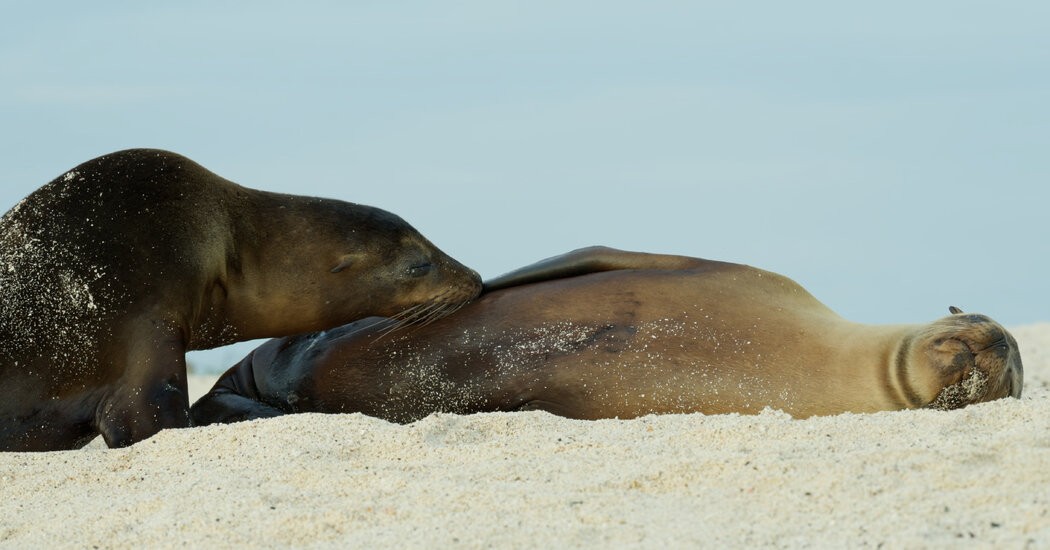
Galápagos sea lions exhibit an unusually extended period of nursing, with some individuals continuing to suckle from their mothers well into adulthood—a behavior unprecedented among mammals. A long-term study reveals that many Zalophus wollebaeki continue nursing for years after reaching sexual maturity, with documented cases persisting into the equivalent of human middle age.
A Biological Anomaly
For most mammals, weaning marks a clear transition to independence. However, Galápagos sea lions challenge this expectation. Researchers have observed individuals nursing as late as age 16—a stage comparable to a human in their early 60s still receiving maternal milk. This behavior contradicts established biological principles that suggest mothers should discontinue lactation once offspring can sustain themselves and reproduce.
The persistence of nursing despite the high energetic cost of producing lipid-rich milk is particularly remarkable. As marine mammal expert Patrick Pomeroy notes, this phenomenon “goes against all the accepted wisdom.” Anthropologist Sarah Blaffer Hrdy adds that the continued nursing is “utterly extraordinary,” given the biological and evolutionary pressures that would normally terminate such behavior.
Implications and Questions
Darwinian logic dictates that mothers should cease milk production when offspring no longer depend on it for survival. Yet, among Galápagos sea lions, mothers often nurse older young while simultaneously raising new pups.
This raises critical questions about the social dynamics and reproductive strategies within the species. Is prolonged nursing a cultural adaptation? Does it provide additional nutritional benefits? Or is it a unique quirk of their island ecosystem? Further research is needed to fully understand why these sea lions deviate so dramatically from typical mammalian behavior.
This behavior is not only unusual but also challenges our understanding of maternal investment and offspring dependence in the animal kingdom. It underscores how much remains to be discovered about natural selection and adaptation in even well-studied species.