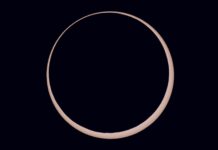
An annular solar eclipse, often called a “ring of fire,” will occur on February 17th. This event happens when the Moon passes between the Earth and the Sun, but is too far away to completely cover the solar disk. As a result, a bright ring of sunlight remains visible around the Moon’s silhouette.
Eclipse Timeline (Eastern Standard Time)
The eclipse will unfold as follows:
- Partial eclipse begins: 4:56 a.m. EST (0956 GMT)
- Maximum annularity (“ring of fire”): 7:12 a.m. EST (1212 GMT) – this phase will last up to 2 minutes and 20 seconds.
- Partial eclipse ends: 9:27 a.m. EST (1427 GMT)
Visibility and Geographic Impact
The full annular effect will be visible only from a narrow corridor across Antarctica, roughly 2,661 miles long and 383 miles wide. Observers in other parts of Antarctica, southern Africa, and southernmost South America will see a partial eclipse instead. The Moon will cover approximately 96% of the Sun’s disk at peak annularity.
Why This Matters: Understanding Annular Eclipses
Annular eclipses are less common than total solar eclipses. They occur when the Moon is at a greater distance from Earth in its elliptical orbit. Unlike total eclipses, where the Sun is entirely blocked, annular eclipses never create complete darkness; the “ring of fire” remains visible.
Safety First: Protecting Your Eyes
Never look directly at the sun without proper protection. Viewing a solar eclipse without specialized filters can cause severe, permanent eye damage. To view the eclipse safely:
- Use certified solar eclipse glasses that meet the ISO 12312-2 international safety standard.
- Equip cameras, telescopes, and binoculars with appropriate solar filters before looking at the Sun.
- If you are unsure about safety, consult a reliable astronomy guide or expert.
Future Solar Events
The next major solar event will be a total solar eclipse on August 12, 2026, visible from Greenland, Iceland, and northern Spain. Partial eclipses will be observable across Europe and Africa.
The February 17th eclipse offers a rare spectacle for those in the viewing path, but it underscores the importance of safe observation practices when witnessing solar phenomena.