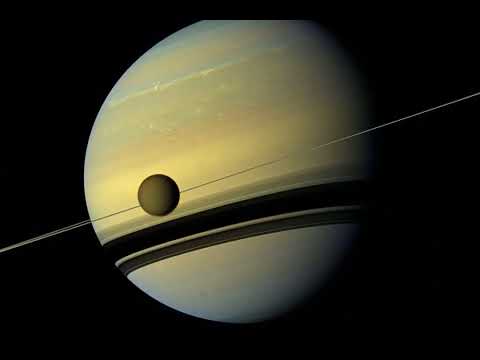
Saturn’s majestic rings, along with several quirks in its moons’ orbits, may be the result of a cataclysmic collision involving its largest moon, Titan. New research suggests that a now-vanished moon, dubbed Chrysalis, slammed into Titan roughly 400 million years ago. This impact wasn’t just destructive; it could explain several long-standing mysteries about the Saturnian system.
The Saturn System’s Oddities
For years, scientists have puzzled over anomalies in Saturn’s moons and rings. The rings appear surprisingly young, given the planet’s age. Saturn’s axial tilt doesn’t align with expected gravitational influences from Neptune, and the small moon Iapetus has an unusually tilted orbit. Titan itself is remarkably crater-free and follows an elliptical path, rather than a circular one. These irregularities have no easy explanation… until now.
The Chrysalis Impact Theory
The leading theory posits that a former moon, Chrysalis, once existed in the outer Saturnian system. Simulations previously suggested it broke apart to form the rings, but this explanation has issues. The new model suggests that Chrysalis didn’t break up—it collided with Titan. This collision would have reshaped Titan, erasing craters and stretching its orbit into an ellipse. More importantly, it would have flung debris into the Saturnian system.
“This is sort of a grand unified theory that covers all of the major problems,” says Matija Ćuk, who led the research team behind this work.
From Collision to Rings
The impact with Titan would have been violent enough to create a debris field. Over time, this debris spiraled inward, colliding with Saturn’s inner moons. These collisions ground the moons down into the tiny particles that now make up the planet’s iconic rings. The small moon Hyperion may even be a remnant of the original collision. This cascading series of events explains not only the rings but also the odd orbits of Saturn’s inner satellites.
Testing the Theory
The upcoming NASA Dragonfly mission, scheduled to launch in 2028, may hold the key to confirming this hypothesis. By closely examining Titan’s surface in 2034, scientists can search for evidence of a past merger. If the data supports the collision theory, it would dramatically reshape our understanding of Saturn’s formation and evolution.
The Saturn system’s peculiarities have long been an enigma. This new research doesn’t just offer an explanation; it connects several mysteries into a single, testable narrative, potentially revealing that Titan’s history is central to understanding the entire planetary system.