Black holes don’t just sit there.
They change. They merge. They explode. And Stephen Hawking’s famous 1970s theory? It struggled to keep up.
Hawking gave us radiation. Thermal leakage. The idea that these cosmic traps could eventually evaporate, implode, and die. It was groundbreaking. It was legendary.
It was also limited.
New research suggests we’ve been looking at the problem the wrong way. Forget the event horizon for a moment. Think about a pot of water on the stove.
Boiling water gets messy. Disordered.
That disorder is called entropy.
And black holes? They have it too.
“Hawking’s laws… provided a satisfying connection between extreme and oddinary physics… but they have a serious limitation.” — Abhay Ashtekar, Penn State
The catch? Hawking’s laws only work when the black hole is chilling. Equilibrium. Unchanging. Static.
Reality doesn’t do static.
Black holes are dynamic. They form. They fight. They evaporate.
So the team at Penn State—led by Abhay Ashtakar with help from grad students Daniel E. Paraizo and Jonathan Shu—decided to rewrite the rules. Not the physics, just the framework.
Einstein’s shadow
You can’t talk holes without talking gravity. And you can’t talk gravity without Albert Einstein.
- General Relativity drops.
The math screams “singularity.” A point where equations go to infinity. The heart of the beast.
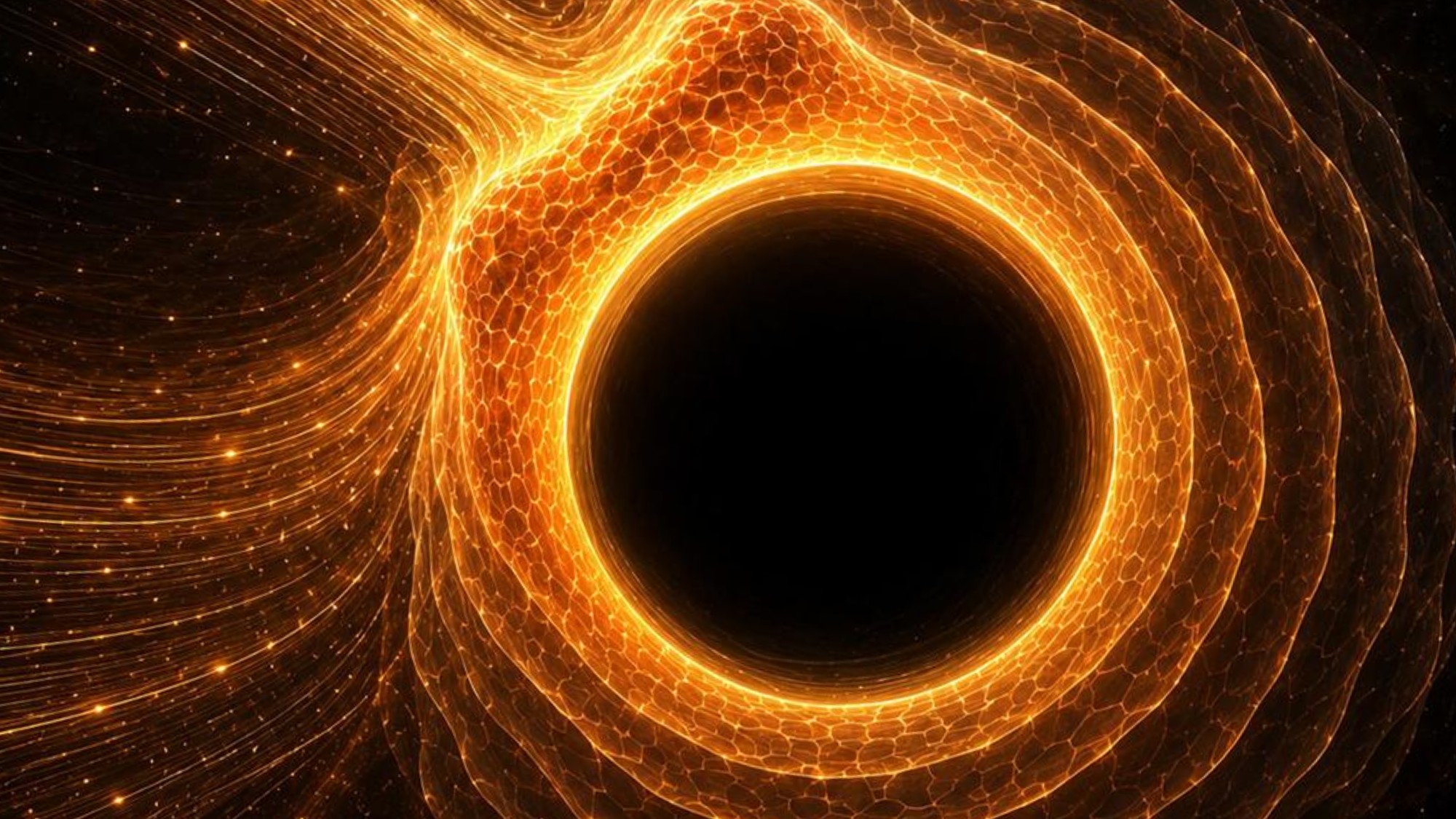
Surrounding it? The event horizon. The point of no return. Gravity is so strong there that even light gets stuck. Escape velocity exceeds lightspeed. Nothing out. Not even information.
For decades, that was it. Zero temperature. Zero radiation. Infinite ways to make a hole.
It seemed like the thermodynamic laws—those nice rules about energy and disorder—had no business applying to something so dark.
Then came Hawking.
1974. He changed the game.
Suddenly, black holes radiated heat. Suddenly, they had temperature. Suddenly, we could apply thermodynamics to them. It shifted them from math problems to physical realities.
Hawking’s recipe was elegant. Area equals entropy. Spin and mass inversely proportional. It worked.
Until it didn’t.
The problem with the view
Here’s the rub.
Analogies fail when things get busy.
“In dynamic situations… event horizons can form… where nothing is happening.” — Jonathan Shu
When a black hole is growing, merging, or eating stars, the “event horizon” is a bad measuring stick.
Why?
Because you can’t define its properties right now.
You have to predict the future. You have to see if light will escape or not. That’s not physics. That’s prophecy.
Paraizo put it simply.
If you can’t see inside, you can’t know what’s inside. Not really.
The area of that horizon cannot measure the actual physical entropy of a changing hole. It’s a lagging indicator. Useless for understanding the birth or death of the beast.
So the Penn State team did something radical.
They threw out the event horizon.
Replaced it with a dynamical horizon.
Already used in simulations. Never fully applied to thermodynamic law.
This simple switch fixes everything.
First Law of Thermodynamics? Applied. Energy changes form, but isn’t created.
Second Law? Applied. Entropy always increases.
No more waiting for the future to define the present.
No more requiring the black hole to sit still.
This works for birth. Merger. Evaporation. Even that explosive death Hawking predicted.
It extends the laws beyond the 50-year equilibrium paradigm.
“We wanted to find a way to… extend the laws to black holes that are you of equilibrium.” — Ashtekar
Does it solve all our problems?
Maybe.
Quantum theory still has holes of its own. But this makes the math fit the chaos.
We finally have a way to talk about a black hole while it’s moving.
Instead of just waiting for it to die.