Photographer David Severn’s striking images offer an unprecedented look into the world of quantum physics – a field that remains largely hidden from public view. His work, recently shortlisted for the Portrait of Britain award, captures not just the cutting-edge technology, but also the human element behind the breakthroughs happening in UK laboratories. These aren’t sterile images of machines; they’re portraits of scientists immersed in a reality that often defies common sense.
The Human Face of Quantum Research
Severn’s project began with no prior knowledge of quantum mechanics. He was simply tasked with documenting the people and labs at the forefront of this emerging field. However, as he worked, he discovered unexpected parallels between the abstract concepts of quantum physics and the intuitive, often illogical, nature of artistic perception.
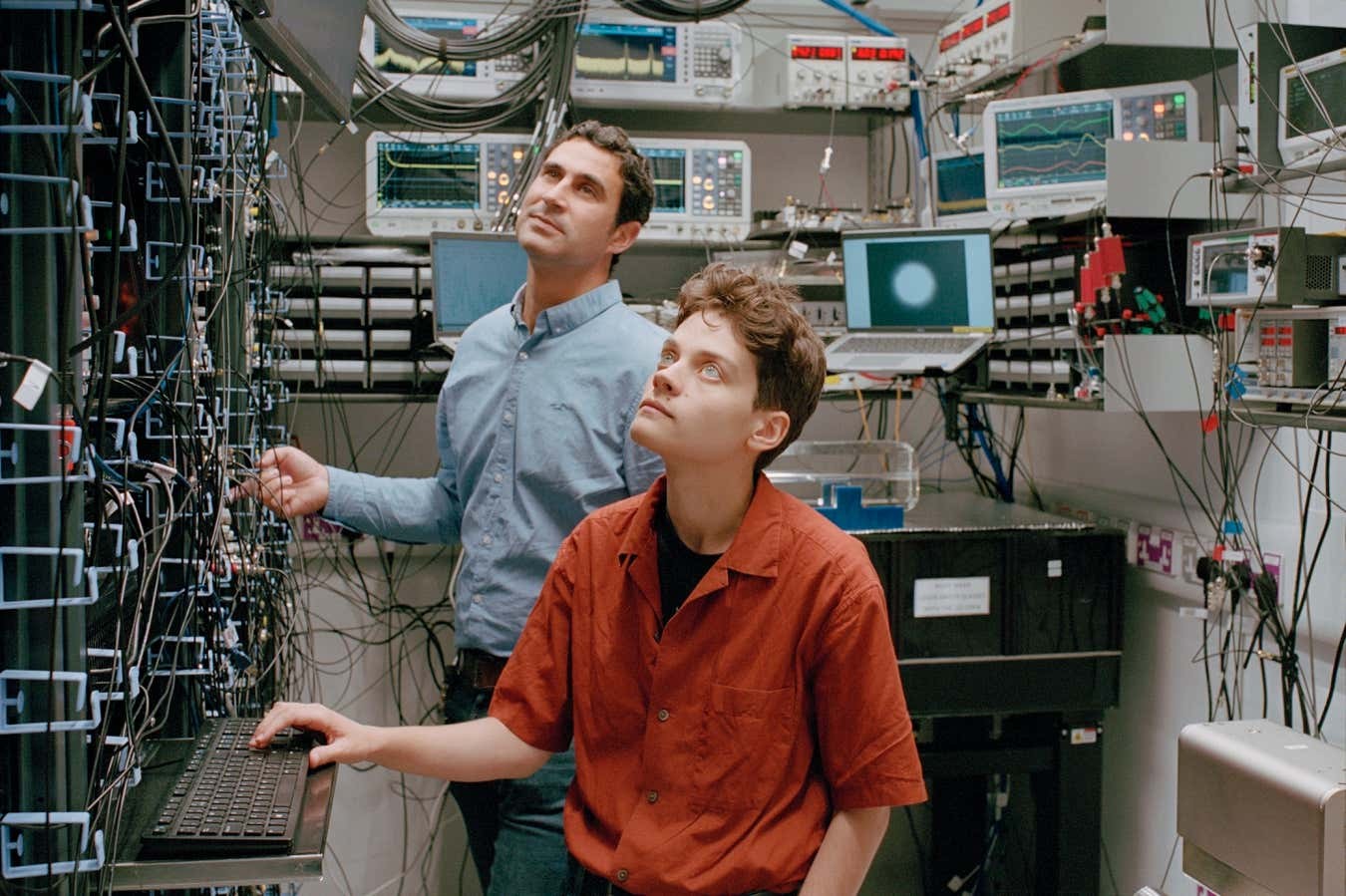
One photograph depicts two physicists monitoring an ultra-stable laser at the National Physical Laboratory in London. Their relaxed demeanor belies the complexity of the work they’re doing, almost evoking imagery of past industrial workers – submarine operators or cotton mill hands from a bygone era. This visual echo suggests that while the technology has advanced, the fundamental human interaction with powerful, often mysterious, machines remains consistent.
Beyond the Machines: Applications in Medicine and Beyond
The images aren’t limited to theoretical setups. Severn also documented practical applications of quantum research. One striking example is a 3D-printed helmet housing quantum sensors designed to image the human brain using magnetic fields. Another captures Hartmut Grote at Cardiff University, meticulously checking a vacuum pump that ensures the pristine conditions required for laser experiments.
These aren’t abstract concepts confined to textbooks; they are tools being developed for real-world use. The labyrinthine arrangement of pumps and mirrors needed to maintain the cleanliness of optical equipment highlights the painstaking precision required in quantum research.
Embracing the Mystery
Severn intentionally leans into the enigmatic nature of quantum physics. He references Diane Arbus’s idea that “a photograph is a secret about a secret,” applying it to the field itself. The more we attempt to understand quantum phenomena, the more elusive they become.
Just when we think we’ve grasped how light behaves, the quantum world introduces counterintuitive realities. This inherent mystery is what makes the field both challenging and compelling.
The Quantum Untangled exhibition, running until February 28th at the Science Gallery at King’s College London, offers a rare chance to experience this hidden world firsthand. The show, adapted from Cosmic Titans: Art, Science and the Quantum Universe, underscores the growing intersection of art and science in exploring the universe’s deepest secrets.
Quantum physics remains a field shrouded in complexity, yet these images remind us that at its core, it is driven by human curiosity and ingenuity.