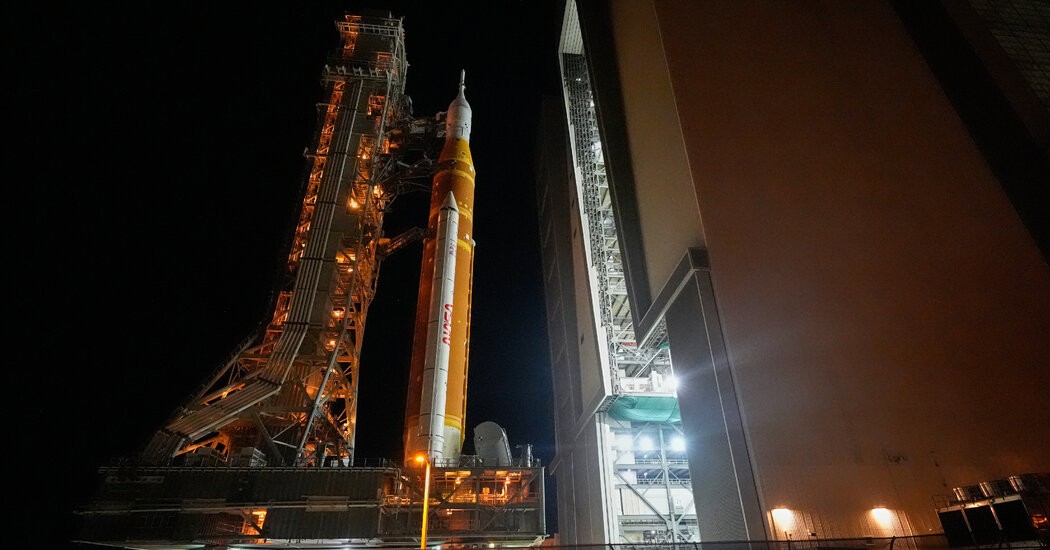
NASA has officially set April 1 as the target launch date for Artemis II, a landmark mission that will send four astronauts on a close-loop flight around the moon – the first crewed lunar mission in over 50 years. The announcement follows successful resolution of technical challenges, including hydrogen leaks and helium flow interruptions, which previously delayed launch attempts in February and March.
Crew and Historical Significance
The Artemis II crew includes Commander Reid Wiseman, Pilot Victor Glover, and Mission Specialists Christina Koch and Jeremy Hansen. This mission holds several firsts: Victor Glover will become the first Black man to travel around the moon, Christina Koch the first woman, and Jeremy Hansen the first non-U.S. citizen on such a mission. The crew will begin a mandatory quarantine period on March 18 in preparation for the 10-day flight.
Mission Details and Vehicle Readiness
The mission will use the Space Launch System (SLS) rocket, the same powerful vehicle employed by Artemis I, to carry the Orion capsule and crew around the far side of the moon without landing. NASA officials have stated that despite inherent risks in a test flight, both the team and hardware are prepared for launch. The rocket and capsule were initially moved to the launchpad in January but returned to the Vehicle Assembly Building for repairs after issues were detected during pre-flight testing.
Addressing Technical Challenges
The primary delays stemmed from a hydrogen leak discovered during a full-scale fuel loading test, followed by an interruption in the helium flow to the upper stage. Helium is critical for pressurizing the liquid hydrogen and oxygen propellants used by the rocket engines. Both issues have now been resolved, allowing NASA to proceed toward the April 1 launch window.
“It’s a test flight, and it is not without risk, but our team and our hardware are ready,” stated Lori Glaze, NASA’s acting associate administrator for Exploration Systems Development.
This mission serves as a crucial stepping stone toward future lunar surface landings, currently planned for 2028. The Artemis program represents a renewed commitment to deep-space exploration, and Artemis II’s success will pave the way for sustained human presence beyond Earth orbit.
The Artemis II mission is not just a technical feat; it’s a symbolic leap forward in space exploration, breaking barriers in representation and reaffirming NASA’s ambition to return humans to the moon and beyond.