NASA’s Transiting Exoplanet Survey Satellite (TESS) has turned its gaze toward a rare visitor: interstellar comet 3I/ATLAS, offering scientists a unique opportunity to study an object originating outside our solar system. The probe tracked the comet as it moved away from the Sun, gathering data on its rotation and activity.
Comet 3I/ATLAS: A Transient from Another Star System
Comet 3I/ATLAS is not native to our solar system. It’s an interstellar traveler, meaning it formed around another star and was gravitationally ejected into interstellar space before eventually crossing into our cosmic neighborhood. Such comets are extremely rare, making each observation valuable.
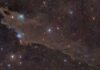
TESS observed the comet between January 15 and 22, recording it as a bright, fast-moving point of light with a faint tail. The spacecraft’s wide-field view allowed scientists to compile 28 hours of footage, though the recording includes a gap due to a brief “safe mode” event when TESS experienced solar panel issues.
What Scientists Hope to Learn
The primary goal of tracking 3I/ATLAS is to determine its rotational speed and how vigorously it sheds dust and gas. These factors offer insight into the comet’s composition and how it interacts with the Sun’s radiation.
- Brightness: TESS measured the comet’s brightness at a magnitude of 11.5, visible through telescopes but too faint for the naked eye.
- Activity: The data should reveal how much material the comet loses as it warms up near the Sun.
- Rotation: The rate at which the comet spins will help scientists understand its internal structure.
TESS: More Than Just an Exoplanet Hunter
TESS was originally designed to find planets orbiting distant stars by detecting the slight dimming of a star as a planet passes in front of it. However, its wide field of view and continuous monitoring also make it suitable for observing objects within our solar system, like comets and asteroids. In fact, TESS detected 3I/ATLAS before its official discovery, by sifting through old data.
While the mission cannot determine the comet’s precise origin, the data gathered will provide valuable insights into the composition and behavior of interstellar visitors. This is important because such objects may carry clues about the formation of planetary systems around other stars.
Tracking these interstellar travelers helps us better understand the building blocks of planets and the conditions in other star systems. The data from 3I/ATLAS will serve as a reference for future observations of similar objects.