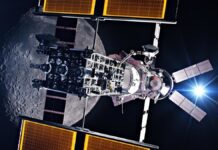
NASA’s Artemis II mission marks humanity’s return to deep space with the Orion spacecraft – a tightly engineered capsule designed to carry four astronauts beyond Earth orbit for the first time in over half a century. The stakes are high: this ten-day test flight is critical to NASA’s broader plans for sustained lunar exploration.
A Compact Living Space
The Orion capsule isn’t spacious. At just 330 cubic feet, it’s roughly the size of a minivan and requires significant compromise from its crew. Astronauts Christina Koch, Reid Wiseman, Victor Glover, and Jeremy Hansen will share this confined space as their cockpit, lab, dining room, bathroom, bedroom, and emergency shelter all in one.
The interior is designed for efficiency: stowage compartments double as radiation shields, a compact kitchenette allows for rehydrated meals (shrimp, macaroni and cheese, and tortillas were tested), and a free-floating exercise device helps mitigate the effects of prolonged weightlessness. The toilet, a 5-cubic-foot unit under the floor, includes privacy curtains – a necessity given astronaut Hansen’s 6-foot-2 height. In the event of system failure, backup urine collection bags will be used.
The Mission’s Critical Importance
Artemis II isn’t just about comfort. The mission will test Orion’s ability to sustain human life in deep space, including its radiation shielding and emergency systems. During the four-day outbound journey, the crew will rehearse sheltering from solar storms in a shielded cavity beneath the cabin floor. If Orion fails, NASA’s entire moon-return strategy is at risk.
The capsule’s tight design reflects a deliberate trade-off: while astronauts will have over 50% more room than their Apollo predecessors, the living space is significantly smaller than that aboard the International Space Station. Every item, from laptops to checklists, must justify its presence.
Adapting to Microgravity
Life inside Orion will require adaptation. Astronauts will sleep in bags strapped to the walls, eat rehydrated meals, and exercise using a flywheel device to avoid steering issues caused by vibrations. The spacecraft’s small size forces efficiency; after launch, the crew will set up the toilet, water dispenser, and food warmer, folding away seats to maximize floating space.
As commander Reid Wiseman put it, “It’s like climbing into my bed, and I’ll feel warm and tucked-in.”
The Future of Deep Space Travel
The Artemis II mission is a critical step toward NASA’s long-term goals: establishing a sustainable human presence on the Moon and beyond. The success of Orion will determine whether future missions can rely on the spacecraft as a safe, reliable habitat for deep space exploration. After splashdown, the crew will emerge onto an inflatable raft – NASA’s “front porch” – marking the end of a historic flight.