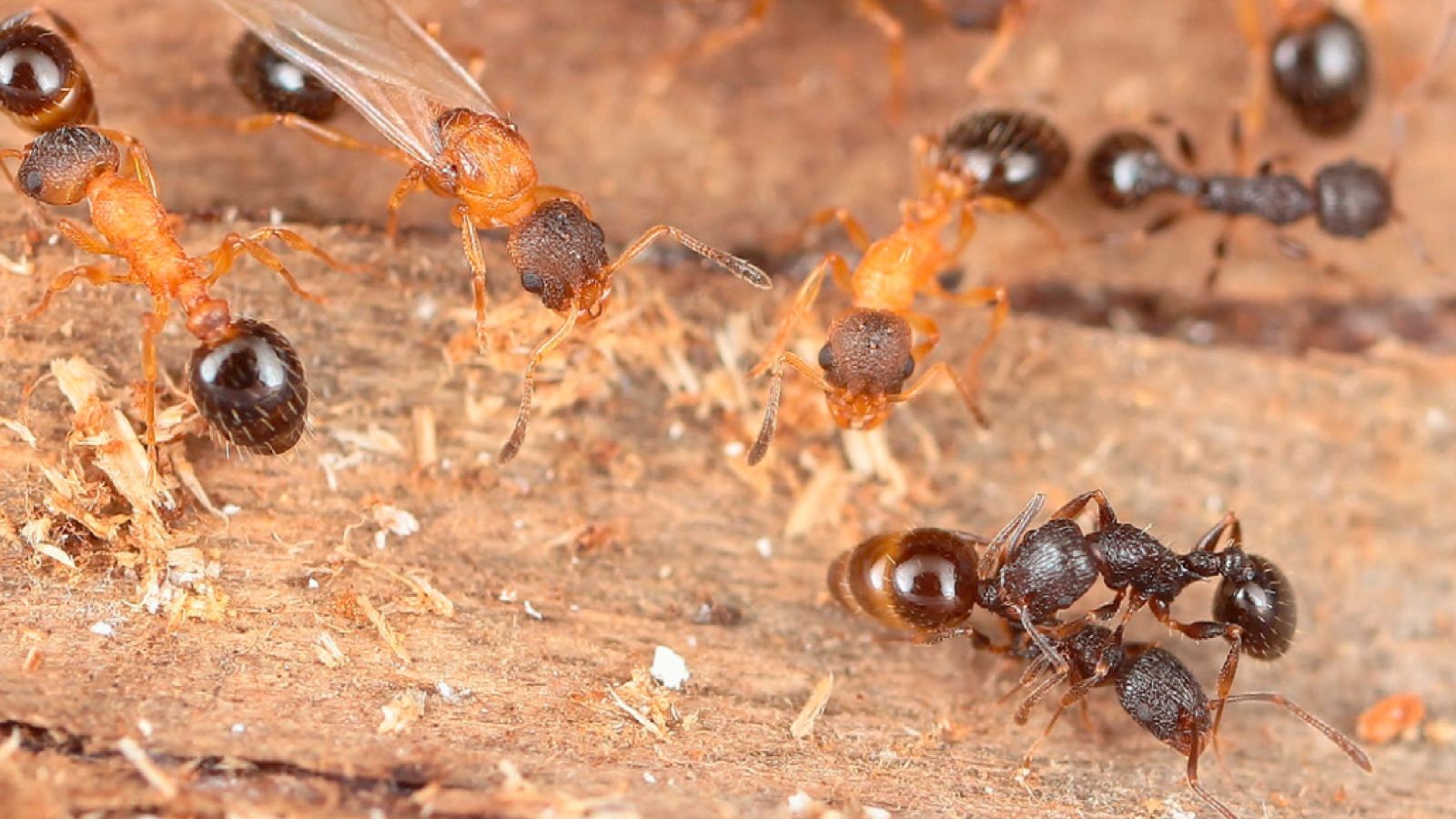
A newly studied ant species in Japan, Temnothorax kinomurai, operates in a unique way: it consists entirely of queens that reproduce through cloning and invade the colonies of other ant species to survive. The discovery marks the first documented case of an insect species with no workers or males—only queens.
The Parasitic Life Cycle
Unlike typical ant colonies with a queen, workers, and males, T. kinomurai queens infiltrate the nests of a related species, Temnothorax makora. They forcibly take over these colonies by stinging the host queen and aggressive worker ants. Once successful, the invading queen manipulates the surviving workers into raising her cloned offspring. The parasitic queen cannot survive without the host colony’s workforce for foraging and brood care.
Asexuality Confirmed in Lab Studies
Researchers reared 43 offspring from six T. kinomurai colonies in a controlled lab setting. Examination confirmed that all 43 offspring were queens, with no males or workers present. This supports the hypothesis that the species reproduces exclusively through parthenogenesis, a form of asexual reproduction.
When given the opportunity, seven of these virgin queens successfully staged coup attempts in new T. makora colonies. The resulting 57 offspring were also all queens, confirming the species’ reproductive strategy.
Evolutionary Implications
Experts note that this combination of social parasitism and asexual reproduction is unusual, but makes evolutionary sense. Asexual reproduction allows the queens to maximize their own genetic contribution to the next generation, bypassing the need for mating and male production. The trade-off is a loss of genetic diversity in workers, which could impact colony resilience against disease or specialized labor.
Given the existence of over 15,000 ant species, this case is remarkable. While sexual reproduction typically balances benefits like pathogen defense and labor division, T. kinomurai demonstrates that when worker production is unnecessary, asexual cloning can become the dominant reproductive strategy.
The findings highlight how species can adapt in extreme ways to optimize survival. This parasitic ant serves as a stark example of how evolution favors strategies that ensure reproduction, even at the cost of conventional social structure.