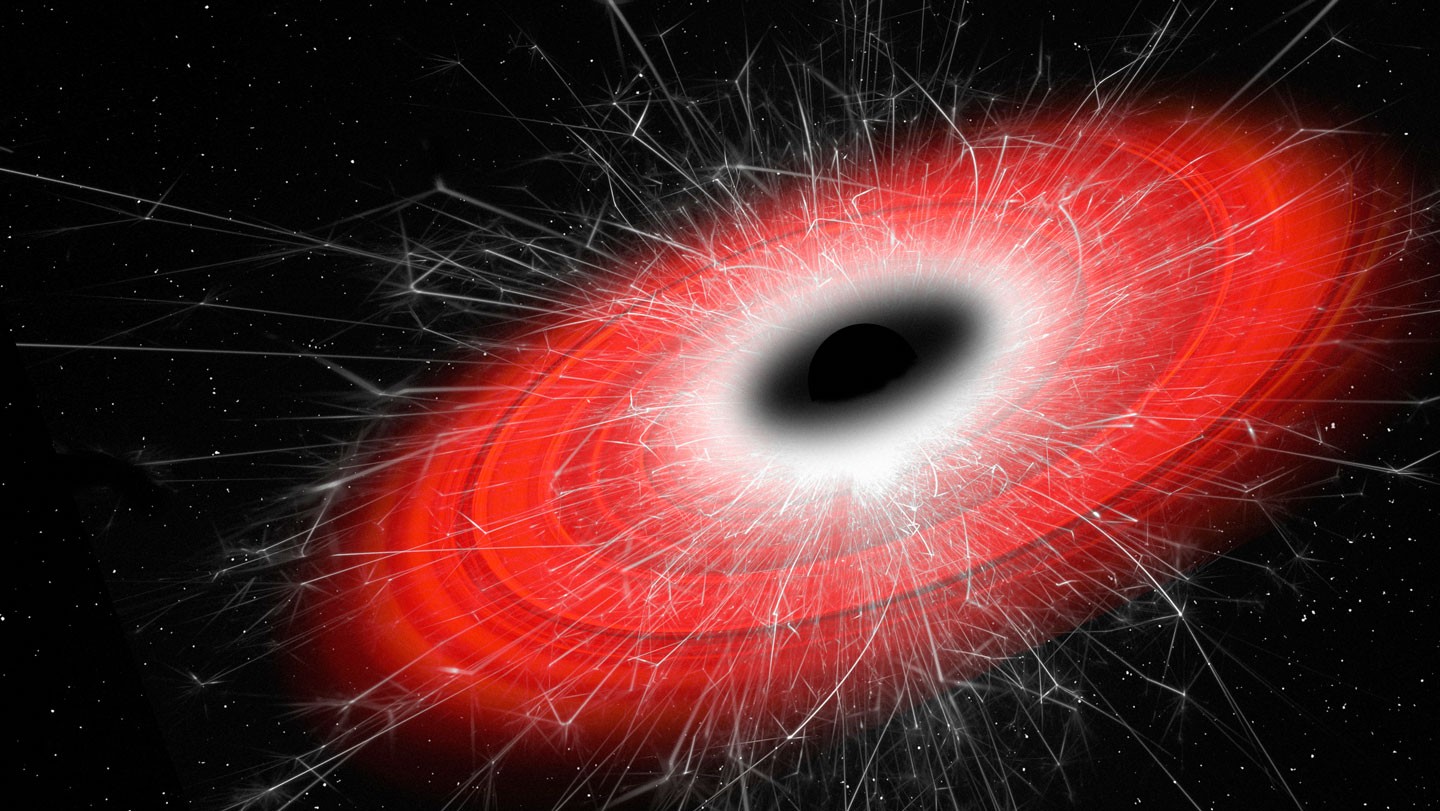
Black holes are not truly black. According to theoretical physics, they emit a faint, ghostly mist of particles known as Hawking radiation. This phenomenon is central to some of the most profound puzzles in modern science, yet it remains impossible to observe directly because the signal is far too weak for current instruments to detect.
However, a breakthrough in mathematical physics may finally allow scientists to study these elusive emissions indirectly. By leveraging a concept known as the “double copy,” physicists have found a way to translate the complex mathematics of black holes into the more manageable language of particle physics.
The Double Copy: Physics’ Rosetta Stone
To understand this advance, one must first look at the two pillars of modern physics, which have historically operated in separate domains:
- The Standard Model: Describes the behavior of subatomic particles and forces (excluding gravity).
- General Relativity: Describes gravity and the large-scale structure of the universe.
For decades, these theories have resisted unification. But in 2010, physicists discovered a surprising mathematical link between them called the double copy. Essentially, many gravitational phenomena can be calculated by taking equations from particle physics and “squaring” them—mathematically combining two copies of the particle equations to produce a gravitational result.
“It allows us to calculate things we’ve never been able to calculate before, just by recycling results in a clever way,” says Chris White, a theoretical physicist at Queen Mary University of London.
This technique has already proven useful for calculating gravitational waves and other effects. Until now, however, it had not been successfully applied to Hawking radiation.
Translating Hawking Radiation
In a recent study accepted by the Journal of High Energy Physics, White and his colleagues successfully translated Hawking radiation into the language of the Standard Model.
The result was unexpected but elegant. In the realm of particle physics, the mathematical equivalent of a black hole emitting Hawking radiation is a charged particle scattering off a collapsing spherical shell of charged matter.
This finding was independently confirmed by two other teams, whose results were published in Physical Review Letters. These parallel discoveries suggest that the physics governing black holes is deeply embedded within the Standard Model of particle physics.
Why this matters:
* Bridging Scales: Hawking radiation connects the macroscopic (enormous black holes) with the microscopic (tiny quantum particles). The double copy demonstrates that this bridge is mathematically sound.
* New Calculational Power: As Cynthia Keeler of Arizona State University notes, finding this analog “constitutes a major advance” because it opens the door to calculating black hole behaviors that were previously intractable.
Solving the Information Paradox
The ultimate goal of this research is not just mathematical elegance, but solving one of physics’ greatest mysteries: the black hole information paradox.
When Stephen Hawking proposed his radiation theory in 1974, he inadvertently created a problem. If black holes emit radiation and eventually evaporate, what happens to the information about the matter they swallowed? Quantum mechanics dictates that information cannot be destroyed, yet general relativity suggests it disappears when the black hole vanishes.
By translating Hawking radiation into the language of particle physics, scientists hope to trace this information more clearly. Anton Ilderton of the University of Edinburgh, a co-author on one of the studies, explains that these papers show “how to extract that information from the standard model.”
What Comes Next?
While the translation of Hawking radiation is a significant step, physicists are already looking toward even harder problems. The next major target is the event horizon —the boundary beyond which nothing, not even light, can escape.
Uri Kol of Harvard University highlights the potential of this new toolkit: “These papers provide tools that can be used to address this question.” By continuing to map gravitational phenomena onto particle physics, researchers may soon unravel the secrets hidden behind the event horizon.
Conclusion
The discovery of a mathematical analog for Hawking radiation marks a pivotal moment in theoretical physics. By using the “double copy” to translate black hole behavior into the language of particle physics, scientists have gained a powerful new tool to explore the universe’s most extreme environments. This approach not only simplifies complex calculations but also offers a promising path toward resolving the long-standing conflict between gravity and quantum mechanics.