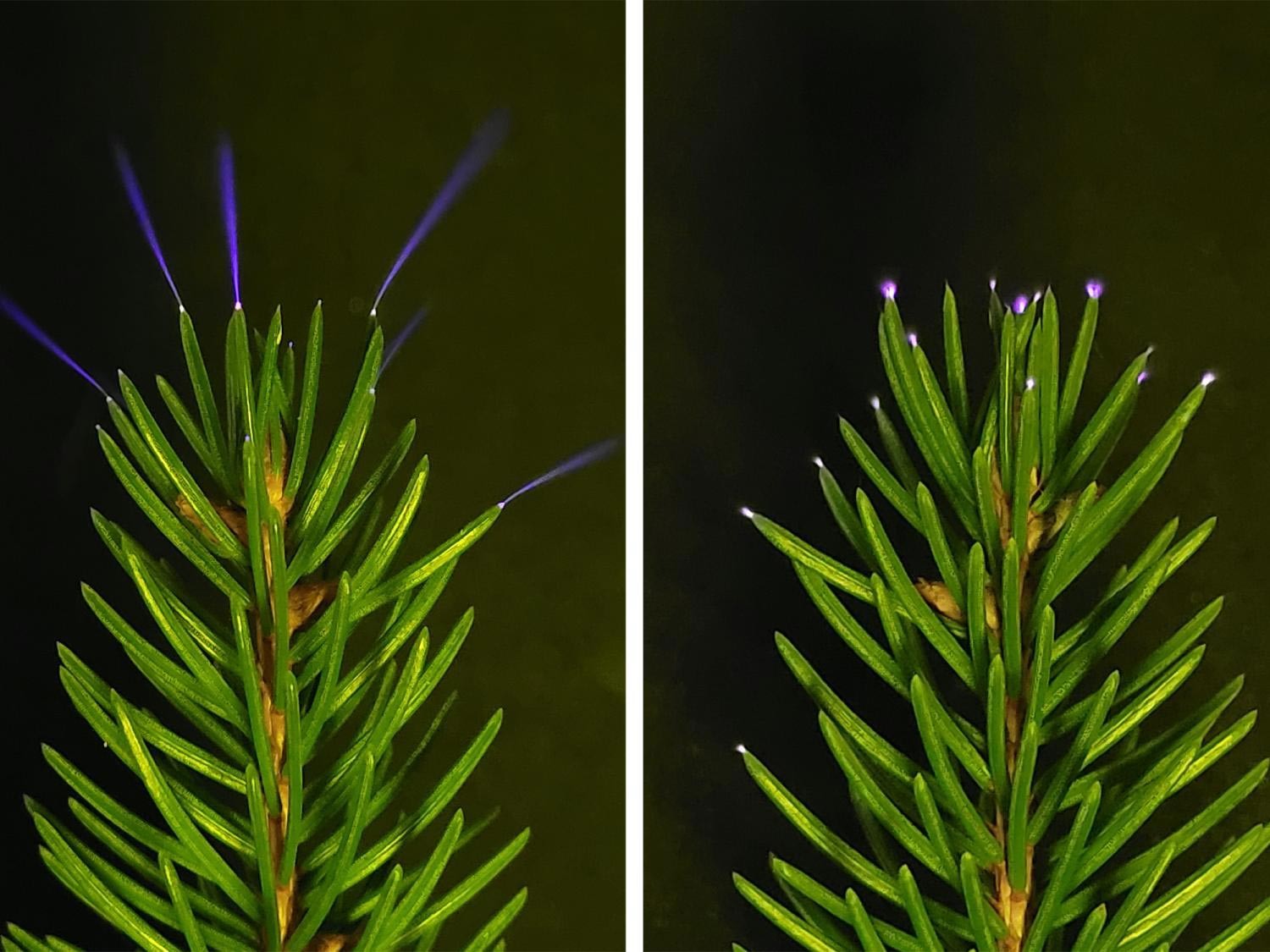
For over 70 years, a scientific theory has lingered in the shadows of atmospheric science: the idea that treetops act as lightning rods for tiny, nearly invisible electrical bursts. Now, researchers have finally moved this phenomenon from the laboratory into the real world, proving that trees actually emit “corona discharges”—faint, glowing electrical flashes—during thunderstorms.
The Discovery: From Theory to Reality
While scientists have long suspected that trees experience intense electrical activity during storms, direct observation in a natural setting has been notoriously difficult. In a recent study published in Geophysical Research Letters, a team from Penn State University successfully captured this phenomenon using a specialized “Corona Observing Telescope System.”
The breakthrough occurred not in a controlled lab, but during a transit through North Carolina. After weeks of unsuccessful tracking in Florida, the team utilized a custom-equipped vehicle to monitor a sweetgum tree and a loblolly pine during a two-hour thunderstorm.
The results were staggering:
– The team recorded 859 corona events on a single sweetgum tree.
– They documented 93 events on a nearby loblolly pine.
– These flashes, while nearly invisible to the human eye, were clearly captured by UV-sensitive cameras.
How It Works: The Physics of the Treetop
The phenomenon is driven by the massive electrical imbalances created by approaching storm clouds. As storm clouds accumulate negative charges, they pull positive charges upward from the ground.
Because trees are tall and conductive, this electrical current travels upward through the trunk and concentrates at the highest, most delicate points: the tips of leaves. At these extremities, the electric field becomes so intense that it ionizes the air, creating a faint glow in both visible and ultraviolet (UV) light.
Why This Matters: A Natural Air Purifier?
This discovery is more than just a visual curiosity; it has significant implications for atmospheric chemistry and air quality.
The UV light generated by these tiny flashes plays a vital role in breaking apart water vapor, which leads to the formation of hydroxyl (OH). Hydroxyl is often called the “detergent of the atmosphere” because it acts as a primary oxidizer, reacting with various chemicals to neutralize them.
“Such widespread coronae have implications for the removal of hydrocarbons emitted by trees… and could have broader implications for the health of trees, forests, and the atmosphere,” noted lead author Patrick McFarland.
By producing hydroxyl, these electrical discharges may help:
1. Cleanse the air of pollutants.
2. Break down methane, a potent greenhouse gas.
3. Process organic compounds released naturally by forest canopies.
Unanswered Questions and Future Research
Despite the success of the observation, the study opens a new chapter of scientific inquiry. The researchers noted that these electrical events can cause minor damage to leaf tissue, leading to a fundamental question: Is this process a stressor or a symbiotic benefit?
Moving forward, the team is collaborating with ecologists and biologists to determine:
– Whether trees have evolved specific adaptations to survive these discharges.
– If the chemical reactions triggered by the corona help maintain forest health.
– How these micro-events influence the broader global carbon and nitrogen cycles.
Conclusion: By proving that trees emit electrical corona discharges, scientists have uncovered a hidden mechanism through which forests interact with the atmosphere, potentially acting as a natural, lightning-powered system for cleaning the air.