Astronomers have recorded the most direct evidence yet of a black hole warping the fabric of spacetime, a phenomenon predicted by Einstein’s theory of general relativity. The observation, made in 2024, captures what happens when a star is violently torn apart by a supermassive black hole 400 million light-years away.
Frame-Dragging Confirmed
This effect, known as frame-dragging or the Lense-Thirring effect, is akin to how a spinning spoon drags honey with it. Massive rotating objects, like black holes, twist spacetime around them, and this warping is strongest closest to the object itself. While previously observed around Earth (though weakly), this new case shows the phenomenon on a galactic scale, offering physicists a natural laboratory.
Why this matters: Until now, these effects have been difficult to study directly. Black holes are too distant, and subtle shifts in spacetime are hard to measure without a dramatic event. This observation provides real-world confirmation of a cornerstone of modern physics.
Stellar Disruption Reveals the Twist
The event unfolded in the galaxy LEDA 145386, where a star wandered too close to a black hole approximately five million times the mass of our Sun. In January 2024, the Zwicky Transient Facility detected a sudden, intense brightening—the signature of a tidal disruption event (TDE). This occurs when a black hole’s gravity overwhelms a star, stretching it into shreds before consuming it.
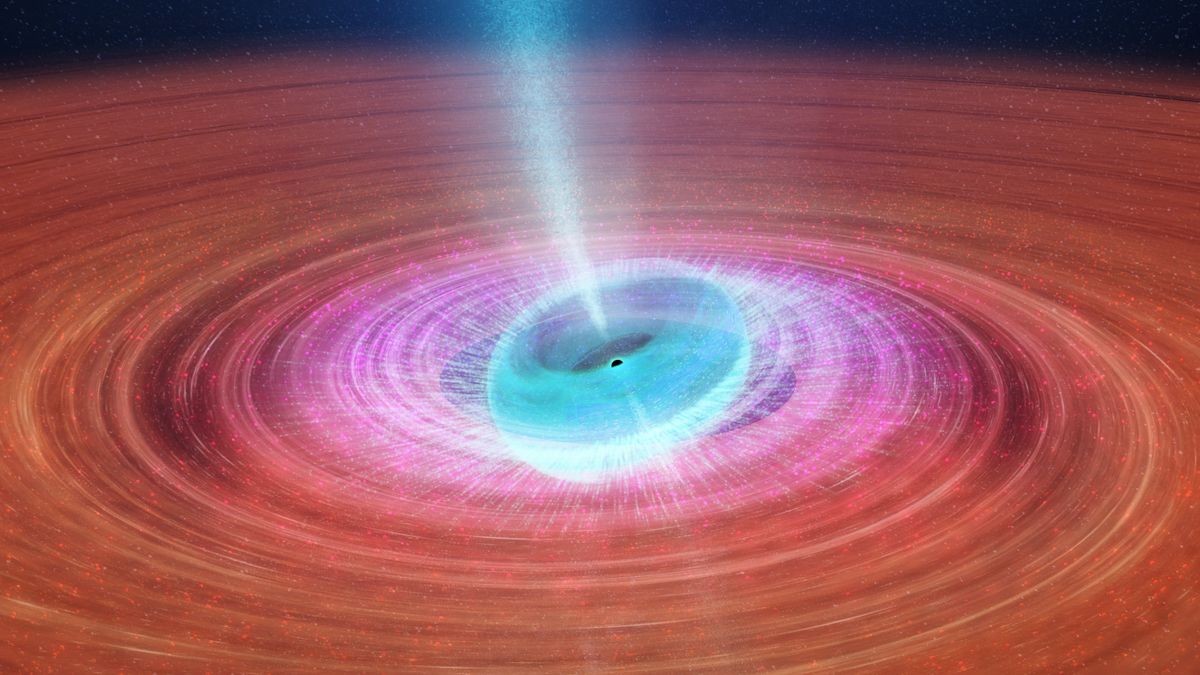
Astronomers tracked the aftermath, noticing unusual behavior: X-ray and radio emissions from the black hole fluctuated in sync every 19.6 days, with extreme variations in brightness. These synchronized fluctuations pointed to a fundamental instability—the entire accretion disk (the swirling debris from the destroyed star) and the jets of material ejected from the black hole were wobbling like a spinning top.
Wobbling Jets and Gravitomagnetic Fields
As the star’s remains swirled into the black hole, some material was blasted out in powerful jets along the black hole’s magnetic field lines. The synchronized fluctuations in X-ray and radio light suggest that this entire system—disk and jets—is rigidly coupled, rotating around the black hole’s spin axis.
Key takeaway: This wobble isn’t random. It’s a direct result of the black hole’s rotation dragging spacetime with it, a process that generates a “gravitomagnetic field” much like rotating charged objects create magnetic fields.
This observation confirms that black holes not only distort space but also actively twist it, influencing the motion of nearby objects. The findings provide new insight into how material behaves around supermassive black holes and how their spin affects the surrounding universe.
In essence, this event shows general relativity in action, confirming that black holes warp spacetime as predicted, and that their spin creates observable effects on the surrounding environment.