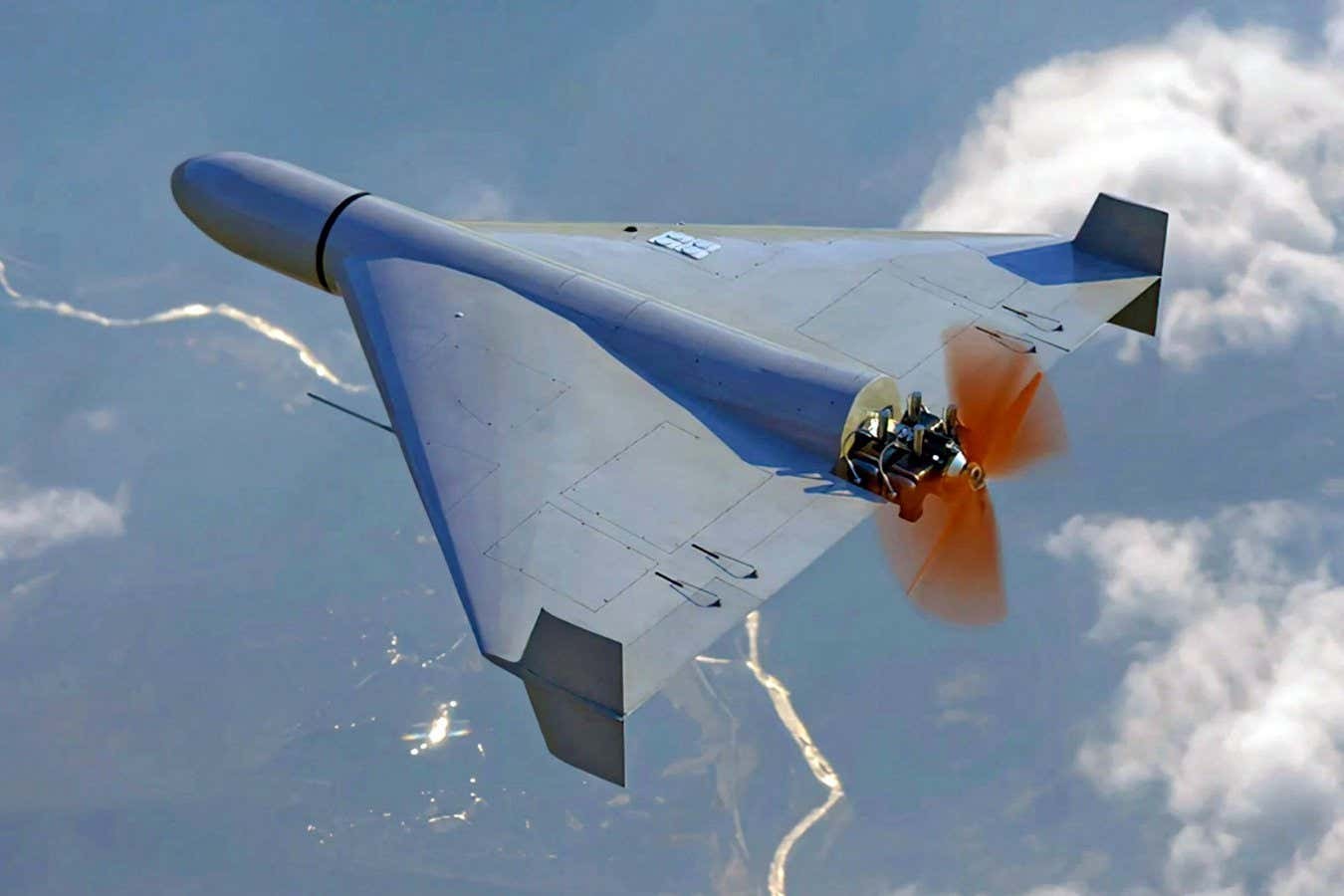
The United States military is now fielding a domestically produced drone that is, in effect, a direct copy of the Iranian-designed Shahed 136. This development marks a significant shift in modern warfare, where low-cost, expendable drones are becoming central to combat strategies, even if it means using enemy designs against the originator. The US’s move highlights a growing trend towards weaponizing simplicity and affordability in conflicts where sheer numbers and economic sustainability are proving decisive.
The Shahed 136: A Revolution in Drone Warfare
The Shahed 136, developed by Iran’s Shahed Aviation Industries, is a 2.6-meter-long attack drone capable of carrying a 15-kilogram payload over roughly 2,500 kilometers. While slow at around 185 km/h compared to conventional missiles, its key advantage lies in its low production cost – estimated at around $50,000 per unit. This affordability has allowed it to proliferate rapidly, being deployed in mass strikes by Russia in Ukraine and by Houthi forces in Yemen.
The drone’s effectiveness is not in technological superiority but in overwhelming defenses through sheer volume. Its use forces adversaries to expend vast resources on interception, sometimes exceeding the cost of the drone itself and its target. This creates an unsustainable economic calculus for defense, making prolonged resistance difficult.
US Reverse-Engineering and Deployment
In response to Iranian attacks in the Gulf, the US military has deployed the Low-cost Uncrewed Combat Attack System (LUCAS), manufactured by Spektreworks in Arizona. LUCAS is essentially a cloned version of the Shahed 136, dubbed the FLM 136 as an apparent nod to its origin. The US reportedly obtained and reverse-engineered the drone after capturing units from Iranian-backed militias in Iraq and Syria, successfully test-launching it from a Navy ship last year.
This move underscores a practical shift in US military strategy: rather than relying solely on high-tech weaponry, the US is adapting to the reality of low-cost drone warfare. As Anthony King of the University of Exeter notes, these drones represent a modern equivalent of the WWII-era “doodlebug” – cheap, simple, and effective in overwhelming defenses.
The Economic Calculus of Modern Conflict
The implications of this shift are profound. Western militaries are learning from conflicts like the one in Ukraine, where the Shahed has proven its disruptive power. Ian Muirhead of the University of Manchester argues that while these drones won’t replace crewed aircraft or advanced missiles, they are increasingly valuable in large-scale conflicts.
“If it costs you 10 times more for your defense than it is for your attackers, you’re never going to be able to outpace the other side.”
This economic imbalance is reshaping how wars are fought. The US’s adoption of the Shahed 136 design against Iran is a direct demonstration of this principle.
Historical Roots and Future Trends
Interestingly, the Shahed 136’s concept isn’t entirely new. A similar design, the Dornier “Die Drohne Antiradar,” was explored by Germany and the US during the Cold War as a means of saturating Soviet air defenses. This suggests that the current trend is not just a product of modern technology but a reemergence of older, proven strategies adapted to contemporary warfare.
The increasing reliance on cheap, expendable drones is likely to continue. As conflicts evolve, the economic advantages of mass-produced, low-cost weaponry will likely outweigh the benefits of expensive, high-tech systems in many scenarios.