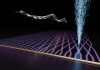
The James Webb Space Telescope (JWST) has delivered the clearest image yet of the region surrounding a supermassive black hole, resolving a decades-old debate about what causes unusual infrared brightness near these galactic engines. New data from JWST confirms that this excess light comes not from material ejected by the black hole, but from the dust and gas actively falling into it. This discovery refines our understanding of how black holes grow, and how they influence the galaxies they inhabit.
The Puzzle of Infrared Emissions
For over 20 years, astronomers have observed an unexpected surplus of infrared radiation around supermassive black holes (SMBHs) in active galaxies. The prevailing theory suggested this brightness originated from superheated outflows – streams of matter blasted away from the black hole’s immediate vicinity. However, this explanation never fully matched observations.
JWST’s Breakthrough in Circinus Galaxy
A recent study, published in Nature Communications, used JWST to examine the Circinus galaxy, located 13 million light-years from Earth. By combining JWST’s sharp imaging with ground-based observations, researchers found that roughly 87% of the excess infrared emissions originate from the disk of material spiraling into the SMBH. This disk, known as an accretion disk, forms as gas and dust fall toward the black hole, heated to extreme temperatures by gravitational forces.
The team utilized JWST’s aperture masking interferometer (AMI) to effectively double the telescope’s resolution, allowing for unprecedented clarity. As explained by Joel Sanchez-Bermudez, an astrophysicist at the National University of Mexico, this is equivalent to observing with a 13-meter telescope instead of Webb’s standard 6.5-meter size.
Black Holes: Doughnuts, Disks, and Dynamics
Active black holes feed on a ring of gas and dust resembling a doughnut (called a torus). As material falls into the black hole, it forms a thinner, faster-spinning accretion disk. The friction within this disk generates intense heat and light, obscuring the black hole itself.
Black holes don’t consume everything; they also eject some matter in jets or winds. Understanding the interplay between these inflows and outflows is crucial to determining how black holes accrete matter, influence star formation, and ultimately shape their host galaxies.
Implications and Future Research
The JWST’s findings eliminate a long-standing uncertainty about the source of infrared emissions. It also highlights the power of interferometry for studying these extreme environments. Researchers will now apply this technique to other active SMBHs, seeking to determine whether the dominance of disk-driven emissions is universal.
Future observations will attempt to confirm whether this accretion process is suppressing star formation in Circinus’s central region. This research demonstrates JWST’s unique ability to resolve previously unseen details in the universe’s most extreme environments.
The discovery marks a significant step forward in understanding the complex dynamics of black holes and their role in galactic evolution.