For over two decades, the scientific community believed it had found a biological milestone: Pohlsepia mazonensis, a 300-million-year-old fossil once celebrated as the oldest known octopus species. However, a recent re-examination has revealed a surprising truth—the “octopus” never actually existed.
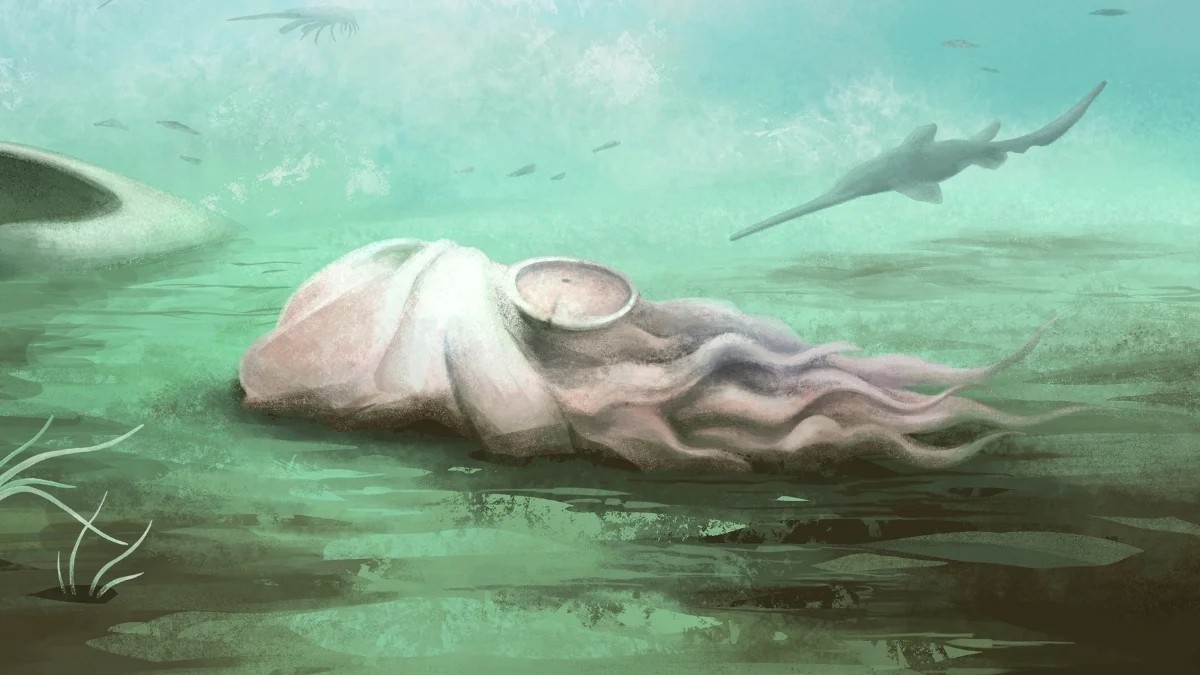
What was once a Guinness World Record holder has been reclassified as a nautiloid, a shelled cephalopod related to the modern nautilus. This correction does more than just fix a single error; it fundamentally reshapes our understanding of the evolutionary timeline for both nautiloids and octopuses.
The Illusion of Decomposition
The error originated from how the fossil was preserved. Discovered in 2000 in the Mazon Creek area of Illinois, the specimen had undergone significant decomposition before it was buried in sediment.
According to paleobiologist Thomas Clements of the University of Reading, this decay created a “convincing” illusion. The squashed, decaying remains appeared to possess eight limbs, two eyes, and an ink sac—all hallmarks of an octopus. In reality, these features were likely the result of distorted soft tissue rather than true octopus anatomy.
High-Tech Detective Work: Seeing Through Stone
The breakthrough came not from looking closer, but from looking through the rock. Using synchrotron imaging —a highly advanced form of X-ray technology powered by particle accelerators—researchers were able to peer inside the dense fossil without destroying it.
This technology is billions of times more powerful than a standard medical X-ray, allowing scientists to detect microscopic details that were previously invisible. The imaging revealed two smoking guns that debunked the octopus theory:
- The Radula (The “Tongue”): The team discovered 11 tiny, tooth-like structures arranged in a row. This is a radula, a specialized feeding organ found in mollusks. While octopuses typically have seven or nine teeth per row, nautiloids have thirteen. The specific shape and count of these teeth pointed directly toward a nautiloid identity.
- The Missing Ink: The feature previously identified as an ink sac showed no evidence of melanosomes (the pigment-carrying structures found in real ink), suggesting the “sac” was simply a structural anomaly caused by decay.
Redrawing the Evolutionary Map
The reclassification has a massive “domino effect” on the cephalopod family tree. Because Pohlsepia is actually a specimen of an existing nautiloid species (Paleocadmus pohli ), the timeline for both groups has shifted significantly:
- Nautiloids: The record for the oldest preserved soft tissue of a nautiloid has been pushed back by approximately 220 million years.
- Octopuses: Because we no longer have this 300-million-year-old “anchor,” the earliest evidence for the evolution of octopuses has been moved forward by about 150 million years.
Why This Matters for Science
This correction highlights a common reality in paleontology: the tools of the present often reveal the errors of the past. When Pohlsepia was first studied in 2000, researchers worked with the best visual data available at the time. Today, the ability to see microscopic, internal structures allows for a level of precision that was previously impossible.
“Sometimes, reexamining controversial fossils with new techniques reveals tiny clues that lead to really exciting discoveries,” says Thomas Clements.
Conclusion
By correcting this 300-million-year-old mistake, scientists have gained a much more accurate timeline of life on Earth, proving that even a “wrong” discovery can eventually lead to a much greater understanding of evolution.