For years, a significant tension has existed between our theoretical understanding of the universe and the actual observations made by the James Webb Space Telescope (JWST). The telescope has spotted massive, mature galaxies existing much earlier in cosmic history than standard cosmological models predicted. This led many to wonder if our fundamental understanding of how the universe works was flawed.
However, new research suggests the problem isn’t the model itself, but rather the level of detail used in our simulations. By adding “missing ingredients”—specifically dust and cold gas —scientists have successfully bridged the gap between theory and reality.
The Missing Ingredients: Dust and Cold Gas
To understand why this matters, we have to look at the “soup” of the early universe. Following the Big Bang, the cosmos was a hot, dense plasma that eventually cooled, allowing matter to coalesce. Historically, because simulating the entire universe requires immense computing power, scientists had to use simplified models. These models often ignored the “messy” details to save on processing time.
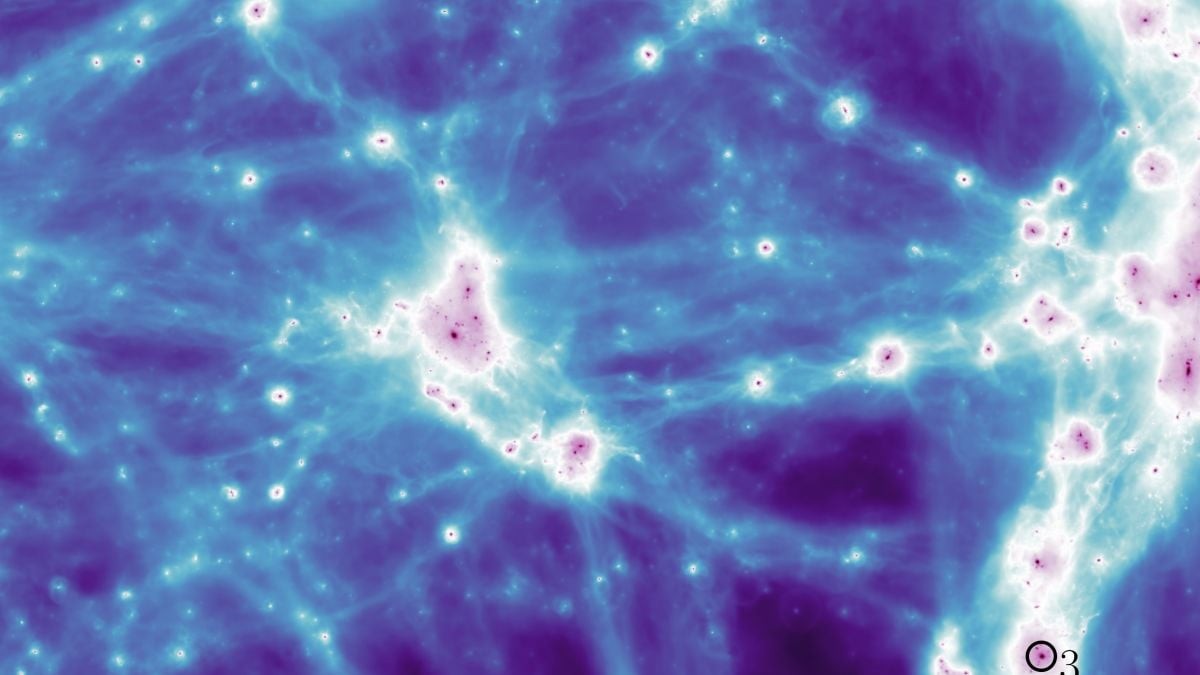
The COLIBRE cosmological simulation project has changed this approach. Instead of relying on simplified physics, researchers built a “virtual universe” that accounts for the complex, granular reality of cosmic evolution.
Key breakthroughs in the COLIBRE simulation include:
- Cold Gas Modeling: Unlike previous simulations that focused on hot, ionized gas, COLIBRE incorporates the cold gas that serves as the actual building block for star formation.
- Complex Dust Chemistry: The team integrated a sophisticated dust model featuring three different types of grains in two different sizes.
- Radiation and Molecular Growth: This dust isn’t just “debris”; it plays a functional role by helping atoms bond into molecules and by shaping how light (radiation) travels through space by blocking or filtering specific wavelengths.
A Virtual Twin of the Cosmos
The scale of this undertaking was massive, requiring 72 million CPU hours of supercomputing time. The goal was to see if a universe built purely from the laws of physics could replicate the one we inhabit.
The results were a triumph for computational astrophysics. The simulated galaxies emerged with properties—such as size, color, luminosity, and quantity—that are virtually indistinguishable from the real galaxies observed by astronomers.
“It is exhilarating to see ‘galaxies’ come out of our computer that look indistinguishable from the real thing,” says physicist Carlos Frenk of Durham University.
This success confirms that the standard cosmological model is still robust; it simply requires more realistic, detailed physics to account for the rapid growth of early galaxies observed by the JWST.
The Next Frontier: “Little Red Dots”
While COLIBRE has resolved much of the tension regarding galaxy formation, it has also highlighted new mysteries. One of the most perplexing phenomena recently uncovered by the JWST is a group of objects known as “Little Red Dots.”
These small, intensely red objects defy easy categorization. Current theories suggest they could be:
1. Massive, ancient stars.
2. Supermassive black holes.
3. A combination of both (stars housing black holes).
As of now, even the highly detailed COLIBRE simulation cannot fully explain these objects. This suggests that while we have mastered the “big picture” of galaxy formation, the specific mechanics driving these tiny, red anomalies remain one of the most significant unanswered questions in modern astronomy.
Conclusion
By incorporating the complex roles of dust and cold gas, the COLIBRE project has reconciled our cosmological models with recent telescope observations. While this validates our understanding of how galaxies grow, it sets the stage for a new era of research into the unexplained mysteries of the early universe.