For centuries, physicists have been haunted by a persistent discrepancy in one of the most fundamental numbers in science: Big G, the gravitational constant. Despite countless experiments, different research teams have consistently produced slightly different values for the strength of gravity. This lack of consensus has left scientists wondering whether the error lies in flawed experimental methods or if our fundamental understanding of gravity itself is incomplete.
A recent, highly sophisticated experiment has now provided one of the most reliable measurements to date, bringing the scientific community a step closer to a unified answer.
The Challenge of Measuring a Weak Force
Gravity presents a unique set of hurdles for experimental physicists. Unlike electromagnetism, which can be shielded or blocked, gravity is omnipresent; there is no way to “turn it off” or protect an experiment from its influence.
Furthermore, gravity is incredibly weak compared to other fundamental forces. While magnets can snap together with visible force, the gravitational pull between two everyday objects—like two coffee cups—is so minuscule that it is impossible for a human to feel. This extreme weakness means that even the tiniest environmental disturbance can drown out the signal researchers are trying to measure.
A Modern Evolution of the Torsion Balance
To overcome these challenges, researchers have long relied on the concept of the torsion balance, a method pioneered by Henry Cavendish in 1798.
The principle is elegant in its simplicity:
1. A horizontal rod is suspended by a thin thread.
2. Small weights are attached to the ends of the rod.
3. When a large mass is brought near the rod, its gravitational pull causes the rod to twist slightly.
4. By measuring this minute rotation, scientists can calculate the strength of gravity.
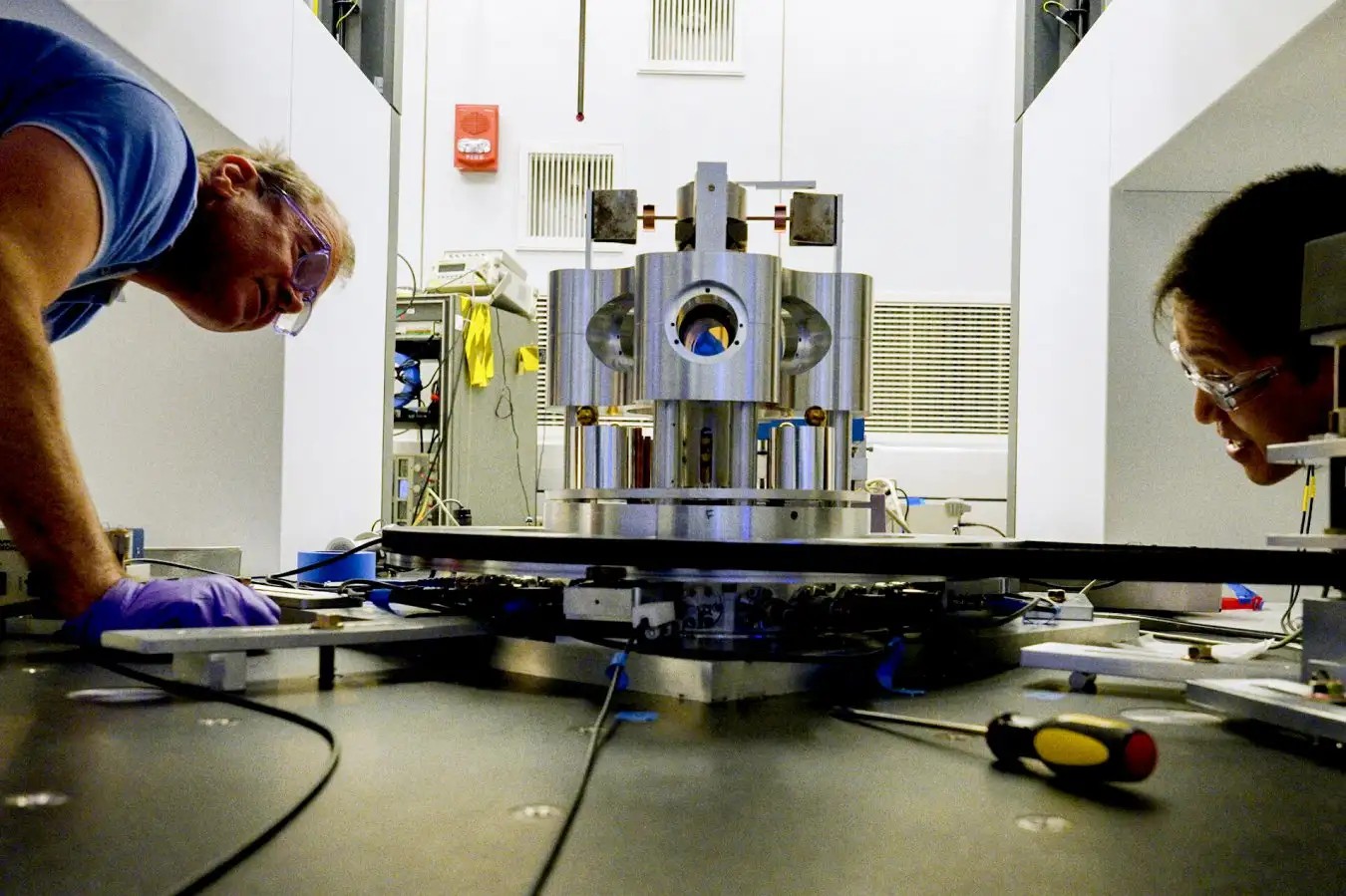
The latest breakthrough, led by Stephan Schlamminger at the US National Institute of Standards and Technology (NIST), involved a hyper-refined version of this setup. The team used eight weights positioned on two precisely calibrated turntables, all suspended by ribbons as thin as a human hair.
This was not a quick study; the researchers spent a decade meticulously identifying and neutralizing every conceivable source of error and uncertainty.
Results and Scientific Implications
The experiment yielded a value for Big G of $6.67387 \times 10^{-11} \text{ m}^3 \text{kg}^{-1} \text{s}^{-2}$.
While this value is slightly lower (by a fraction of a percent) than a major 2007 study, it is significant because it aligns much more closely with other historical measurements. By narrowing the gap between conflicting data points, the NIST team has made the “landscape” of gravitational measurement more trustworthy and reliable.
“Big G is not just a measurement of gravity—it’s a measurement of how well you can measure gravity,” says Schlamminger.
Why This Matters for the Universe
The precision of these laboratory measurements has profound implications for cosmology. Much of our understanding of how the universe expands, how galaxies form, and how much dark matter exists relies on knowing the exact strength of gravity.
The stakes are high because:
– Scaling Effects: A tiny error in a laboratory setting can result in massive discrepancies when applied to the scale of the entire universe.
– New Physics: If, despite these increasingly precise measurements, the numbers still refuse to align, it could signal “exotic new physics.” This would suggest that gravity does not behave according to our current laws, potentially revealing a “crack” in our understanding of the cosmos.
Conclusion
By refining the measurement of Big G with unprecedented care, researchers have reduced long-standing uncertainties and provided a more stable foundation for physics. Whether this leads to a final consensus or reveals a fundamental flaw in our cosmic models, it marks a vital step forward in our quest to understand the forces that govern the universe.