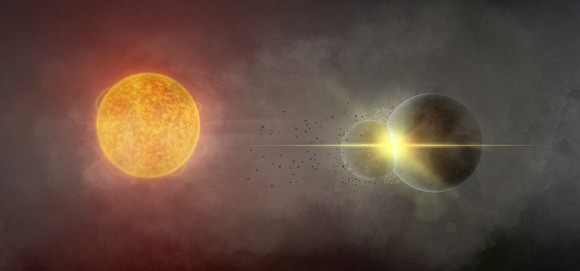
Astronomers have witnessed the immediate aftermath of a catastrophic planetary collision around a distant star, providing unprecedented insight into the chaotic processes that shape young planetary systems. The event, observed near the star Gaia20ehk, located 11,000 light-years away in the constellation Pupis, involves a massive debris field resulting from the destruction of at least two planets.
The Unusual Flickering of Gaia20ehk
Gaia20ehk, a stable star similar to our Sun, began exhibiting erratic brightness fluctuations in 2016. Instead of the expected steady light output, the star experienced several dramatic dips, culminating in violent instability around 2021. These changes weren’t caused by the star itself, but by immense clouds of rock and dust passing between it and Earth, partially blocking the light.
“Stars like our Sun don’t just randomly change brightness like that,” explains Anastasios (Andy) Tzanidakis, a doctoral candidate at the University of Washington. “When we saw this one, we knew something big was happening.”
Evidence of a Planetary Smashup
The debris field’s composition and orbital patterns strongly suggest a massive planetary collision. This isn’t just another astronomical observation; it’s a rare, real-time view of a process that likely played a pivotal role in the formation of our own solar system. Only a handful of similar events have been recorded, and none with such clear evidence.
The dust cloud orbits Gaia20ehk at approximately one astronomical unit (the Earth-Sun distance), suggesting the debris could eventually coalesce into a new planetary system resembling Earth and the Moon.
Implications for Astrobiology
This discovery raises crucial questions about the frequency of such events and their role in creating habitable worlds. The collision bears striking similarities to the impact that formed Earth and the Moon roughly 4.5 billion years ago.
“How common is an event like the one that created the Earth and the Moon?” asks Professor James Davenport of the University of Washington. “That’s a fundamental question for astrobiology.”
The Moon is now understood to have played a critical role in stabilizing Earth’s climate, shielding it from asteroids, and potentially influencing tectonic plate activity – factors that may be essential for life as we know it. By observing more collisions, scientists hope to determine whether such dynamics are common or exceptionally rare.
“If we catch more of these collisions, we’ll start to figure out how often they happen and whether they are a necessary step in the creation of habitable planets.”
The findings were published in the Astrophysical Journal Letters, marking a significant step toward understanding the violent origins of planetary systems.