Astronomers using the James Webb Space Telescope (JWST) have definitively identified the remnants of luminous red novas – rare stellar collisions that occur when two stars merge and explode in a spectacular burst of light. The research confirms that these events don’t simply destroy stars; they create massive, cool stars resembling red supergiants, potentially seeding the universe with the building blocks for life.
The Mystery of Stellar Mergers
Transient events like supernova explosions and black hole mergers happen quickly, allowing scientists to study them in real-time. Luminous red novas fall into this category, unfolding over months rather than millennia. This rapid evolution makes them ideal for observation. Until recently, however, what remained after the initial explosion remained unknown. The team led by Andrea Reguitti of the Istituto Nazionale Di Astrofisica (INAF) analyzed nine previously observed luminous red novas to answer this question.
JWST Reveals the Aftermath
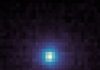
Two events, AT 2011kp (25 million light-years away) and AT 1997bs (31 million light-years away), provided the clearest data. The challenge lay in observing through the massive cloud of dust ejected during the merger. This dust, sometimes equivalent to 300 Earth masses, initially obscured the newly formed star. The JWST’s infrared capabilities were crucial; it cut through the debris, revealing the resulting stellar body years after the initial explosion.
The observations revealed a red supergiant star, hundreds of times larger than our sun. If placed in our solar system, it would engulf the inner planets and extend to Jupiter’s orbit. Despite this immense size, the star’s surface temperature (around 3,200-3,700°C) is cooler than the sun’s. This unexpected result challenges prior assumptions about post-merger stellar evolution. Scientists expected a hotter, more compact object.
The Role in Cosmic Evolution
The JWST also analyzed the composition of the surrounding dust. It found a high concentration of carbon compounds, including graphite. This is significant because carbon is essential for life. Luminous red novas are now recognized as a major contributor to interstellar dust, potentially providing the raw materials for planet formation and even the origins of life itself.
“We are made of carbon compounds, the same carbon that this dust is rich in,” Reguitti concluded. “It’s a different way of telling the old story that we are ‘stardust.’”
This discovery reshapes our understanding of stellar evolution, demonstrating that catastrophic collisions can give birth to new stars and contribute to the very foundations of life in the universe.