


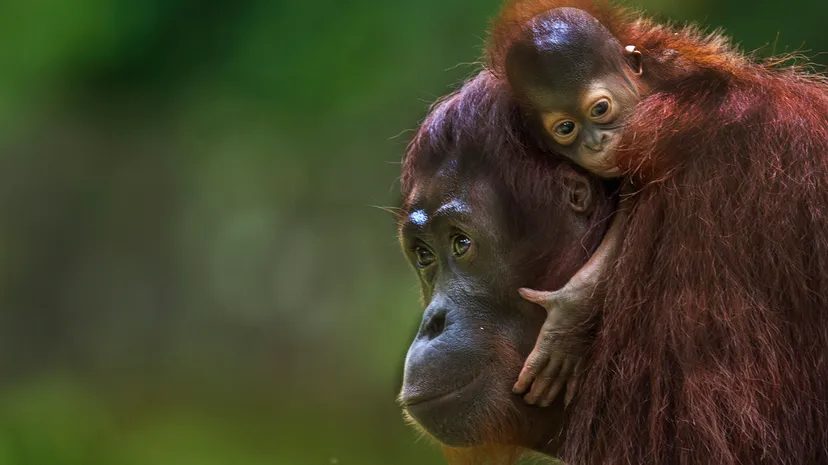
Fewer than 14,000 left. That is the grim count for the Sumatran orangutan, a number that represents a species on the very brink of collapse.
These are not just animals. They are our closest living relatives in the trees, sharing genetic ties that stretch back millions of years. In Malay, the name means “person of the forest.” It feels fitting. They are intelligent. They are complex. And they are being erased from the map of Sumatra, Indonesia, at a pace that defies logic.
Deforestation for palm oil. Illegal trade. A reproductive rate so slow it barely keeps the population afloat. The threats are multifaceted, but the outcome is singular: extinction.
The Anatomy of a Canopy Dweller
To understand the loss, you have to understand the creature. The Sumatran orangutan (Pongo abelii ) is the largest arboreal primate on Earth.
Adult males are massive. They stand between 4.5 and 6 feet tall. Their weight ranges from 110 to 200 pounds, with some giants hitting 250 pounds. Females are smaller, roughly 3 to 4 feet tall, weighing in at 66 to 110 pounds. Note that wild individuals tend to be lighter than their captive counterparts. Food availability in the wild is sporadic. In captivity, it is not.
Their fur is reddish-orange, sparse, and fine. It blends into the dappled light of the rainforest. Distinguishing them from their Bornean cousins can be tricky. The hair color is similar. The features are closely related. But the genetic divergence is real.
Their bodies are engineered for life in the canopy.
Arms that are 50 percent longer than their legs allow them to swing through the trees with ease. Long, strong fingers and toes provide a grip that is unshakeable. Opposable thumbs help them manipulate tools and extract food from tight spaces. Their feet are essentially hands, allowing for interchangeability when navigating the dense forest ceiling.
Solitary and Silent? Not Quite.
Orangutans are not like gorillas or chimpanzees. They are mostly solitary.
Males are loners. They do not form groups. Females form bonds, but only with their offspring. A mother cares for her young for about six to seven years. That is an exceptionally long time. It is a period of intense teaching and survival training.
Communication happens through dozens of vocalizations. The long call of a male can travel up to 1.2 miles (1.9 kilometers). It is a broadcast of presence. A warning. A declaration.
Where They Live and Where They Are Losing Ground
Historically, these primates roamed across Sumatra and even Java. That range has evaporated.
Today, they are confined primarily to the northern part of Sumatra. Specifically, the provinces of North Sumatra and Aceh. They inhabit tropical and subtropical moist broadleaf forests. These ecosystems provide the fruit, leaves, and nesting sites they need. Without them, the orangutan cannot survive.
The habitat is shrinking. Fast.
The Two Main Threats: Trees and Traders
The decline of the Sumatran orangutan is driven by two primary forces. Habitat destruction and the illegal wildlife trade.
The Palm Oil Problem
Deforestation is the biggest killer. The expansion of oil palm plantations and other agricultural activities has carved up the rainforest. In the last two decades alone, the habitat has shrunk by 80 percent.
This is not just about orangutans. It is about the entire ecosystem. Other species rely on these same forests. When the trees go, the web of life unravels.
The Pet Trade and Hunting
Despite legal protections, orangutans are still captured.
The demand for infants as pets is high. People want the cute baby. They do not see the mother who was killed to get it. They do not see the slow, painful journey to the black market.
Hunting for meat is another threat. It is often incidental, but it adds up. The reproductive rate of the Sumatran orangutan is agonizingly slow. Females give birth only once every eight years. This means that even low levels of hunting or capture can wipe out a population. There is no recovery time. No buffer.
The Fight Back
Conservation efforts are underway. They are not enough, but they are necessary.
Protected areas have been established. Reintroduction programs attempt to return rescued orangutans to the wild. Anti-poaching initiatives work to stop the traps. Promoting sustainable palm oil production aims to reduce the demand for deforestation.
It is a long fight. The numbers are against them. But the intelligence of the orangutan is also its resilience. They adapt. They remember. They survive.
For now, the forest is still there. The question is whether it will be enough.
最後の砦を守る
スマトラ島のオランウータンを救うための戦いは、彼らが消えていくのをただ見守るだけではありません。それは積極的な実践的な介入です。 ブキティガプル国立公園 などの保護地域は重要な保護地域となっています。 これらは地図上の単なる線ではありません。 これらは、人間の絶え間ない侵入の圧力を受けずに霊長類が生き残ることができる最後の本当の避難所です。
しかし、保護だけでは十分ではありません。 この戦略の重要な部分には、物議を醸すが必要な慣行の再導入が含まれます。 違法なペット取引で捕獲されたオランウータンは、都市の市場や民家の劣悪な環境から救出されることが多く、釈放の準備が進められている。 目標は現実的なもので、野生の個体数を増やし、その長期的な生存能力を確保することです。 これは、捕獲された個体や救出された個体が実際に再び野生で生き残ることができるかどうかをテストするために設計された一か八かの実験です。
Cracking Down on the Trade
The illegal wildlife trade is a cruel business. To combat this, organizations such as the World Wildlife Fund (WWF) work closely with local governments. The focus here is on two issues: anti-poaching and stricter law enforcement.
Poachers do not operate in a vacuum. They use a network of smugglers to transport these animals from the forest to the pet market. The goal is to shrink the market by targeting this supply chain and punishing violators. If the risks are too great and the benefits too small, then in theory the demand for orangutans as exotic pets should decrease. This is a direct attack on the economics of extinction.
The Palm Oil Paradox
You can’t talk about orangutan conservation without talking about palm oil. An elephant in the room, or rather a palm tree in the forest. Oil palm plantations are a major cause of habitat loss, clearing away the rainforest that orangutans call home.
This has started a massive movement towards sustainable palm oil production. Organizations such as the Association of Zoos and Aquariums (AZA) work to promote environmentally sustainable practices. They didn’t just shout from the sidelines. They work directly with industry stakeholders. The message to producers is clear. Palm oil can be produced, but it must be produced in a way that minimizes the impact on the orangutan’s habitat. It’s about finding a balance between commercial reality and ecological survival.
“The goal is to reduce the demand for orangutans as pets and to protect wild orangutan populations.”
The road ahead is difficult. This includes negotiating with companies, enforcing laws in remote areas, and praying that reintroduced orangutans don’t return to the black market. But without this concerted effort, the story of the Sumatran orangutan may end in silence.


