The release of newly declassified government documents has brought fresh attention to a persistent mystery in space exploration: the recurring reports of unexplained phenomena by NASA astronauts. Published on May 8 through a new archive for Unidentified Anomalous Phenomena (UAP), these records span from 1965 to the mid-1970s, featuring transcripts, audio recordings, and annotated photographs from some of America’s most historic space missions.
While the documents do not prove the existence of extraterrestrial life, they highlight a pattern of unresolved observations made by highly trained professionals. The administration, led by President Donald Trump, aims to increase transparency by releasing these files in rolling batches. The release includes data from NASA, the FBI, and various intelligence agencies, offering a rare glimpse into the “strange-yet-seemingly-innocuous” oddities that have long haunted the margins of space history.
A Legacy of Unexplained Observations
Astronauts are often viewed as the ultimate objective observers—individuals steeped in telemetry, checklists, and rigorous training. When such figures report seeing drifting objects, strange lights, or unidentified aircraft in orbit, those accounts carry significant weight. However, the newly released files underscore a critical reality: many of these cases remain unresolved not because of conspiracy, but because investigators lacked sufficient data to reach a definitive conclusion.
NASA Administrator Jared Isaacman welcomed the release, emphasizing the agency’s commitment to candor. “We will remain candid about what we know to be true, what we have yet to understand, and all that remains to be discovered,” Isaacman stated. This approach suggests that the goal is not to sensationalize, but to unlock the secrets of the universe through rigorous exploration and transparency.
Key Incidents from the Archive
The declassified materials provide specific details from several major missions, illustrating the consistency of these reports over time.
Gemini 7: The First “Bogey”
In 1965, during the second lap of the Gemini 7 mission over the Caribbean Sea, astronaut Frank Borman radioed mission control with a deadpan report: “We have a bogey at 10 o’clock high.”
The term “bogey,” military slang for an unidentified aircraft, signaled immediate concern. Borman and his crewmate, Jim Lovell, also described a cloud of particles drifting near their spacecraft. Lovell later noted a bright object against the blackness of space. Handwritten notes attached to the mission transcript explicitly labeled the event a “UFO sighting by Borman.”
Apollo Missions: Lights and Debris on the Moon
The Apollo missions, culminating in the first human moon landing, yielded numerous unexplained observations.
- Apollo 11 (1969): Buzz Aldrin reported seeing a large object en route to the moon, which the crew examined with a monocular. While they speculated it might be a piece of the Saturn V rocket, Aldrin also described repeated flashes of light inside the cabin and a bright light on the return journey that they tentatively identified as a laser.
- Apollo 12 (1969): Astronaut Alan Bean described particles and flashes of light “sailing off in space” while using the spacecraft’s optical telescope. Commander Pete Conrad reported illuminated debris floating outside the lunar module before the light source suddenly vanished. The archive includes photographs from the landing site with highlighted “areas of interest” above the lunar horizon.
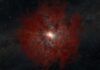
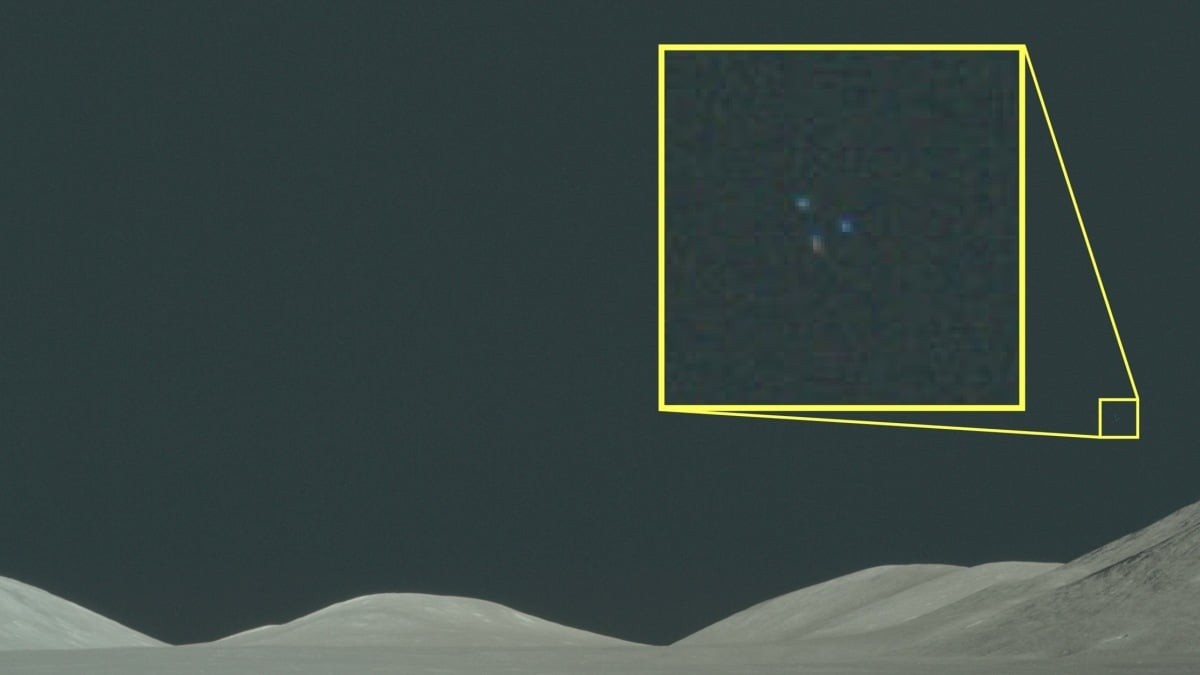
- Apollo 17 (1972): This mission produced some of the most detailed accounts. Ronald Evans described bright particles tumbling near the spacecraft, while Harrison Schmitt compared the visual spectacle to “the Fourth of July.” Commander Eugene Cernan reported intense flashing lights resembling a train headlight. Notably, government analysts have reopened the case regarding an image showing three unexplained dots in a triangular formation, obtaining the original film for further study.
Skylab: Persistent Flashes in Orbit
Astronauts aboard Skylab, the United States’ first space station, documented similar phenomena in 1973 and 1974. Crews reported frequent light flashes while attempting to sleep. One team tracked a bright reddish object for several minutes, concluding it moved in an orbit similar to Skylab’s. Another crew observed flashing lights moving independently of the station, though they suspected the sources might be debris or satellites.
Why These Files Matter
The significance of these releases lies not in proving alien contact, but in documenting the limits of current understanding. For decades, these reports were tucked away in archives, often dismissed as equipment glitches or space junk. By bringing them into the public domain, the government acknowledges that anomalies exist and that transparency is essential for scientific progress.
These files raise important questions about how we monitor space and interpret data. They serve as a reminder that even in the age of advanced technology, the universe still holds mysteries that defy immediate explanation. As more files are released, they will continue to fuel both public curiosity and scientific inquiry, challenging us to look closer at the unknown.
“Exploration and the pursuit of knowledge are core to NASA’s mission as we endeavor to unlock the secrets of the universe.” — Jared Isaacman, NASA Administrator
The declassification of these records marks a shift toward openness, inviting the public and the scientific community to examine these historical anomalies with fresh eyes. While answers may remain elusive, the pursuit of truth remains the driving force behind human exploration.