We have found an atmosphere. Not around a gas giant, not around a puffball mini-Neptune. Around a rocky world in the habitable zone. This matters because it confirms we can finally sniff the air on planets like our own.
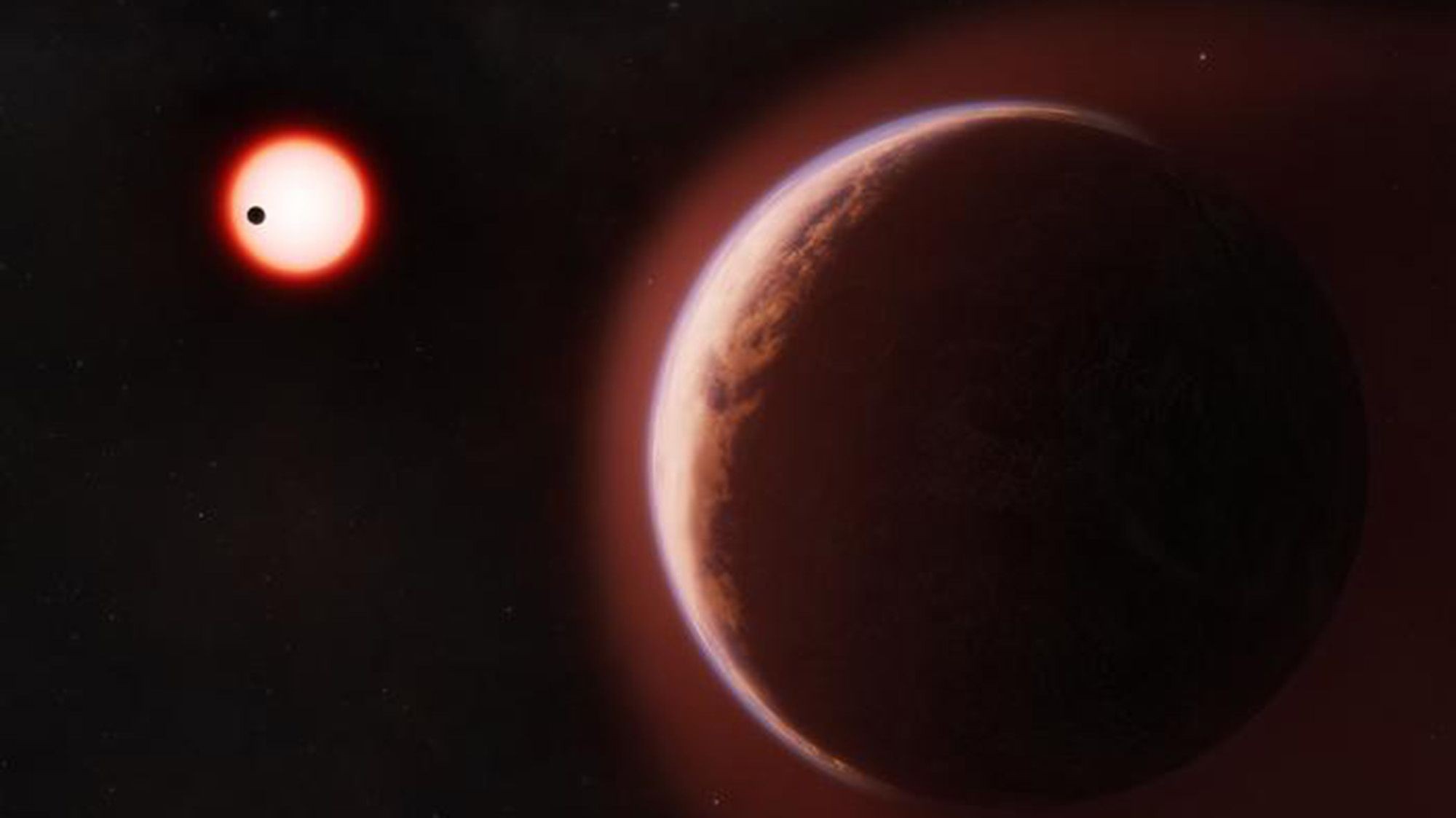
LHS 1140 b is the prize. It is 48 light-years from Earth, a super-Earth circling a dim red dwarf star. It sits in the sweet spot where liquid water might pool. But it doesn’t stop there. The planet retains a sky. This is the strongest evidence yet. And the method used to find it is surprisingly clever.
Why detecting exoplanet atmospheres has been impossible (until now)
For decades, the dream of analyzing alien skies stalled out. Why? Size and distance.
Atmospheres around Earth-sized planets are microscopic compared to those of Jupiter. From here? They are ghosts. Most detection methods look for bulk properties. That fails with thin air on small rocks. You need a signal strong enough to pierce 48 light-years of vacuum.
So researchers tried something else. Instead of looking at the atmosphere directly, they looked for a leak.
The planet loses gas. Helium escapes its grip, streaming into space as a comet-like tail. If you look at the star when the planet crosses in front of it, you get a transmission spectrum. Light filters through the escaping gas. Specifically, it hits helium. Helium absorbs light at specific infrared wavelengths. A dip in that signal means helium is present. And if helium is leaving, an atmosphere must be there to push it out.
“We are getting closer to studying atmospheres of worlds that could plably harbor life.”
It is not magic. It is math followed by observation. A theoretical model predicted the leak. Astronomers tested it. The telescope listened. And it heard a scream in the infrared.
LHS 1140c vs. LHS 1140B: What the comparison tells us about atmospheric survival
To know the helium came from LHS 114B and not just noise or stellar activity, researchers needed a control group. Good thing their solar system came with one.
There is a second planet here. LHS 11C. It orbits much closer. It is smaller. It gets hammered with five times more radiation than its neighbor. It has less gravity to hold on to its stuff.
When both planets transited their star within 40 minutes of each other, the data came in loud and clear.
- LHS 1C showed no helium signal. None. Its atmosphere likely boiled off billions of years ago.
- LHS 4B showed a definitive, undeniable helium signature.
This contrast proves the detection method works. It also paints a picture of planetary survival. The inner world died. It was stripped bare. The outer world? It held on. It is further out. Cooler. Calmer. Red dwarf stars are violent things, bathing nearby worlds in flares that erase skies. Yet LHS B has persisted for over 3 billion years. That changes the timeline. Some rocky worlds around red dwarfs aren’t doomed.
The search for life requires more than just an atmosphere
Is the planet alive? No one knows. Should not guess.
The helium leak confirms gas is present in the upper layers. It confirms a boundary where the space wind pushes back against gravity. That is a prerequisite. Not the whole requirement. We need oxygen. Carbon dioxide. Methane. Water vapor. Biosignatures. Those require different spectroscopic fingerprints. We are not ready for them yet. Not with this telescope.
But we have crossed the Rubicon. We know how to do this. The method is proven. It relies on precise timing—watching for transits. It relies on specific tools—the WINERED spectrograph on Chile’s Magellan Clay. And it relies on patience.
Astronomer Robin Wordsworth put it best: Twenty years ago, we weren’t sure rocky planets existed. Then they popped up. Then we found them in habitable zones. Now we see them keeping their air.
This is step one. Step two involves characterizing the full composition of that atmosphere. Step three involves staring for chlorophyll-like signals in the deep red. The Habitable Worlds Observatory won’t be here for a decade. Maybe two. We might have to wait. But we have a blueprint.
LHS 40 B remains a cold place, probably hovering near -47°C without a greenhouse effect to warm it up. It is far away. It is small. It is stubbornly retaining what it has. There are more like it out there. And now we have the keys to start checking them.