


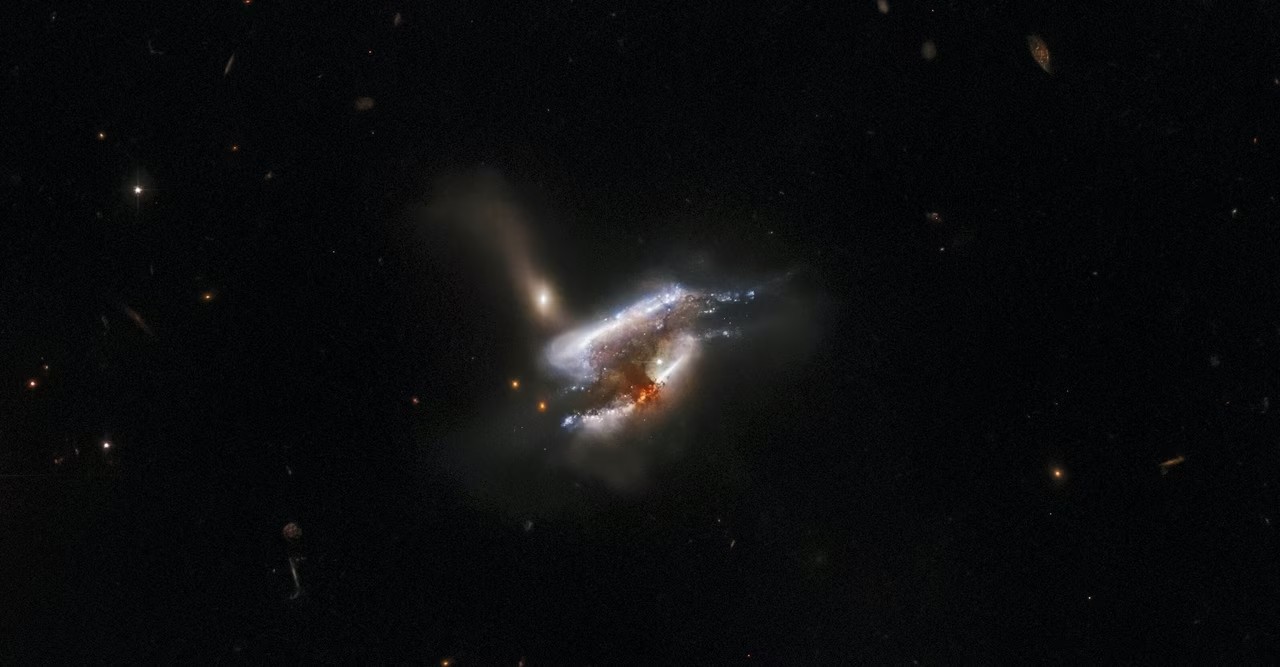
More than 100,000 volunteers. That’s the number of people who stepped up to tackle a massive data set. They spent their time classifying 900,000 objects. The goal was simple. Identify galaxies. The speed at which they completed this task was staggering. And what they found? A treasure trove of cosmic collisions.
These weren’t just distant, static lights. They were galaxies in the midst of merging. One of those images is being highlighted by the Hubble Space Telescope right now. It’s a stunning look at gravitational chaos.
The drama unfolds about 680 million light-years away. This is deep within the constellation of Cancer. But it’s not just two objects crashing into each other. It involves three distinct galaxies.
Eventually, they will stop being three separate entities. They will coalesce into one single galaxy. Astronomers call this final merged object IC 2431.
The Mechanics of Cosmic Collision
The current image captures the turmoil. It shows star formation kicking into overdrive. Tidal distortions are tearing at the edges of the galaxies. These are the direct results of gravitational interactions between the three objects.
There is a dark region at the center of the image. It’s not empty space. It’s a thick cloud of dust. This dust hides what’s happening in the background. It obscures the view, creating a veil of mystery around the core activity.
Studying these events isn’t just about looking pretty pictures. It’s about understanding our own future. Our own Milky Way has experienced similar fusions in the past. It will likely undergo more.
“Studying this kind of collision allows astronomers to get an idea of the future of our Milky Way.”
Why does this matter to us? Because we are part of this galactic cycle. We are made of stardust forged in these violent mergers. Understanding how galaxies interact helps us predict how our own home will evolve.
IC 2431 is a snapshot of that inevitable future. It shows the process in action. The violence of the collision. The birth of new stars. The obscuring dust.
It’s messy. It’s chaotic. It’s exactly how galaxies grow.
We will see what happens next in part two. For now, look at the image. See the distortion. Feel the gravity.
The digital divide isn’t just about access anymore. It’s about understanding.
You’ve probably seen the headlines. Artificial intelligence. Quantum computing. CRISPR. They sound like buzzwords designed to inflate startup valuations. But look closer. These aren’t just tech trends. They are fundamental shifts in how we interact with reality.
Why Your Smartphone Can’t Solve the Climate Crisis
We live in an era of data saturation. We have more information than ever before. Yet, we struggle to make sense of it. Traditional computing hits a wall here. It processes linearly. One step after another.
This is where the shift happens.
New algorithms are moving from abstract math labs into hospitals and farms. Consider precision agriculture. Farmers are no longer guessing when to water crops. They’re using satellite imagery combined with machine learning models. These models predict soil moisture levels with startling accuracy. The result? Less water waste. Higher yields. This isn’t science fiction. It’s happening in Iowa and Ukraine right now.
The Quantum Leap Explained Simply
Quantum computing gets a bad rap. It sounds like magic. It’s not. It’s physics.
Traditional computers use bits. Zero or one. Quantum computers use qubits. They can be zero, one, or both at the same time. This superposition allows them to solve complex problems exponentially faster.
Why does this matter to you?
Drug discovery. Designing new molecules is like finding a needle in a haystack the size of a galaxy. Classical computers struggle to simulate molecular interactions. Quantum computers can model these interactions natively. This could cut the time for developing new antibiotics or cancer treatments from years to months.
“The real value of quantum isn’t speed. It’s possibility.”
Where the Rubber Meets the Road
It’s easy to get lost in the theory. The practical applications are where the rubber meets the road.
Take logistics. Global supply chains are fragile. A blocked canal or a pandemic can halt everything. AI-driven logistics systems analyze millions of variables in real-time. Weather patterns. Traffic. Fuel costs. Labor availability. They reroute shipments dynamically. This resilience keeps shelves stocked. It keeps prices stable.
Then there’s energy. The grid is aging. Renewable sources are intermittent. Batteries are improving but still imperfect. AI optimizes energy distribution. It predicts demand spikes. It balances the load between solar, wind, and traditional sources. This reduces waste. It stabilizes the grid.
The Human Element in a Digital World
Technology is a tool. It doesn’t have intentions. It doesn’t have ethics. We do.
The rapid integration of these technologies raises valid concerns. Privacy. Job displacement. Bias in algorithms. These aren’t side notes. They are central to the conversation.
We need transparent algorithms. We need regulations that protect citizens without stifling innovation. We need a workforce that’s being retrained, not just replaced.
The future isn’t something that happens to us. It’s something we build.
What Comes Next?
The next decade will be defined by convergence.
AI will enhance quantum computing. Quantum computing will simulate new materials for better batteries. Better batteries will power electric vehicles that feed data back into smart grids. It’s a feedback loop. A cycle of innovation.
But here’s the


