


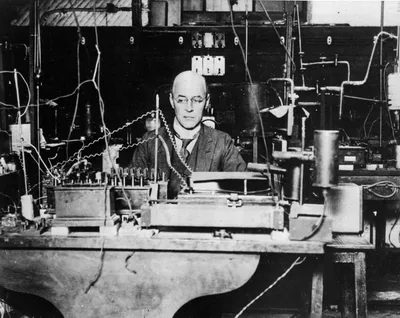
Sir Owen Willans Richardson did more than just study physics. He helped build an engine that powered the 20th century. Born in Dewsbury, Yorkshire in 1879, he spent his life studying the behavior of electrons. His research into why hot metal emits particles led directly to the invention of the vacuum tube. Without this discovery, the early radios, televisions and computers that defined modern life would not exist.
He graduated from Trinity College, Cambridge in 1900. There he studied under J.J. Thomson at the Cavendish Laboratory. The relationship is formative. Thomson discovered the electron himself. Richardson took this abstraction and figured out how to control it.
Proving the Source of Electron Emission
The early 1900s was a turbulent time in physics. Scientists knew that electricity could flow through gas, but they didn’t fully understand how vacuum tubes worked. Some researchers believe that when the metal is heated inside the tube, the surrounding air or gas molecules actually release electrically charged particles. This is a reasonable assumption. The air is there. The heat is there. The current was there.
Richardson proved them wrong.
In 1911, he demonstrated conclusively that the electrons do not come from the surrounding air, but from the hot metal itself. This is a fundamental change in the understanding of “thermionic emission”. This shows that heat alone can release electrons from the metal lattice.
The Equation That Changed Technology
In the same year, he proposed a mathematical formula to explain this phenomenon. The electron emission rate is directly proportional to the absolute temperature of the metal. This is called Richardson’s law or Richardson-Dushman equation.
Why is this important today?
This equation allows engineers to design better vacuum tubes. This provides a predictable way to control the flow of electrons. Until then, the development of vacuum tubes had been a series of trial and error. Richardson’s law made it possible to calculate exactly how much current a heated filament would produce at a given temperature. This precision accelerated the development of electronics by decades.
From Princeton to King’s College
Richardson’s academic career progressed rapidly. He became … between 1906 and 1913 a professor of physics at Princeton University. He returned to England in 1914 and took up a post at King’s College, London. He became a physics professor and ten years later a research director.
He retired in 1944. By then the world had changed. The vacuum tubes he helped theorize helped create global communications. In 1939, he was knighted for his work for science.
Nobel Prize and legacy
He received the Nobel Prize in Physics in 1928. The prize focused on his research on electron emission from hot metals. This is the “basic principle” of vacuum tube technology.
Vacuum tubes are now largely obsolete in consumer electronics, replaced by solid-state transistors. But the principle remains. Understanding how heat affects the movement of electrons remains important for high-power electronics, aerospace components, and certain types of sensors.
Richardson died in Alton, Hampshire in 1959


