
The skimmer is a bird that looks like it defies physics. It belongs to the family Rynchopidae within the order Charadriiformes and consists of three distinct species. What makes these water birds so strange is their beak. Specifically, the lower mandible is one-third longer than the upper one. It is a bladelike bill that creates a unique silhouette.
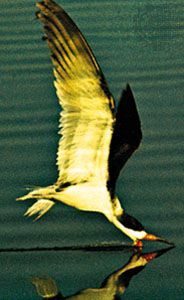
This asymmetry is not a defect. It is a highly specialized tool. By day, the skimmer stays onshore, resting on the ground. The real action happens at twilight. As the light fades, the bird takes off over calm, shallow water. It flies low, keeping the tip of its bill submerged in the liquid.
How does it actually eat? The bird moves forward, sweeping that longer lower jaw through the surface. The upper mandible stays closed. When a fish or crustacean crosses the path, the upper jaw snaps down. It is a precise, mechanical trap. This feeding strategy allows the skimmer to target small prey that other birds might miss.
Reproduction follows a standard pattern for the group. Skimmers nest in small colonies. A female lays three to five eggs. Once the chicks hatch, the feeding process changes. The parents cannot just drop food in front of them. Instead, they use regurgitation to feed the young. This method continues until the chicks’ mandibles grow into their adult form.
Why does this matter? It highlights how evolution tweaks anatomy for specific niches. The skimmer’s bill is a perfect example of form following function. It is a simple design that solves a complex problem: catching moving, slippery food in a thin layer of water.

Where Skimmers Make Their Home and How They Look
These birds stick to estuaries and wide rivers in warm climates. They aren’t everywhere, just specific warm-water zones. The three species share a distinct look. Dark backs, white bellies. A white face and forehead stand out against the darker plumage.
Their legs are short and red. The bill is red too. Then there are the wings. Long, narrow, and jet black.
Which Species Is the Largest Skimmer?
The black skimmer (Rynchops nigra ) dominates in size. Native to the Americas, it reaches 50 cm (20 inches) in length. It is the biggest of the three.
The African skimmer (R. flavirostris ) and the Indian skimmer (R. albicollis ) are smaller. They follow the same color pattern but lack that extra bulk.
The black skimmer’s 20-inch frame makes it the clear size leader among the Rynchops species.