


Most mammals give birth to live young. Monotremes do not.
They lay eggs.
It sounds like a biological paradox. A mammal that acts more like a reptile or a bird. Yet, the platypus and the echidna are definitively mammals. They are the only ones.
This group, scientifically known as Order Monotremata, represents the oldest living lineage of mammals alive today. They are not primitive in the sense of being “simple.” They are ancient. Their bodies are a confusing mosaic of old traits and highly specialized new ones.
What Makes a Monotreme a Monotreme?
The name itself gives it away. Monotreme comes from Greek for “one hole.”
Both male and female monotremes share a single rear opening used for excretion and reproduction. It is a cloaca. You will find this same setup in birds, reptiles, and amphibians. But not in other mammals.
Take the platypus. It is an amphibious carnivore-insectivore. It swims with a duck-like bill and a beaver-like tail. It hunts small crustaceans and insect larvae in Australian waterways.
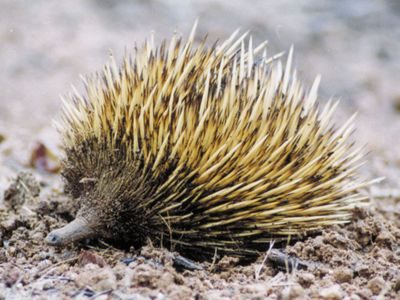
Then there are the echidnas. Terrestrial. Spiny. They dig for ants, termites, and worms. They do not swim. They do not have bills. But they share that single-hole anatomy and that egg-laying habit.
Their skeleton tells the rest of the story. Specifically their shoulder girdle.
Most modern mammals have a specific set of bones in the shoulder. Monotremes do not. Their shoulder structure is primitive. It looks more like the ancient ancestors of mammals than like the mammals we see today. This has confused scientists for decades.
The Evolutionary Puzzle
How do you classify an animal that looks like it fell out of time?
Monotremes exhibit what biologists call mosaic evolution. They keep old features while developing new ones. Some skull traits link them to extinct early mammal groups from the Mesozoic Era. But genetic data tells a different story.
Genetics suggest monotremes are actually close relatives to marsupials.
This conflict between bone structure and DNA is the central problem in understanding monotreme evolution. Did they split off before marsupials and placentals? Or did they diverge later and just hold onto archaic traits?
The shoulder girdle suggests an origin in the middle of the Jurassic Period, around 199.6 million years ago. That is long before the famous non-avian dinosaurs went extinct.
Fossils From the Cretaceous
If you want to see just how weird these animals used to be, look at the Cretaceous Period fossils.
In Australia, scientists have found two extinct families of monotremes. Both are known only from jaw fragments. And not just any bones. Opalized jaw fragments.
- Steropodontidae : A platypus-like species called Steropodon galmani.
- Kollikodontidae : A uniquely specialized species called Kollikodon ritchiei.
Kollikodon was a shock. Its molar teeth had strange, rounded cusps. Paleontologists expected tooth shapes similar to the platypus. They got something else.
This discovery changed everything. It proved that Cretaceous monotremes were far more diverse than we thought. They were not just a quirky side-note. They were likely the dominant mammals in the Australian sector of Gondwanaland, the ancient supercontinent.
A Continental Journey
The fossil record extends back to the early Cretaceous, but the origins lie deeper.
Consider the oldest known platypus fossil. It was found in South America.
This is not a mistake. It is evidence of distribution. During the Paleogene Period (65.5 to 23 million years ago), platypuses ranged from Australia, through Antarctica, all the way to South America.
The continents had not fully drifted apart. The animals moved with them. Or they swam. The exact mechanics are less important than the fact that monotremes were once widespread across the southern hemisphere.
Today, they are restricted.
The Survivors
Only five species remain. Two families. Two distinct lifestyles.
Family Tachyglossidae (Echidnas)
* 4 species.
* 2 genera.
* Found in Australia, Tasmania, and New Guinea.
* Terrestrial. Insectivores.
Family Ornithorhynchidae (Platypus)
* 1 species.
* Found only in Australia.
* Semiaquatic. Carnivore-insectivore.
It is a small number. Fragile, even. But they have survived. They have survived dinosaurs. They have survived continental drift. They have survived the rise of placental mammals.
Why haven’t they gone extinct?
Their niche is specific. Deep in the soil. Deep in the river. They do not compete with the big predators. They do not need to run fast. They just need to be weird enough to survive.
The shoulder girdle remains a puzzle. The DNA remains confusing. But the egg remains real.
We still do not fully understand how these animals fit into the tree of life. Is it better to call them a separate branch? Or a strange cousin?
The classification matters less than the fact that they are here. Laying eggs. With one hole. While the rest of the mammal world gives birth.
It is an oddity. A relic. A living fossil that refuses to stay in the past.


