


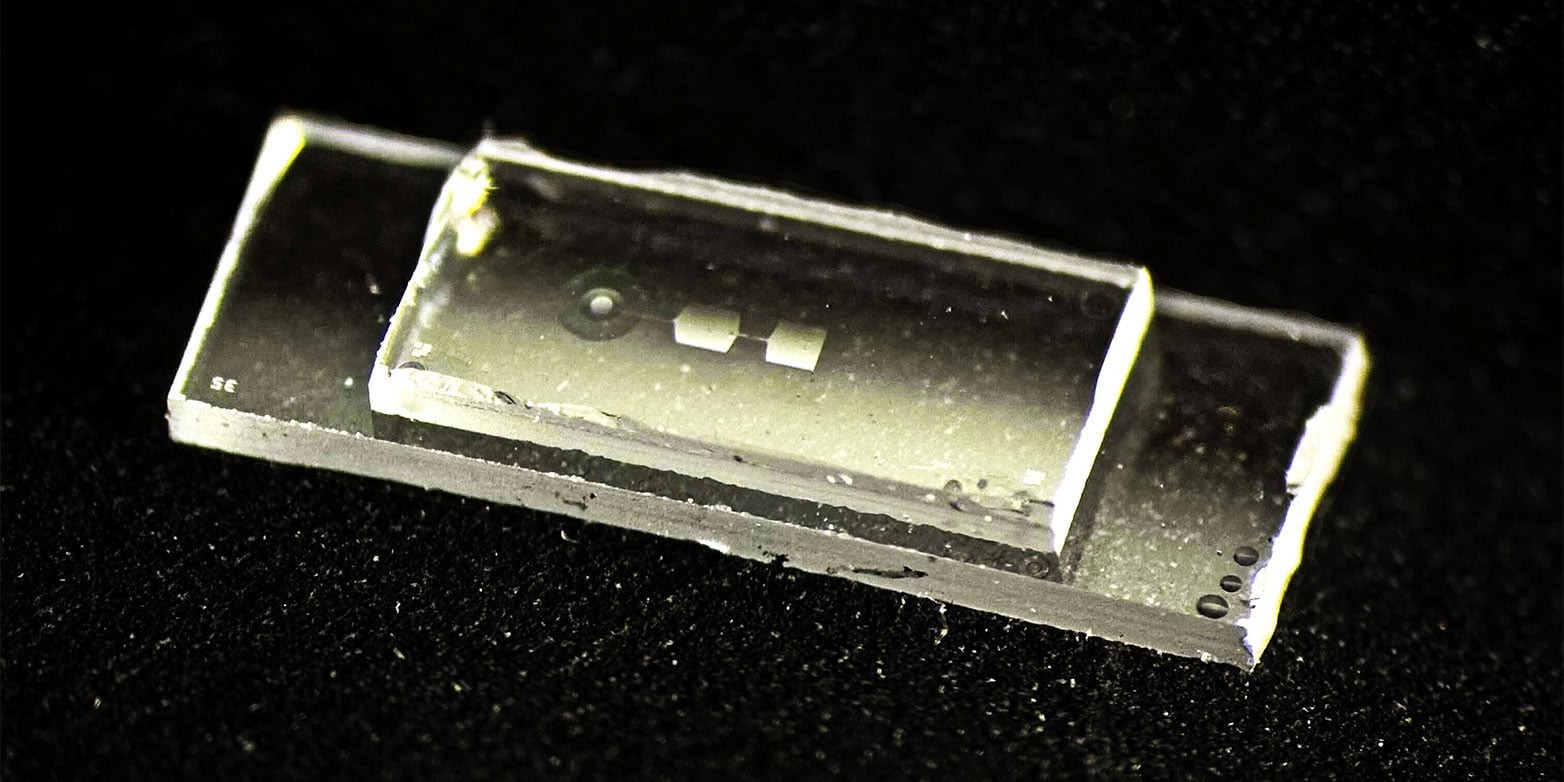
A quantum chip no bigger than your pinky nail is changing how we think about data storage. It doesn’t use electricity. It doesn’t even use magnetic fields. Inside the ETH Zurich device developed by physicist Yiwen Chu and her team, information lives as a vibration.
Think of it like a guitar string.
Pluck it, and you get a note. Do the same in this microscopic world, and you get a quantum bit. These aren’t audible sounds, though. They are ultra-high-frequency oscillations occurring inside tiny mechanical resonators. The packets of energy carrying the data are called phonons. The chip itself? Just 7.5 by 2.5 by 1 millimeters.
This sounds poetic, but it is purely functional. The goal? To solve a problem that has plagued quantum computing hardware for years: memory.
Borrowing the Classical CPU and RAM Model
Most current quantum systems are messy. They mix calculation and storage in the same hardware blob. Add more qubits? You need more bulk. Add more memory? The system bloats. It’s hard to scale.
Chu’s team took a page from the book of classical computing. You know how a standard PC works, right? The CPU crunches numbers while RAM holds the data temporarily. They are separate. The processor can grab what it needs, do the math, and toss the data back. It’s efficient.
The new quantum architecture mimics this. A superconducting qubit acts as the brain (the processor). The mechanical resonators act as the RAM. But there is a catch. In classical RAM, data is electromagnetic. Here?
It is mechanical.
“In our quantum working memory,” Chu explains, “information is not stored electromagnetically… but rather in the form of mechanical vibrations.”
This separation is vital. It allows the processor to be fast and nonlinear while the memory sits quietly, holding the fragile quantum state for as long as possible.
How Vibrational Quantum Memory Actually Works
Classical bits are simple. Zero or one. Quantum bits (qubits) are complicated. They can be in a superposition of both states. They can become entangled. This weirdness is what makes quantum computers potentially faster for specific tasks like cryptography or material simulation. But that weirdness is also fragile. Keep it too long in the wrong environment, and the data decoheres. Dies.
The ETH Zurich system solves this by choosing specific vibrational modes within the resonators as storage slots. Need to read data? The superconducting qubit talks to the resonator. It tweaks the quantum state of that specific mode. It reads it. Then it puts it back.
Why do this?
Superconducting qubits are great at logic gates. They are fast. But they aren’t great at holding data for long periods without interference. Mechanical resonators? They are small. They can support many distinct vibrational modes. You can pack multiple “notes” into a single physical chip. It’s dense storage. And unlike electromagnetic resonators, which take up valuable real estate, these mechanical ones are tiny.
The researchers didn’t just theorize this. They proved it works. They coupled the mechanical memory to a superconducting qubit and built a programmable architecture. This wasn’t just passive storage. The system could execute actual quantum algorithms.
Proving the Concept: Fourier and Period Finding
To show this isn’t just a lab trick, the team ran two heavy-duty tests: the Quantum Fourier Transform (QFT) and quantum period finding.
The QFT is a backbone algorithm. It finds hidden patterns in data. Period finding uses the QFT to spot repeating mathematical structures. It’s the kind of math that powers Shor’s algorithm—the one that could break modern encryption.
Executing these required precision. The system had to:
* Prepare quantum states.
* Store them in mechanical modes.
* Connect them without destroying their coherence.
* Move data between processor and memory seamlessly.
They did it. The chip performed controlled phase operations across its available memory slots. It’s proof of concept. It shows that a processor can control compact mechanical memory and use it to run code.
“‘The Quantum Fourier Transform’ is a fundamental computational procedure required for many,” says co-author Igor Kladaric.
The Road to Scalability
Let’s be clear. This chip cannot outperform a supercomputer. Not yet. It is a demonstration of principle.
The next hurdle is scale. To be useful, you need more memory. You need lower error rates. You need thousands, maybe millions, of these resonators working in sync. Can mechanical resonators maintain their advantages when you move from one chip to a thousand?
That is the open question.
“The interaction between the quantum processor and the quantum memory… is crucial for establishing quantum computers as a reliable way to perform computations.” – Yiwen Chu
For now, we have a chip that thinks with its vibrations. It’s a different way to organize the quantum machine. One that looks less like a black box and more like a traditional computer with a specialized memory unit.
The music is still silent. But the data is playing.
Reference: “Mechanical resonator–based quantum computing,” Science, May 28, 2026.


