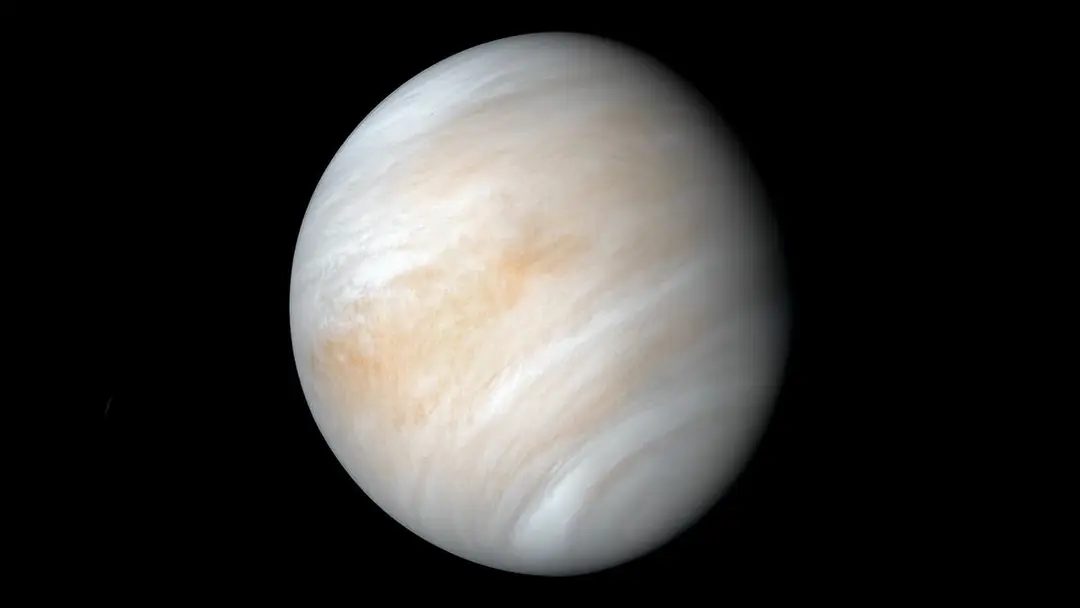
Venus has dominated the headlines recently, largely due to the controversial hypothesis that life may exist in its clouds. But while the search for biology is in the spotlight, the University of California team is focusing on something much more fundamental. They’re not looking for microbes. They measure how fast the planet rotates.
The results, published in Nature Astronomy, provide a precise new clock for our solar system’s most stubborn neighbor.
Measuring spin with radio echoes
Between 2006 and 2020, Jean-Luc Margot and his colleagues did not send a spacecraft to Venus. They used radio waves. The team beamed signals from the planet’s surface using two giant antennas located thousands of miles apart — one in Goldstone, California, and the other in Green Bank, West Virginia.
The method was deceptively simple, but technically rigorous. By measuring the precise delay between signals received at each location, the researchers were able to calculate Venus’ rotation rate. The time window where the echoes were most similar indicated the planet’s axial tilt.
“The precise delay between the two signals tells us the rotation rate, while the time window where the echoes are most similar tells us the planet’s tilt.”
This approach allowed them to refine long-standing uncertainties. For decades, estimates of the length of a Venusian day varied greatly, causing confusion in planetary science. The new information clarifies the debate precisely.
A day that lasts 243 days
The core finding is stark. One day on Venus – rotating on its axis – takes 243.0226 Earth days. That’s about two-thirds of the Earth’s year. If you could stand on Venus (ignoring the crushing pressure and acid rain), you would wait almost nine months for the sun to rise and set.
But here’s where things get complicated. The rotation is not constant.
The researchers observed differences of up to 20 minutes between different measurements. This inconsistency explains why previous attempts to determine the length of the Venerian day produced conflicting results. The planet accelerates and decelerates as it rotates.
What causes this variation? The culprit must be the atmosphere. Venus’ atmosphere is incredibly dense, with a pressure 90 times that of Earth’s atmosphere. This thick blanket interacts with the solid surface through friction, speeding up or slowing down the planet’s rotation in a chaotic dance. It is the mechanical coupling between the air and the rock that makes the rotation of Venus irregular.
Axial tilt and hidden core
In addition to the length of the day, the radio echoes revealed other critical geometries. The axial tilt of Venus is only 2.6392 degrees. Compare that to Earth’s 23 degrees and you’ll understand why Venus lacks the seasons that determine our climate cycles. Its axis is almost perpendicular to the orbit.
The data also helped to map the internal structure of the planet. Scientists concluded that the radius of Venus’ core is about 3500 km – about the same size as Earth’s. However, the radio reflections could not tell whether this core is solid or liquid. This question remains open.
Why this is important for Earth
These numbers may seem like abstract tidbits, but they hold the key to the mystery of the planet. Earth and Venus are often called twins


Never miss a technical update by following Futura on WhatsApp and Google News