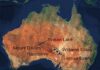
A recently mapped magnetic anomaly beneath Australia’s Northern Territory has revealed a striking resemblance to the continent itself. The underground feature, detected during a government aeromagnetic survey, mirrors Australia’s outline with surprising accuracy – including distinct points for Queensland and southern extensions. This discovery isn’t just a curious coincidence; it offers a unique window into Earth’s deep geological history.
How the Anomaly Was Revealed
The anomaly was uncovered using high-resolution aeromagnetic surveys conducted by Australia’s Commonwealth Scientific and Industrial Research Organisation (CSIRO). Small aircraft equipped with magnetometers systematically scanned the land, capturing subtle variations in the Earth’s magnetic field. These measurements reveal the “magnetic memory” of rocks below the surface, essentially a record of past magnetic field orientations.
Rocks retain the direction of the magnetic field when they form, and this remains locked in over billions of years, even as Earth’s poles shift and flip. By mapping these variations, geologists can reconstruct the history of both the magnetic field and the underlying geology.
The Geological Origins of the Shape
The Australia Magnetic Anomaly originates from volcanic rocks formed over 1.5 billion years ago. These ancient layers are interspersed with sedimentary deposits from former seas and rivers, which have been folded and compressed by tectonic forces. This process has contorted the magnetic minerals into a shape mirroring the continental outline.
“Magnetic data allows us to see through the ground and understand geological architecture that would otherwise remain completely hidden,” explains CSIRO geoscientist Clive Foss. Australia’s dynamic geological position combined with magnetic reversals means that the rock magnetization often occurs in unexpected directions, requiring careful interpretation.
Improving Mapping Technology
The clarity of the new map is thanks to advanced data processing techniques. Dr. Aaron Davis developed a new gridding algorithm that refines the raw magnetic data, producing cleaner and more consistent images. This allows geologists to extract more geological information than ever before.
“By improving how we process and model these datasets, we can extract more geological information than ever before.” – Clive Foss, CSIRO.
This refinement is crucial because magnetic anomalies can be complex. Understanding how the magnetic field has changed over time helps geologists decipher the deep structures beneath the surface, including potential mineral deposits or hidden fault lines.
Why This Matters
The discovery highlights how geological forces can create unexpected patterns over immense timescales. The fact that an underground magnetic feature so closely resembles the continent above it is a reminder of the deep connections between Earth’s surface and its hidden layers. This anomaly isn’t just a visual curiosity; it provides valuable insights into the evolution of the Australian landmass and the planet’s magnetic history.
This magnetic fingerprint of the past demonstrates that Earth’s geological story is written not only in visible landscapes but also in the invisible magnetic fields that permeate its depths.