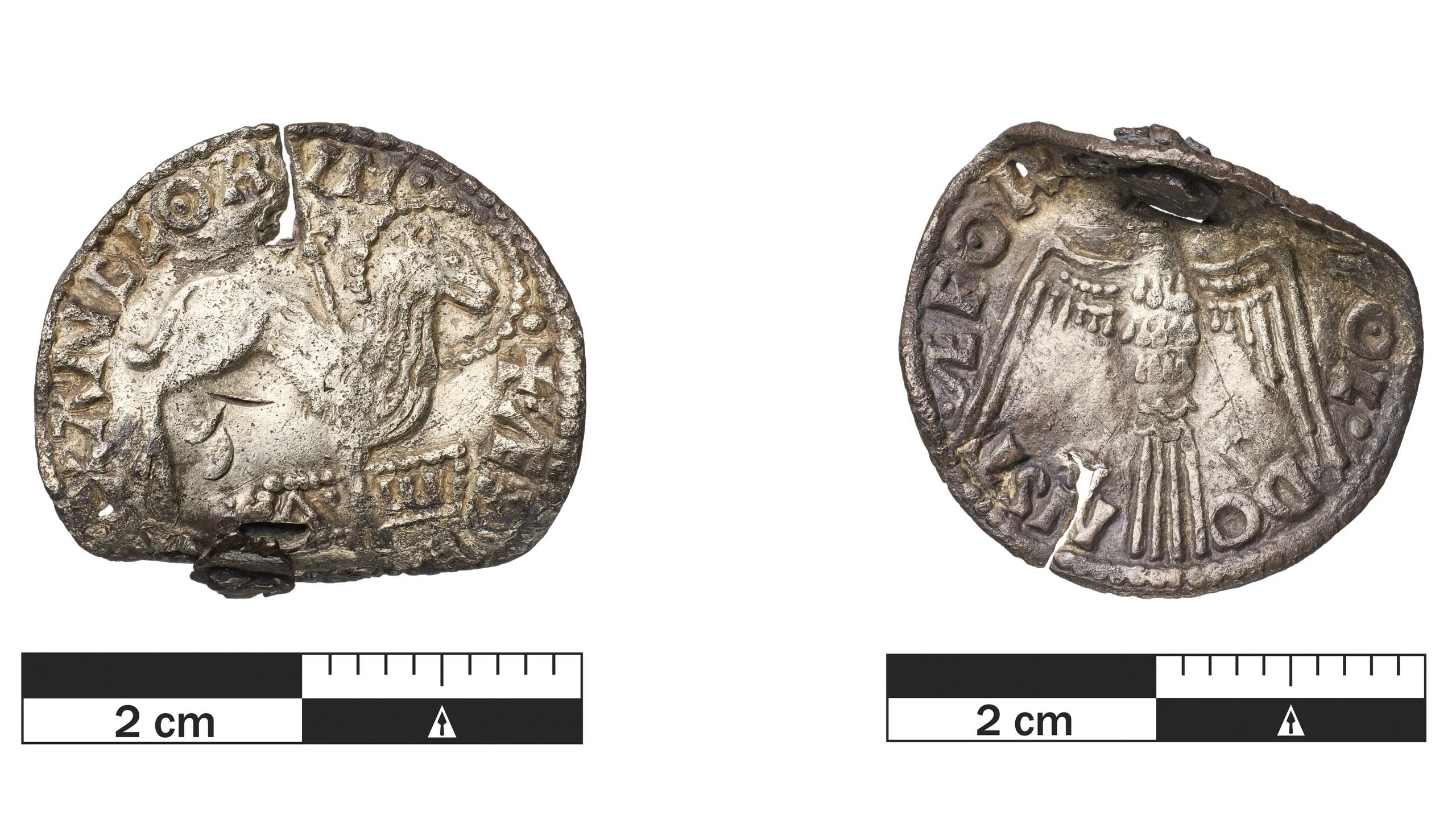
Two rare silver coins discovered by metal detectorists in Denmark have revealed a striking historical irony: artifacts minted specifically to protect England from Viking raids were ultimately repurposed by the very invaders they were meant to ward off. Experts at the National Museum of Denmark confirm that these coins, featuring distinct Christian imagery, were likely worn by Vikings as jewelry or amulets, transforming symbols of divine protection into objects of personal adornment.
The “Lamb of God” Coins
The coins date to approximately 1009, during the reign of King Æthelred II of England, historically known as “Æthelred the Unready.” Facing relentless Viking incursions, Æthelred commissioned these specific silver pennies with the hope that their religious power would deter the Norse warriors.
Experts refer to this specific series as “Agnus Dei” (Lamb of God) coins. Unlike standard contemporary English currency, which typically featured a profile of the king on the obverse and a cross on the reverse, these coins were densely packed with theological symbolism:
- The Obverse: Features a lamb pierced by a cross, representing Christ’s sacrifice. It also includes the Greek letters Alpha and Omega, symbolizing God as the beginning and the end.
- The Reverse: Depicts a dove in flight, a traditional symbol of the Holy Spirit.
Gitte Ingvardson, a curator at the National Museum of Denmark, described the discovery as “almost tragicomical.”
“It gave me goose bumps, because these coins are extremely rare. They were made to obtain protection against the Vikings, but ended up instead as jewelry or amulets worn by Vikings.”
From Currency to Amulet
The discovery highlights a pragmatic shift in Viking behavior. While early raids often involved looting and violence, the Vikings quickly recognized the economic utility of intact silver coins. Rather than hacking silver into irregular pieces (hacksilver) for trade, they preferred using standardized coins for their inherent value and portability.
However, the religious nature of these specific coins added another layer of value. Archaeological evidence suggests that Vikings did not necessarily view the Christian symbols with hostility; instead, they may have appreciated the aesthetic or talismanic qualities of the metal. Most of the “Lamb of God” coins found in Scandinavia feature soldered metal loops, indicating they were pierced and worn as pendants or necklaces. This suggests the Vikings valued the coins not just for their silver content, but potentially as protective amulets in their own right.
A Rare Link Between Cultures
The significance of these finds extends beyond their ironic narrative. To date, only 30 examples of these “Lamb of God” coins have been identified globally. The fact that the majority were discovered in Scandinavia, rather than England, underscores the intensity of Viking raiding and trade networks during this period.
These artifacts serve as a tangible link between several major historical forces:
1. English Royal Authority: Demonstrating Æthelred’s attempts to use religion as a political and defensive tool.
2. Viking Adaptability: Showing how Norse warriors integrated foreign goods into their own culture and economy.
3. Religious Transition: Reflecting the complex interplay between Christianity and Norse paganism in Northern Europe.
The Broader Historical Context
The Viking Age officially concluded in 1066, a period that coincided with the gradual Christianization of Scandinavia. By the 1100s, as Norse paganism declined, societies in modern-day Denmark were increasingly adopting Christian practices. Archaeological findings, such as medieval cemeteries containing over 70 burials from this era, suggest a population that was largely Christian, though likely retaining elements of traditional Norse belief systems.
The repurposing of Æthelred’s coins illustrates this transitional phase. The Vikings were not merely destroying Christian symbols; they were absorbing them, adapting them, and integrating them into their own material culture. This blending of traditions helps explain how, despite centuries of conflict, Christian Europe and the Norse world eventually merged into the medieval political landscape of Northern Europe.
In the end, King Æthelred’s attempt to buy divine protection failed in its immediate military objective, but it succeeded in creating a lasting historical artifact. These coins now stand as a testament to the complex, often unexpected ways in which cultures interact, trade, and influence one another—even across the battlefield.