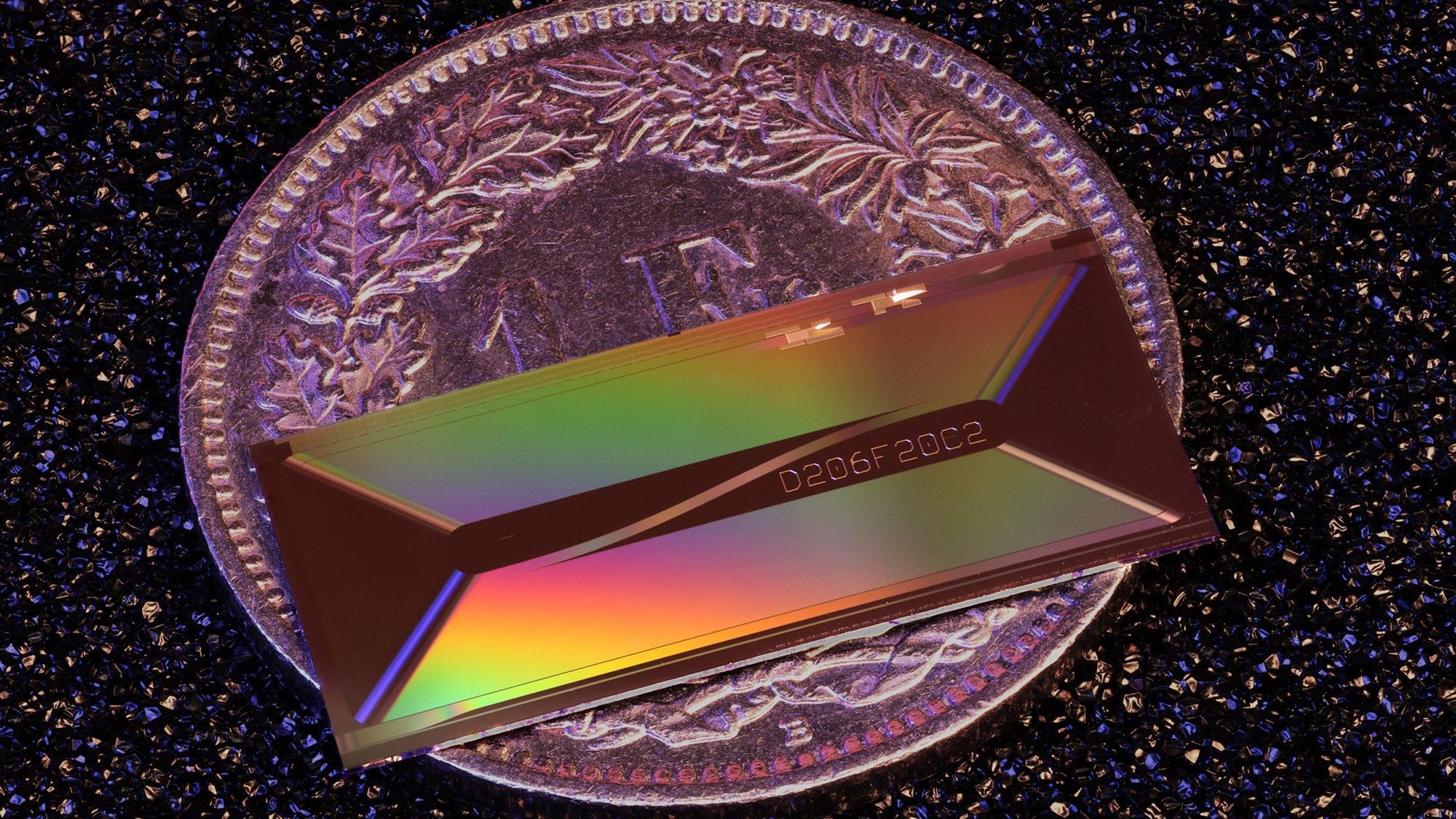
It is small. Like, really small.
Think matchhead small. But it punches above its weight class, delivering bursts of energy that rival massive, table-top laboratory rigs. For twenty years, this was the fantasy. The holy grail. Now, scientists have actually built it.
“It is not only possible, it is elegant.”
Tobias Kippenberg, from EPFL, isn’t just happy. He is impressed that the answer was hiding in plain sight, overlooked for decades. The trick? Going back to the future. Well, back to 1998.
The Problem With Small
Photonic chips are great. They use light instead of electricity for computing. Fast. Cool. No heat issues like your overheating laptop. But they are finicky with high-powered ultrafast lasers.
Why? Confinement. You squeeze light into tiny microscopic waveguides—basically microscopic pipes for photons—and the light starts messing with itself. It gets unstable. The pulse breaks. Chaos ensues.
Current photonic chips cannot handle the intensity. The physics fights back.
So the researchers did something unexpected. They didn’t try to brute-force the physics with new materials or complex filters. They looked at an old design called the Mamyshev oscillator.
It was created by Pavel Mamyshev at Bell Labs. It fell out of fashion. Ignored by the integrated photonics crowd for years. It relies on a specific architecture: a nonlinear waveguide sandwiched between two optical filters.
Here is the beauty of it. High-intensity pulses expand their color range. They pass right through the filters. Weak light—the stuff that causes noise and destabilization? Blocked. It is a built-in gatekeeper. The result is a clean, high-power pulse without the extra bulky components usually needed to stabilize it.
The Matchhead Miracle
The laser cavity itself is still physically long—about 16.5 inches. You can’t fold fiber-optic cable without breaking the signal or creating a mess.
But on a photonic chip? You just etch the path in a spiral. It folds in on itself.
The final footprint? Around the size of a match head.
That is a huge win for density. It takes 147 femtoseconds—147 quadrillionths of second—to fire. In that blink, it delivers 1.05 nano joules. Enough energy to compete with systems that occupy entire desks in expensive labs.
And then there is the cost.
Standard ultrafast lasers are pricey beasts. Rare. Complex to align. But this new chip is silicon-based. That means it gets manufactured exactly like the CPU in your phone. You run the wafer, and poof —over a thousand laser cavities in one batch.
The economies of scale kick in. The price crashes. The accessibility skyrockets.
What Now?
Where do these tiny powerhouses go? Everywhere they are currently too big to go.
Imagine handheld diagnostic tools. A doctor could have advanced medical imaging in her pocket, not in a separate, lead-lined room. Think portable spectrometers for detecting pollutants in a river or a field, without needing a van full of equipment.
Or better atomic clocks. Smaller navigation systems. Faster optical communications.
The technology is here. It works. It is cheap enough to make and small enough to carry. The era of the desktop ultrafast laser is over.
It is just a question of where we put them next.