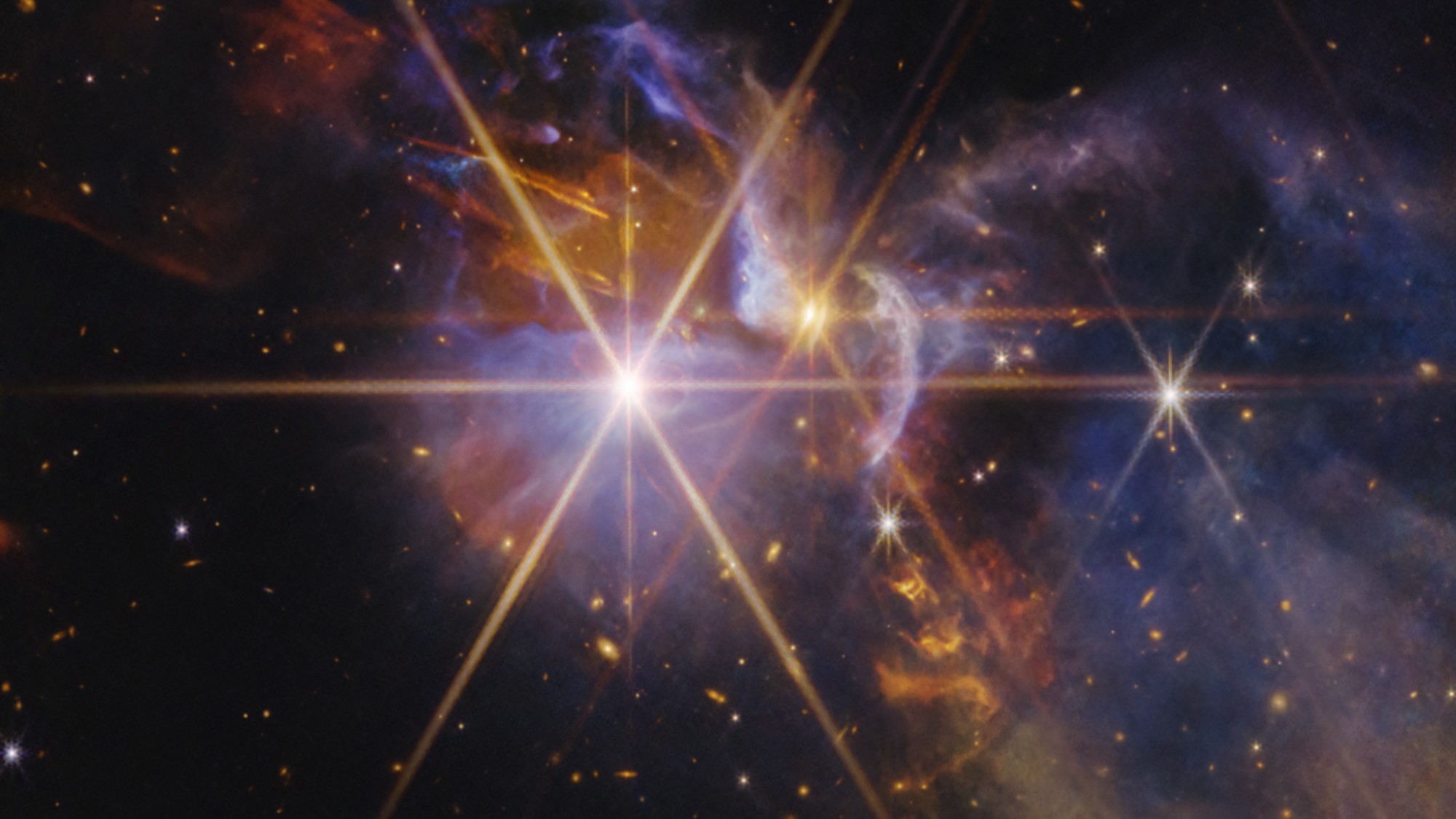
James Webb Space Telescope drops a new image. Infant stars are celebrating their independence. Well.
Not with a parade. With cosmic fireworks.
NASA released it to mark the U.S.’s 250th birthday. A fitting tribute these protostars break free from their birth clouds. They’re leaving the womb so to speak becoming their own fully-fledged stars.
Protostars start as clumps in vast molecular clouds. Things cool. Gravity pulls them together. They keep eating material from that prenatal soup. Eating and eating. Until there is enough mass for the big switch. Nuclear fusion kicks in. Hydrogen becomes helium in the core.
That defines a main-sequence star.
The View at 450 Light-Years
This isn’t just anywhere. The spot is called FS Tau. Roughly 450 light-years from Earth.
Astronomers love this place. It is the go-to target for watching low-mass stars grow up. We’ve looked before sure but the clouds were always too thick. Gas dust opacity. It blocked the view.
Webb sees in infrared though.
The telescope peers right through that dense fog. Now we can actually see these protostars in high detail. Why? To study what happens around them.
Radiation and material outflows change everything nearby.
As the protostar eats matter it also blasts some away. These outflows are violent. Messy. JWST shows gaps in those flows. That detail supports a specific theory. Protostars don’t feed at a constant pace.
They binge. Then they go dormant.
Accretion happens in discrete episodes. Stop. Go. Stop. Go again.
Who knew star formation was so choppy?
We might not get the full picture yet but at least we aren’t looking at a blur anymore. The dust is lifting. The stars are stepping out into the dark alone.