Dark matter remains unseen. We know it’s there. We just can’t look at it.
It ignores light. Totally. That makes it the universe’s biggest ghost. But ghosts might have a sound.
New research flips the script. Instead of staring into the void for something that doesn’t reflect photons, scientists suggest we listen to spacetime itself. Specifically. They’re looking for ripples in gravity.
“Using black holes to look for dark material would be fantastic,” says Rodrigo Vicente, a researcher at GrAPPA in Amsterdam.
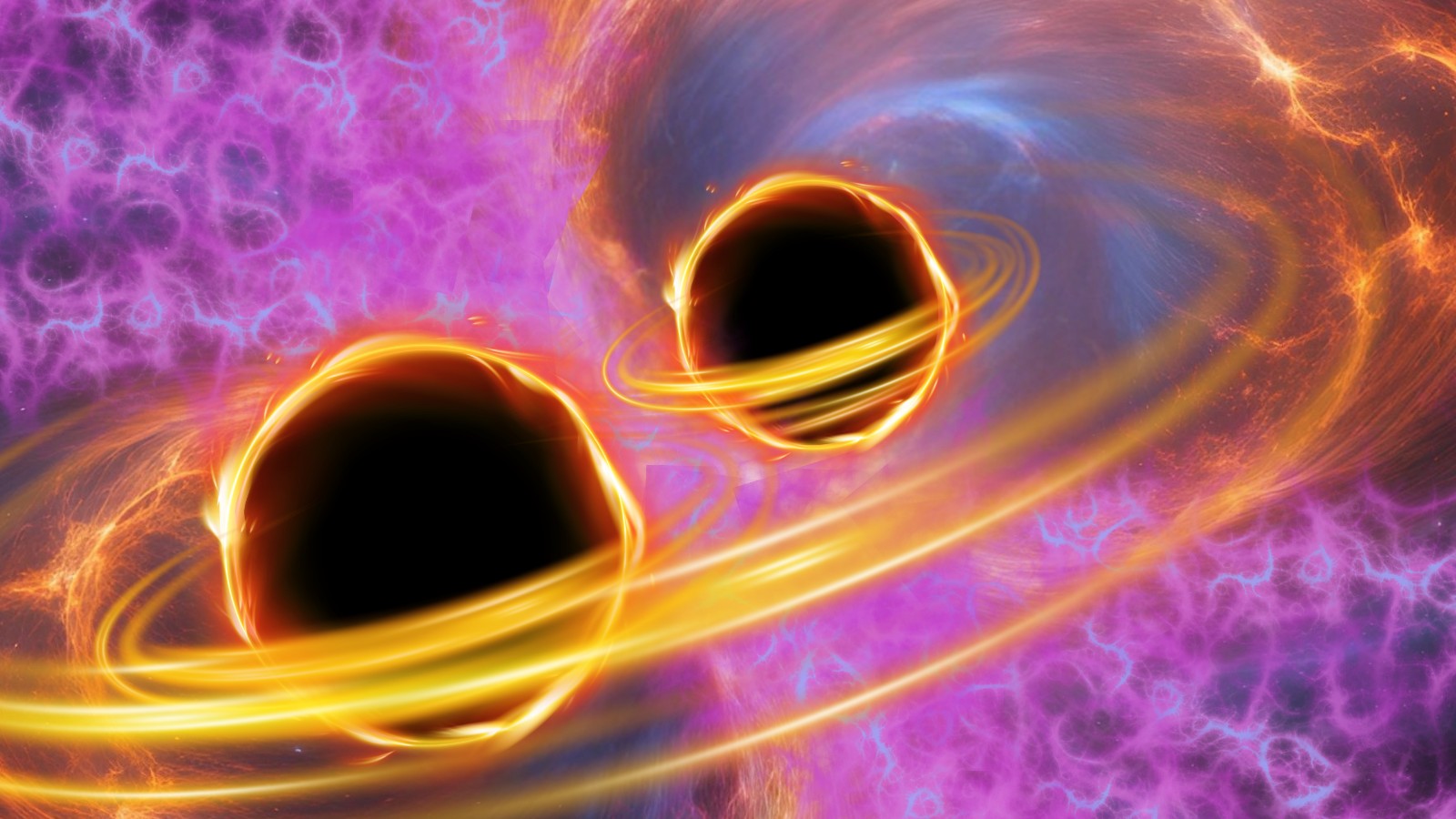
These ripples, or gravitational waves, shake the fabric of the cosmos. Usually. they come from catastrophic events. Like two black holes crashing and merging. A violent dance.
The new theory posits something wilder. If those black holes are spinning inside a dense cloud of dark matter. the rotation churns it up. Think of a mixer beating heavy cream. It creates dark matter “butter.”
This isn’t a metaphor about cooking. It’s about density.
When black holes merge inside this stirred-up environment. the resulting gravitational wave changes. It carries a faint imprint of the medium it traveled through. Like a cough at a Metallica concert.
You wouldn’t hear the cough normally. Over “Seek and Destroy”? Impossible. But with the right equipment. the right sensitivity. you’d spot the anomaly.
And the equipment is improving. LIGO is getting sharper. KAGRA. Virgo. All listening harder.
I Can’t Believe It’s Not Butter
Dark matter is stubborn. It outweighs every atom we see. Five to one ratio. Roughly.
It has to be different from us. No protons. No neutrons. No electrons. Those interact with light. They make stars. They make bodies. They make the screen you’re reading this on. Dark matter skips the electromagnetic party. It only speaks gravity.
So. it warps space. We see the warping. We infer the mass. But we never touch the source.
Scientists hunt for particles beyond the Standard Model. Maybe a light scalar particle. Tiny. Much smaller than an electron. If these particles exist. they would behave like waves.
Waves that can be pumped.
A spinning black hole acts as a engine. It transfers rotational energy to these hypothetical scalars. The density amplifies. The “butter” thickens.
This dense cloud changes how gravitational waves propagate.
Vicente and his team went hunting. They didn’t build new telescopes. They looked at existing data. They sifted through the noise. Focusing on twenty-eight of the clearest merger signals detected so far.
The results? Mostly quiet.
Twenty-seven mergers looked clean. Born in the vacuum. Nothing there to interfere with their song.
But one stuck out.
The Signal in the Static
Signal GW190728. First heard in July 2019.
Two black holes. Combined mass of twenty suns. Sitting eight billion light-years away.
This merger looked messy. In a good way. Or at least. an interesting way. The wave shape carried the tell-tale signature of passing through something. Something dense.
Was it dark matter? Maybe.
The team isn’t shouting from the rooftops. They’re cautious. One signal isn’t a proof. It’s a hint. A whisper in the wind.
“We know that dark material is around us,” says Josu Aurrekoetxea of MIT. “It just has to be dense enough.”
Black holes help. They churn the medium. They pack the density tight enough to leave a fingerprint.
LIGO is entering its fifth operational run. The sensors are more sensitive. The bandwidth is wider.
If that single signal was a ghost of dark matter. others might follow.
We’re building the ears to hear them. We’re learning how the signal changes. When it moves through matter versus vacuum. The theory is ready. The tools are ready.
Maybe. just maybe. we’re finally listening in the right place.