Heat kills. No joke.
With Europe baking in a mega-heatwave and deaths already rising, staying cool is less about comfort and more about survival. Many folks can’t afford air conditioning. They rely on fans. Simple blades spinning. Pushing air around.
Here is the problem. As the temperature climbs, a fan can stop cooling you. It actually starts heating you.
So how hot is too hot?
The UK government says 35°C. The World Health Organization places the tipping point at 40°C. Some studies say lower. Others higher.
The answer? It depends.
The Sweat Factor
Let’s be real. Humans are leaking water when things get tough. That sweat evaporates. It steals heat from our skin. That’s evaporative cooling. It works even when the air is hotter than your skin.
Usually skin temperature sits around 35-37°C in the shade. If the air is cooler, heat leaves your body naturally. If the air is hotter, you absorb it. A fan speeds this up. In either direction.
George Havenith at Loughborough University points out the flaw in old logic.
“35°C used to be cited as the point where fans stop cooling us. But that number ignores evaporation.”
It’s messy. It’s about humidity. It’s about your lungs and your skin working together.
Dry Air: A Fan’s Trap
When it is bone dry, sweat vanishes instantly. You might produce sweat faster than it can vanish though. In extreme dryness, a fan does nothing to boost evaporation because it’s already maxed out.
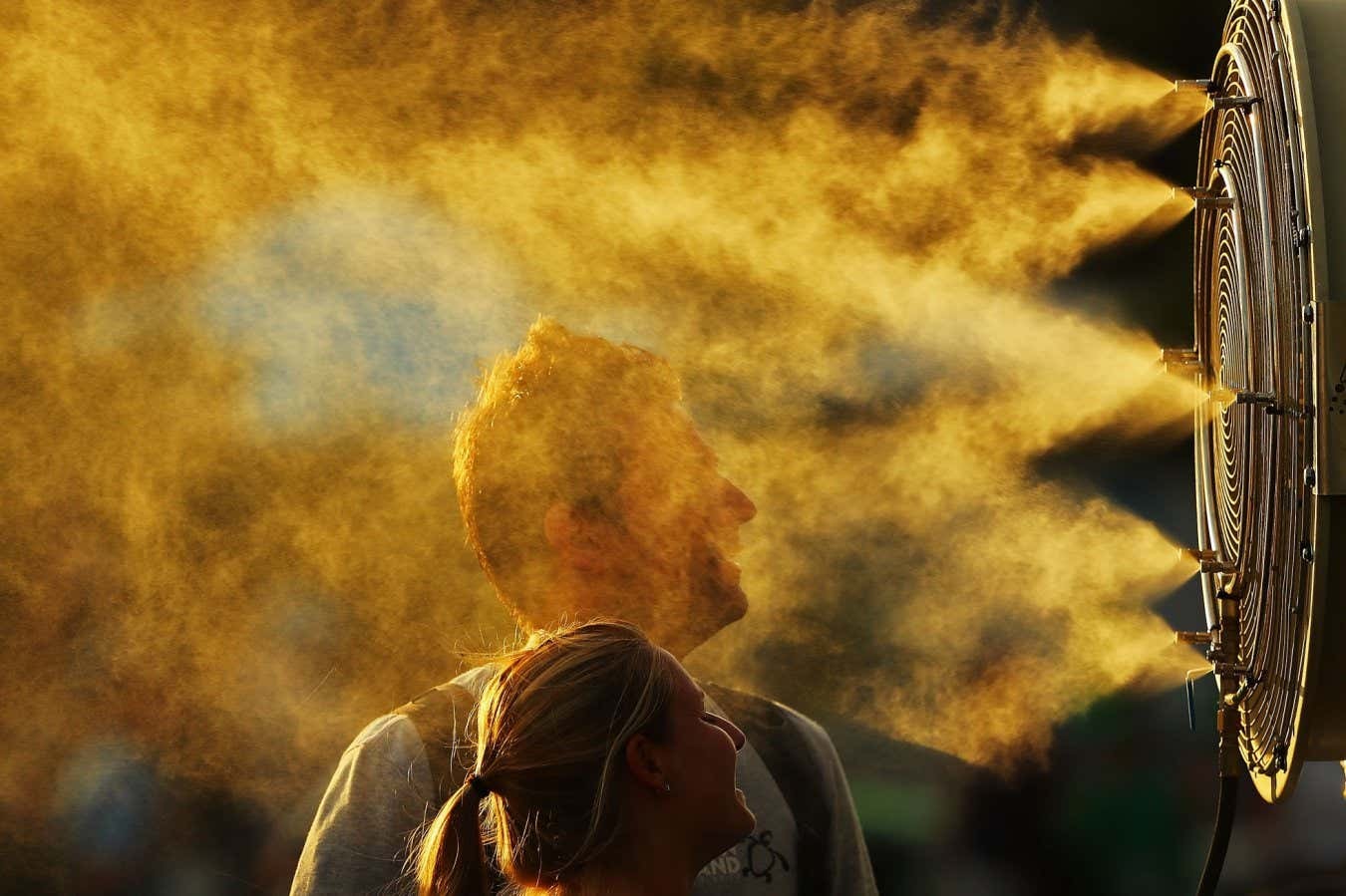
At 15% humidity and 45°C? Turning on a fan almost guarantees you will get hotter. The moving air just pumps heat onto your skin.
Why?
Because the air itself is a thermal source now. The fan acts like a blowtorch. Not a metaphor. Literally.
Humidity Saves You
Turn the dial up. Raise the humidity. Evaporation slows. Moisture lingers. Now you are drowning in sweat. Dropping puddles on the floor.
Here a fan helps. Again.
Why?
The airflow strips that stagnant moist air away. It creates fresh air contact for new sweat to hit. Research suggests a fan can cool you at 38°C if humidity is at 60%. Push the humidity higher though, and even a fan fails. The air is so saturated with water it can’t take any more from you.
Havenith says people often look at national climates for answers. Broad strokes. Useless for individuals.
“So it depends on the humidity in the wind.”
Age Changes the Game
Here is the kicker. You are not a machine. You decay.
As we age, two bad things happen.
- Skin temperature drops.
- Sweating gets harder. Slower start. Less output.
This means an elderly person might start absorbing heat from a fan at 32°C. A teenager can take 35°C before breaking.
It is brutal physics. Biology losing to thermodynamics.
What to Do Now
Wet yourself. Spray water. Wet clothes. This mimics sweat. It lowers skin temperature directly. It also saves your actual sweat so you don’t dehydrate.
Does this work forever? No.
Clothing matters. Acclimatization matters. But there is a ceiling. If your building cooks, even wetting down might not save you from the heat exchange flipping back to heating mode.
What then?
You leave. Find a cooler spot. Any cooler spot.
“At that stage you probably would have to find a cooler place,” Havenith says. “It is a really bad situation.”
We ignore climate shifts at our peril. This isn’t abstract. It’s in your living room right now.
Climate Emergency
Three top scientists break it down. Nathalie Seddon. Kevin Anderson. Paul Behrens. They talk to New Scientist’ Rowan Hooper. No sugar-coating. Just hard data on the nature and climate crises we face.
The heat is the proof. The fan is just a tool. Are we listening?
🌡️ Stay dry or get wet. But watch the thermometer.