Physicists are facing a growing scaling problem: as they build larger detectors to hunt for elusive particles like neutrinos and dark matter, the traditional methods used to “see” them are becoming too complex and costly to maintain.
A research team from ETH Zurich and EPFL has proposed a breakthrough solution. By adapting technology from advanced photography—specifically light-field cameras—they have developed a way to track particles in 3D through large, solid volumes of material without the need for millions of tiny, individual sensors.
The Scaling Bottleneck in Particle Physics
To understand why this matters, one must look at how current detectors work. Most experiments rely on scintillators —materials that emit flashes of light when struck by a particle. To track a particle’s path in 3D, scientists traditionally divide these materials into millions of tiny, separate segments (cubes or fibers).
While highly precise, this approach hits a wall as detectors grow:
– Complexity: Managing millions of individual components is a logistical nightmare.
– Cost: Scaling up a segmented detector to massive volumes becomes prohibitly expensive.
– Physical Limits: There is a limit to how finely you can segment a material before the hardware itself interferes with the physics.
Current state-of-the-art experiments, such as Japan’s T2K or those at CERN, use millions of fibers to achieve submillimeter precision. However, the Swiss team’s new approach, developed under the PLATON project, seeks to eliminate the need for this intense segmentation.
Borrowing from Photography: The Plenoptic Approach
The researchers’ innovation lies in applying plenoptic (or light-field) imaging to particle physics.
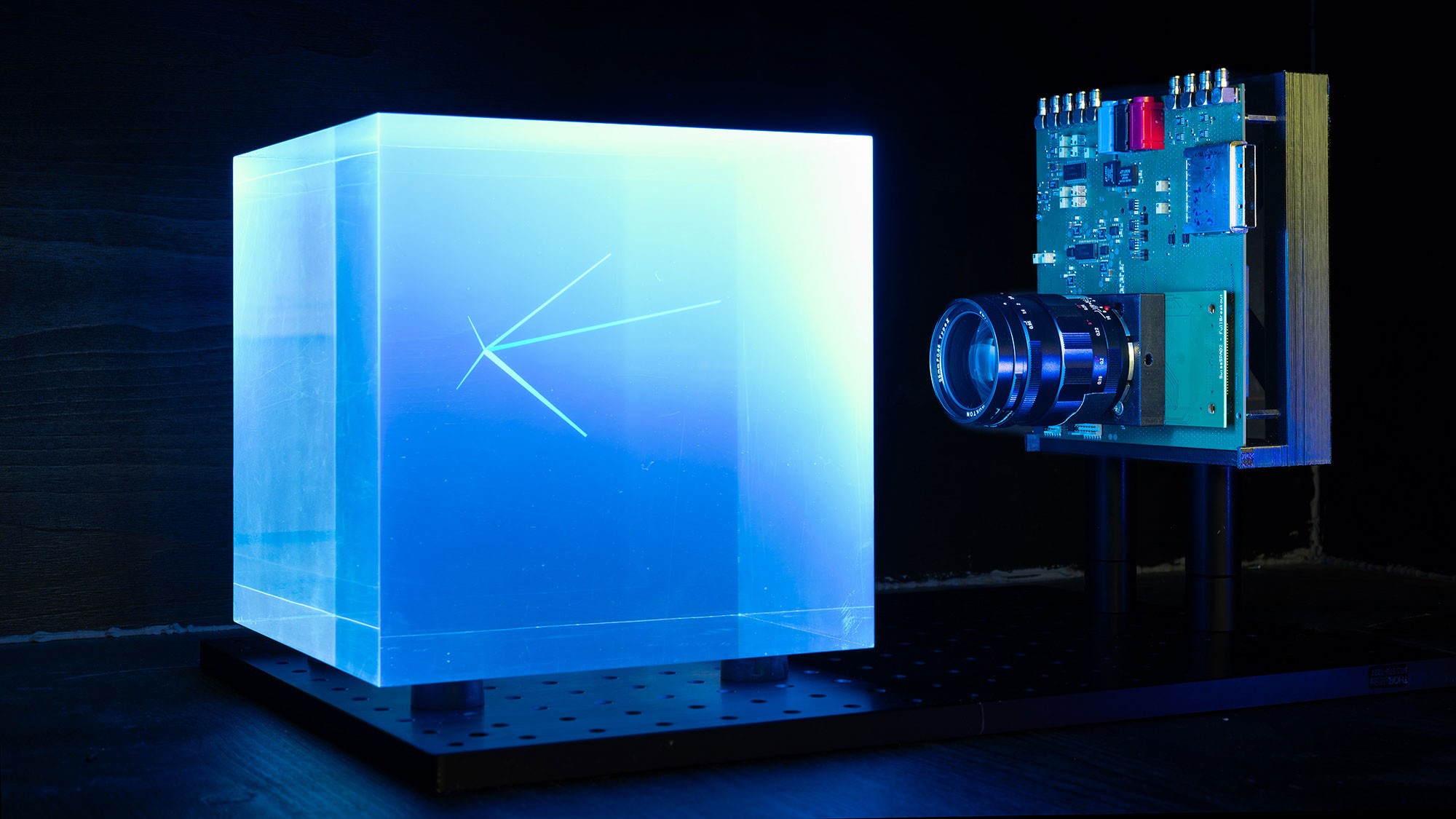
In a standard camera, a sensor records only the intensity of light. In a plenoptic camera, a micro lens array (MLA) is placed in front of the sensor. This allows the device to capture not just how much light is hitting a point, but the direction from which that light is coming. This directional data allows a computer to reconstruct a full 3D image of the light field.
By combining this lens array with Single-Photon Avalanche Diode (SPAD) sensors—specifically the high-performance SwissSPAD2 —the team can track particle interactions even when only a handful of photons are detected.
Proven Results and AI Integration
The prototype has already undergone rigorous testing, and the results are promising:
– High Accuracy: In laboratory tests using a strontium-90 source, the system successfully reconstructed electron tracks in plastic scintillators.
– Low Light Performance: The system maintained spatial resolution even when detecting as few as five photons.
– AI-Driven Reconstruction: To process the complex data, the team is utilizing Transformer architectures —the same type of neural networks that power large language models—to identify patterns and correlations among detected photons.
Projected Capabilities
Simulations suggest that an upgraded version of this system could achieve:
* Sub-millimeter resolution in unsegmented volumes.
* High-accuracy identification of neutrino interactions involving low-momentum protons.
* Scalability to volumes larger than one cubic meter, matching or exceeding current industry standards without the massive hardware overhead.
From Particle Physics to Medical Imaging
The implications of this technology extend far beyond the hunt for dark matter. The researchers have already filed three patents aimed at adapting the PLATON system for Positron Emission Tomography (PET) scans.
Historically, breakthroughs in fundamental physics have revolutionized medicine—most notably through the development of proton therapy. By applying light-field imaging to medical scanners, the team hopes to create more precise, efficient, and potentially more accessible diagnostic tools.
The shift from highly segmented hardware to intelligent, light-field-based sensing represents a fundamental change in how we observe the microscopic world.
Conclusion
By merging advanced optical physics with artificial intelligence, researchers have created a path to build larger, more efficient particle detectors. This breakthrough not only promises to advance our understanding of the universe but also holds significant potential for the future of medical diagnostic imaging.