For centuries, the concept of exponential growth has served as the ultimate benchmark for rapid expansion. Legend tells of an Indian inventor named Sessa who, after creating chess, requested a reward of rice: one grain on the first square, two on the second, four on the third, and so on. By the 64th square, the total would exceed a century’s worth of the global rice harvest.
While this legend illustrates how quickly numbers can spiral out of control, modern mathematics has discovered processes that make exponential growth look like a slow crawl. Mathematicians have found ways to generate numbers so vast they defy conventional logic, effectively breaking the “speed limit” of standard arithmetic.
The Foundation: Peano’s Rulebook and Gödel’s Shadow
To understand how these limits are broken, we must first understand the rules that govern numbers. In the late 19th century, Giuseppe Peano established the Peano axioms, a set of fundamental rules based on “succession”—the simple process of moving from one number to the next (0 to 1, 1 to 2). These axioms form the bedrock of arithmetic, allowing us to build addition, multiplication, and division.
For a long time, these rules seemed absolute. However, in 1931, Kurt Gödel shattered mathematical certainty with his Incompleteness Theorem. He proved that no rulebook (no matter how detailed) can be fully comprehensive; there will always be true mathematical facts that cannot be proven using a specific set of axioms.
While Gödel’s discovery was a shock, most “unprovable” truths were considered abstract logical oddities. For the vast majority of mathematical work, Peano’s rules were more than enough. But recently, researchers have discovered that some very real, very practical mathematical processes require much more powerful “rulebooks” to function.
Breaking the Limit: The Goodstein Sequence
The first crack in the ceiling appeared in 1944 with the discovery of the Goodstein metasequence.
The process is deceptively simple but results in explosive growth. By converting numbers into different bases and then performing specific arithmetic shifts, one can create sequences that skyrocket toward infinity. For example, a sequence starting with the number 4 can take more than $10^{10^{10,000,000}}$ moves just to return to zero.
The significance of the Goodstein sequence isn’t just its size; it is its logical requirement. In 1982, mathematicians Jeff Paris and Laurie Kirby discovered that Peano’s axioms are insufficient to prove that these sequences eventually return to zero. This was a landmark moment: a concrete, non-abstract example of Gödel’s incompleteness in action. To “solve” the Goodstein sequence, you need a more powerful logical framework than standard arithmetic provides.
The Complexity of Networks: The Graph Minor Theorem
If the Goodstein sequence was a crack in the foundation, the Graph Minor Theorem was a structural collapse.
Graphs—networks of dots (nodes) connected by lines (edges)—are used to model everything from molecular chemistry to the internet. A “minor” is a smaller version of a graph, essentially its mathematical skeleton. Between 1983 and 2004, Neil Robertson and Paul Seymour proved a massive theorem stating that in any infinite collection of graphs, one will eventually contain another as a minor.
This theorem is a cornerstone of modern structural graph theory, providing tools to analyze complex networks like electricity grids or transport systems. However, when logicians applied “reverse mathematics” to this theorem, they found something staggering:
– The proof of the Graph Minor Theorem cannot be achieved using standard arithmetic.
– It requires moving far beyond the usual five levels of mathematical complexity.
– It necessitates rules involving “infinite sets”—collections of numbers so complex they defy simple characterization.
Why This Matters: The Search for Irreducible Complexity
Most complex mathematical structures can eventually be explained using Peano’s simple rules of succession. They are complicated, but not fundamentally different from basic counting.
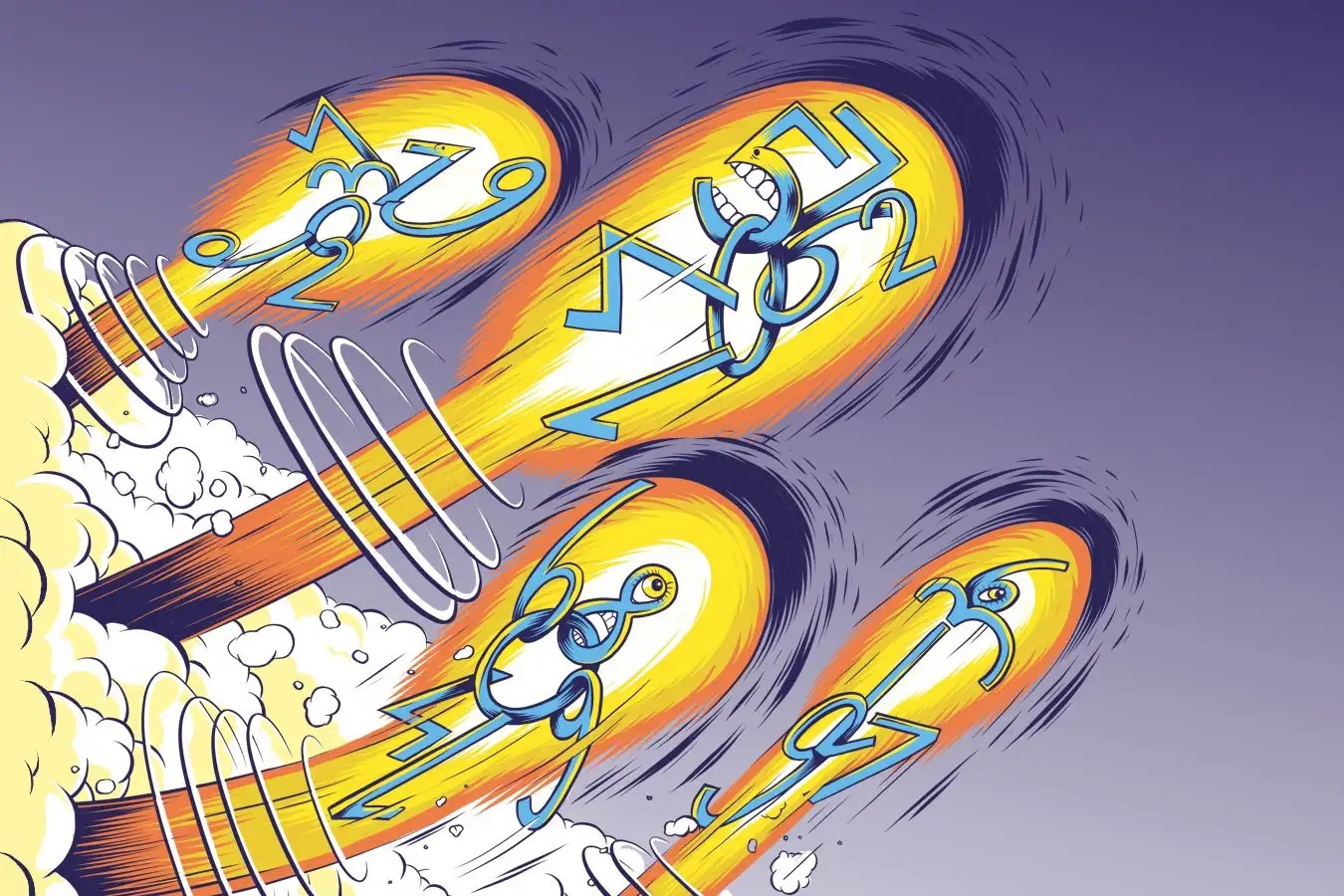
The discovery that structural graph theory—a field based on simple dots and lines—requires “mathematical rocket ship” logic is profound. It reveals that irreducible complexity exists even in the most basic structures. We are learning that the universe of numbers is not just larger than we thought, but deeper and more logically demanding than our most fundamental rules ever predicted.
Conclusion: By exploring the limits of how fast numbers can grow, mathematicians have discovered that even simple networks can require incredibly powerful logical frameworks, proving that our fundamental understanding of arithmetic has much more to learn.