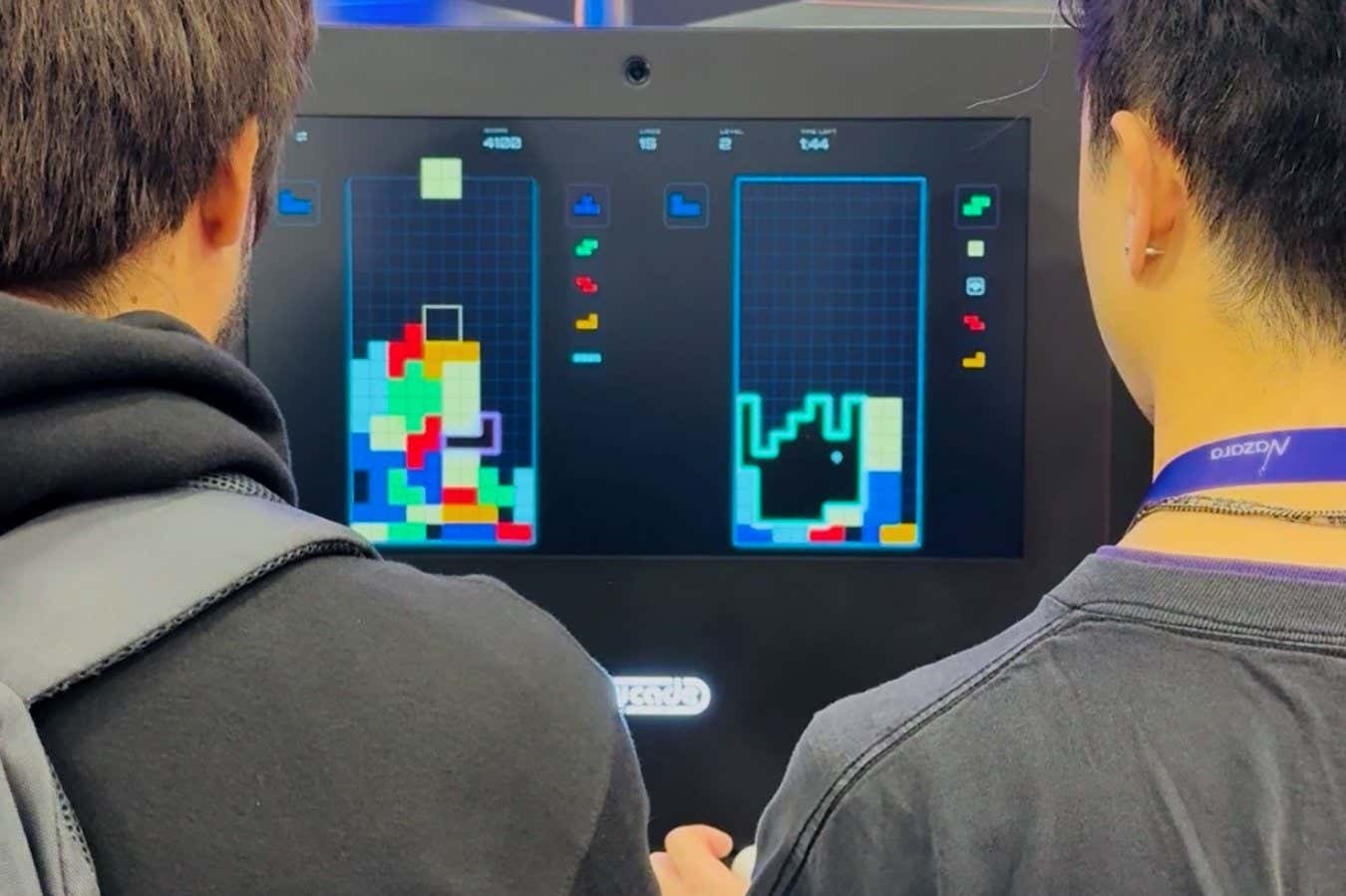
Blocks fall. Pale yellow. Green. The “z” piece. We all know Tetris. You can see it in your head. But there’s a glitch. A block with white borders holding nothing but empty air. Superposition, the instructions call it. It is both there and not there. A weird mix.
I need to know what it is. An eye icon drops from the digital sky. Observe. It hits the empty block. Pop. The shape blinks into reality. Bad timing. My tower crashes into the ceiling. I could have won if the observation had annihilated the block, leaving it gone. I wasn’t that lucky. Game over.
Quantris beat me. Again. Quantum mechanics did nothing to save me from my own lack of reflexes.
This is new for me, but not for the medium. Quantum references have haunted games since the 1980s. Yet nothing happened until 2016. That’s when cloud-based quantum computers arrived. Suddenly, tools like IBM’s software kits caught fire.
Laura Piispanen tracks this at Aalto University. She counts close to 400 quantum games today. Many came from weekend jams. Events that have run since 2014 are spawning developers who treat quantum physics like a mechanic. Like gravity. Like ammo.
Her pick is Qubit the Barbarian. It feels old school. Swords, sorcery, mazes. You walk through tiles. Each tile is a quantum state. Measure it? The path changes. A wall appears. A door opens.
“What could emerge from this brew?”
The question lingers. We have gamers. We have physicists. We have a branch of reality that breaks intuition. Throw them together. Do quantum computers make better games? Do games make quantum computing less intimidating?
First, clear up a myth.
You are not playing these on actual quantum machines. Yet. Those devices are temperamental. Experimental. They struggle with basic errors. They aren’t universal computers. Even in the best-case future scenarios, they won’t run your browser or your MMO. They specialize. Video game rendering isn’t currently one of their strengths.
However.
The hardware is useful. Just not for playing.
Moth Quantum released Quantum Backrooms earlier this year. It is horror. It relies on those eerie, liminal internet spaces. But here’s the trick. An IBM quantum computer generated the levels during development. The rooms exist as quantum states of the machine’s qubits. James Wootton from Moth Quantum says it feels like being trapped inside the hardware itself.
Creepy. Accurate.
Julian Togelius at NYU looks at creativity and AI. He says game worlds are usually local. You jump on an enemy; the other side of the map doesn’t care. Making a world connected? That’s hard. Math with constraints.
Quantum computers might handle that. Potentially.
But don’t get excited yet. The idea is complex. The hardware is imperfect. Wootton admitted Quantum Backrooms stops being quantum once you press “play.” A normal computer takes over. The quantum part is over.
Wootton ran a quantum Rock-Paper-Scissors back in 2017. On real hardware. But mostly? Simulators do the work now.
Chris Cantwell runs Quantum Chess. His game ran on Google’s machine for a few minutes in 2020. It took a complete rewrite of the code. “Hardware is not quite there,” he says. Most quantum games today run on simulators on classical PCs.
So what’s the point?
If we can’t run games on quantum computers, maybe quantum mechanics can be the gameplay.
Superposition. Entanglement.
In Quantum Chess, a knight can be on two squares at once. In Quantum TiqTaqToe (made by Evert van Nieuwenburg), you link your marks. You don’t need a physics degree to use these moves. You just press a button. See what happens.
“He doesn’t understand the quantum at all… but his brain is interacting with genuine量子 phenomena.”
Kids pick it up fast. Van Nieuwenburg told a story. Science night at a school. Kids around six. They started yelling “Oh no, you entangled!” after a minute. No explanation. Just fun.
Cantwell’s eight-year-old prefers quantum chess. Why? More pieces. Less logic, more chaos.
Is this valuable? Spiros Michalakis from Caltech thinks so. He worked on Quantris. He made a quantum Minecraft mod in 2014. That started the trend.
Michalakis has a goal. Not just slapping a quantum backend on a boring app. He wants mechanics that feel fresh. “New tools, new weapons.”
Togelius is skeptical. He says clever math doesn’t always equal fun games. If shooting zombies requires you to calculate wave functions, people will quit. Unless it feels natural. Like a double jump. Like a stealth mechanic.
Making a good game is hard. Making one with quantum physics? Harder.
The stakes are higher here, too. We need to leverage unique quantum operations. Or it’s just a gimmick. A party trick.
But for a kid glued to a screen? For a younger brother who hates physics homework but loves Fortnite? Maybe a quantum puzzle is the only way they’ll ever care.
We might find our next generation of quantum engineers not in a lab coat, but holding a controller.
Or we won’t.
The blocks keep falling anyway.