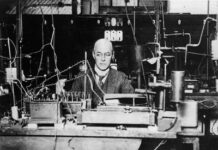
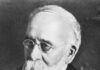
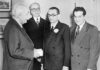
In history books, the era of radio is often attributed to Marconi or Tesla, but Heinrich Georg Barkhausen is rarely mentioned. Born in Bremen in 1881, the German physicist was overshadowed by better-known names, but his contributions laid the foundation for modern electronics and the understanding of matter itself. He died in Dresden in 1956, leaving behind a legacy marked by a strange, jerky sound that changed physics.
From Siemens Labs to Dresden
Barkhausen’s academic path was rigorous. He studied at the universities of Munich and Berlin before obtaining his doctorate in Göttingen in 1907. It was not long before he switched theory to industry and worked in the laboratories of Siemens & Halske in Berlin. This experience grounded his later work in practical application rather than mere abstraction.
In 1911, he made a groundbreaking change. He accepted the world’s first professorship in communications electrical engineering at the Technical Academy in Dresden. It was a new, ill-defined field, and Barkhausen helped define it. He worked on theories of spontaneous oscillation and nonlinear switching elements. He even formulated electron tube coefficients, which engineers still refer to today.
But he wasn’t just focused on circuits. He studied acoustics and proposed methods for measuring loudness using subjective human perception. This mix of hardware and human sensitivity later proved essential to one of his greatest discoveries.
Barkhausen effect explained
The year is 1919. Barkhausen experiments with magnetism and acoustics at the same time. The result was the Barkhausen effect, a phenomenon that gave concrete evidence of the real operation of magnets.
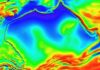
Before this discovery, scientists debated whether magnetization occurred atom by atom or in larger groups. Barkhausen showed that it was the latter. He showed that magnetization affects entire “domains” of a ferromagnetic material. These regions are collections of atoms that work together. When the magnetic field changes, these regions do not move uniformly. They jump.
How do you hear a magnetic jump? You use a speaker. Barkhausen connected a coil of wire to the speaker. When he magnetized a piece of iron, the sudden changes in the magnetic domains caused audible clicks and pops. It was a rough, staticky noise. But in that noise lies a fundamental truth about the physical world. Magnetization is quantized. This happens in discrete steps, not as a continuous flow.
“The Barkhausen effect provided evidence that magnetization affects entire regions of a ferromagnetic material and not just individual atoms.”
This realization was more than just an academic curiosity. It explained why materials retain their magnetism and how they respond to external fields. It bridged the gap between microscopic atomic behavior and macroscopic magnetic properties.
On the way to the microwave
Barkhausen did not stop at magnetism. In 1920, he developed the Barkhausen-Kurz oscillator together with Karl Kurz. This device operated at very high frequencies. It was a direct precursor to the microwave tube.
The oscillator led to a better understanding of velocity modulation. This principle is the key to how microwaves amplify signals. The speed of the electron currents is controlled to increase the strength of the signal. Without this understanding, the development of radar and later satellite communications would have faced significant obstacles