


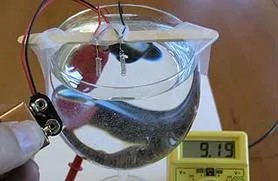
You don’t need a lab coat or a million-dollar grant to see clean energy in action. You just need a popsicle stick, some wire, and a willingness to fumble with a 9-volt battery.
Hydrogen fuel cells are the holy grail of renewable power. They generate electricity with zero emissions—water is the only exhaust. We see them in futuristic buses and high-end concept cars, but the chemistry is simple enough to replicate on your kitchen counter.
This isn’t just a party trick. It’s a tangible demonstration of how we might power our future. And surprisingly, you can build a working model in about ten minutes.
The Materials You Need
The list is short. Most items are household clutter; one item requires a quick online order.
- A popsicle stick or small wooden/plastic plank.
- A 9-volt battery and clip.
- Transparent sticky tape.
- A glass of water.
- A volt meter.
- One foot of platinum-coated nickel wire (or pure platinum).
The wire is the outlier. Platinum-coated nickel runs about $15 online. It’s not exactly a pantry staple, but it’s essential. The platinum acts as the catalyst. Without it, the magic doesn’t happen.
Step 1: Cut and Coil the Wire
Take that foot of wire. Cut it into two six-inch pieces.
Now, coil them. You need tiny springs. These will be your electrodes.
Use the end of a test lead, a nail, or even a coat hanger to wrap the wire tightly. The coiled shape increases surface area. More surface area means more reaction. More reaction means more voltage. It’s basic physics, but it matters.
Step 2: Prepare the Connections
This part requires patience.
Cut the leads on your battery clip in half. Strip the insulation off the new ends. Twist the bare wire onto your platinum coils.
You’re creating a bridge. The battery clip connects to the coils. Two other wires also attach to the coils. These separate wires will eventually connect to your volt meter. Keep the twisted connections dry. Submerge only the platinum coils.
Step 3: Mount the Assembly
Tape the coils to the popsicle stick. Secure them firmly.
Then, tape the stick to the rim of the glass. Lower the coils into the water. They should dangle nearly their entire length.
Here’s the constraint: the twisted wire junctions must stay above the water line. If they get wet, you’ll short the circuit. Dry connections are non-negotiable.
Step 4: Hook Up the Meter
Connect the red wire from the cell to the positive terminal of the volt meter. Connect the black wire to the negative (common) terminal.
At this stage, you should see zero volts. Maybe a tiny fluctuation like 0.01V. That’s noise. Ignore it. The cell is currently dormant.
Step 5: Trigger the Reaction
This is the moment.
Touch the 9-volt battery to the battery clip. You don’t need to clip it. Just touch the terminals together for a second.
Electrolysis begins immediately.
Bubbles form. Hydrogen gathers on one electrode. Oxygen gathers on the other. The battery pushes electricity into the water, splitting the H2O molecules apart.
Now, remove the battery.
If you were using plain nickel wire, the voltage would drop back to zero. The reaction stops. The gas escapes. But you used platinum.
The platinum is a catalyst. It doesn’t get consumed. It lowers the energy barrier for the hydrogen and oxygen to recombine.
The hydrolysis reaction reverses.
The gases meet on the platinum surface. They turn back into water. And in that process, they release electrons.
The volt meter jumps. You are now generating electricity from hydrogen and oxygen. You have built a fuel cell.
Why This Matters
It’s easy to dismiss this as a kid’s science fair project. But the principles are identical to what powers heavy machinery and spacecraft.
The bottleneck has never been the chemistry. It’s been the cost and storage of hydrogen. Platinum is expensive. Storing gas efficiently is hard. But the proof of concept is undeniable.
You just turned water into electricity.
Safety and Reality Check
A few caveats before you start.
Work in a ventilated area. Hydrogen is flammable. Oxygen supports combustion. You are creating a mix of both. Small scale, yes, but still. Wear eye protection. Handle the battery with care to prevent short circuits.
How long does it last?
Not long. The amount of hydrogen and oxygen generated by a 9-volt battery for a few seconds is limited. Once the gases recombine, the cell stops producing power. It’s a burst, not a battery.
But that’s the point. It’s a demonstration of potential.
The future of energy isn’t just about finding new sources. It’s about how we store and convert them. And sometimes, you need to see it with your own eyes to believe it.
The volt meter still reads a few millivolts. The bubbles have settled. The experiment is over. But the question remains: can we scale this up without costing the earth?
We’ll see.


