The chemistry behind the smell and texture of #Play-Doh
Even before you open the can, you can smell the unique, pungent aroma. For those who grew up in the last few decades, this is a fragrance that immediately evokes memories. For some, it’s pure nostalgia. For others, it’s a strong reminder to look for dry red clay under the living room rug. This scent is so iconic that Hasbro released a limited edition Play-Doh perfume to celebrate the compound’s 50th anniversary.
But the olfactory experience is only half the story. The sense of touch is also important. Good Play-Doh is soft. It’s flexible. It feels moist but not sticky. It withstands pressure but retains its shape. However, if you leave it on your coffee table overnight, the magic disappears. The surface crumbles. It hardens into an unplayable rock.
Why is this happening? Why do the materials stay soft for weeks, but dry overnight? Where do they actually come from?
This is not magic. This is chemistry. The story behind its birth is amazing.
From Wallpaper Cleaner to Playground Staple
The origin of Play-Doh was not a high-tech laboratory breakthrough. It all started with a problem in preschool. The teacher’s brother-in-law, Joseph McVicker, owned a cleaning supplies company. He is not from the toy industry. He made wallpaper cleaner.
The teacher complained that the clay the students used was too hard. It cracked. This can be frustrating for children with small hands. McVicker sent her a sample of his wallpaper cleaner. This is a soft, soapy substance designed to be rolled onto walls to remove soot and grime. Non-toxic. It was moldable. It is very cheap.
The teacher loved it. The kids loved it.
By 1955, the “wallpaper cleaner” had become a popular product in classrooms. The company has changed its name. They improved the formula a bit. They call it Play-Doh. It was officially released to the public in 1956.
The Numbers Behind the Dough
The scale of Play-Doh’s success is unfathomable. Since 1956, factories has produced about 900 million pounds of the compound. There are about 2 billion cans. If all the Play-Doh were piled up in a big pile, it would weigh as much as 2000 Statue of Liberty.
In 1957, packaging evolved. The first jar is a simple cardboard tube containing 1.5 pounds of off-white dough. Soon, retailers were selling three-can packs in primary colors: red, green and blue. A year later, White dough followed a year later.
The production line does not stop even today. The factory produces about 95 million cans a year. In stock at over 6,000 stores in the US. Sold in 75 countries. You might think that such a huge global footprint would require complex chemical secrets, but the basic recipe is surprisingly simple.
The Recipe That Changed Play
Most people think that Play-Doh is made of flour, water and salt. It’s close, but it’s not the whole story. The exact proprietary formula is guarded, the mechanism is simple.
The dry ingredients (mainly flour, water and salt) make up the majority. Salt acts as a preservative and prevents the dough from spoiling. It also helps control moisture. Too much salt and the dough gets brittle. Too little causes mold.
The secret to the texture is boric acid. This borax-derived compound gives Play-Doh its characteristic elasticity. It prevents the dough from cracking while it’s being manipulated. It also helps retain softness. But boric acid is not
The Chemistry Behind the Crunch
Anyone who has spent time wrestling with the stuff knows that this isn’t just about school projects. You can mold it into a dog, a flower, a fish or a tree. When it dries, it becomes a sturdy piece that you can keep on a shelf. But let’s be honest, the real fun often comes from just squeezing, squeezing, pulling, rolling and cutting it.
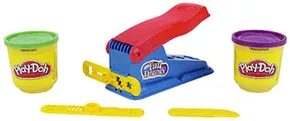
Of course, eating it is a phase (risky one). But aside from consumption attempts, the most common use is extrusion. Many Play-Doh toys allow you to press the dough through a mold to create long ropes or specific shapes. The first toy “Fun Factory” was released in 1960. Different versions are still available. In other Play-Doh toys, the extruded dough transforms into a series of long noodle-like objects, including a dog’s tongue, soft-serve ice cream, and hair, which can be cut and shaped.
Why does the Play-Doh compound behave the way it does? It all depends on the interactions between the ingredients. Although the exact formula is a closely guarded secret, Hasbro, which manufactures and sells the compound, has revealed some facts about its basic ingredients. The dough contains water, salt and flour. It doesn’t contain peanuts, peanut oil or milk, but does contain wheat. This is important for allergy sufferers. If you are looking for details Play-Doh ingredient list, our current patent (US Patent 6,713,624) breaks it down further. This compound is basically a starch-based binder mixed with water, salt, lubricants and preservatives.
Here is what goes into the mix.
- water
- Starch-based binder
- Retrogradation inhibitor
- salt
- Lubricant
- surfactant
- preservative
- Hardener
- Humectant
- Fragrance
- color
Each of these ingredients affects the texture, aroma and appearance of the compound. One of the main factors influencing the softness and texture of Play-Doh compound is the interaction between its two main components: a starch-based binder and water. To understand how dough works, you need to know a few things about starch and what happens when starch comes into contact with water.
We’ll look at the chemistry behind starch.
Anatomy of a starch granule
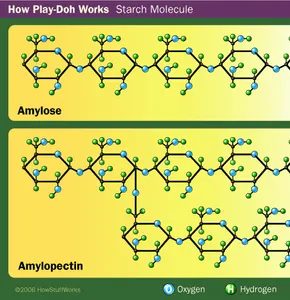
Starch is a polysaccharide. Basically, they are just long chains of sugar molecules linked together. But it’s not a cohesive mess. It consists of two specific types of molecules.
One of them is amylose. It is linear. Straight.
The other is amylopectin. This one is branched. Twisted.
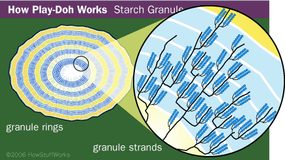
When these strands are packed together, they form granules. They do not accumulate randomly. They are arranged in a starburst pattern around a central point. The name of this center is Hilum.
What holds this structure together? Hydrogen bonds. These bonds between strands give the granules their solid shape.
The size of the granules varies. Some are small. Some are big. The decisive thing is that different starches have a different ratio of amylose to amylopectin. This relationship changes everything. It determines how the starch behaves during cooking. Or bake. Or fry.
The ratio of amylose to amylopectin determines the structural integrity and cooking behavior of the starch granules.
This structural difference is why potato starch works differently than corn starch. Different proportions. Different shapes. Different results on your plate. It’s simple chemistry. But it has complex consequences.
If cold water is poured over the starch, the granules will absorb a little, but remain mostly intact. This is a passive relationship. But warm water? This changes everything. Heat can cause swelling. The granules break down. They release their inner contents into the liquid. This process is called gelatinization.
This reaction can be forced in two ways. Mix the starch with cold water and heat to gelatinization temperature. Alternatively, stir vigorously. The mechanical friction caused by mixing breaks up the particles faster. Watch the animation below to see the particles expand and burst in real time.
Factors that change the texture
The resulting gel is not homogeneous. Its consistency depends on several variables.
- Granule size: Large starch granules swell more easily than small starch granules.
- Amylose content: Amylose is the linear component of starch. The higher the amylose content, the higher the degree of swelling required for starch gelatinization. High amylose also forms stronger and firmer gels. Why? More amylose molecules escape from the granules and dissolve in water, forming a tighter network.
This chemistry explains the core structure of Play-Doh. The compound needs to be firm enough to hold its shape, yet flexible enough to be molded. Wheat starch is the perfect candidate. It contains about 25 percent amylose and 75% amylopectin. This ratio gives the fabric a firm yet flexible structure that we appreciate.
When Water Escapes
The interaction between starch and water also explains a common problem. Leave Play-Doh out overnight, or play with it for hours, and it turns dry. Grainy. Flaky.
这是简单的物理学。 水从面团中蒸发到空气中。 干燥的淀粉成分仍然存在。 如果没有水分来保持颗粒膨胀和润滑,结构就会塌陷成易碎的混乱状态。
Play-Doh surfactants and inhibitors
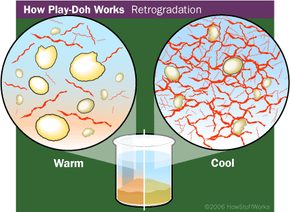
Why #Play-Doh doesn’t turn to stone (The Science Behind Squish)
Starches like amylose give Play-Doh its texture. Maintains the strength and cohesion of composite materials. But there’s a problem. When the mixture of starch and water cools, the amylose chains in the water start to bind together. This process is called retrogradation. or set back. Stiffens the dough permanently.
That’s not the only purpose of styling products.
To prevent this, Play-Doh adds a retrogradation inhibitor. This substance prevents the amylose chains from sticking together. This compound uses amylopectin or waxy starch for this.
However, there is a problem. Too much amylopectin can turn Play-Doh into a sticky paste. It is not a smooth gel. Therefore, more ingredients are needed in the composition to fix the structure. Requires lubrication. Mineral or vegetable oils are effective. Surfactant is also required.
Some of you may be aware of surface active agents in household detergents. These are also called surface active agents. These are man-made molecules designed to suspend substances in water. They work because of their strange molecular structure.
One end is hydrophilic. It likes water. At the other end of the spectrum are lipophilic. It loves fat. This greasy end is also known as hydrophobic.
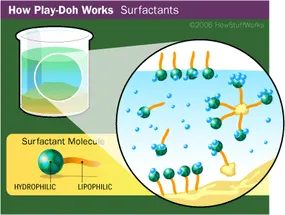
Chemical composition of Play-Doh
Mixing surfactants into an oily environment changes everything. The lipophilic ends of these surfactant molecules bind fats. At the same time, the hydrophilic end sticks to nearby water. The fat remains suspended in the liquid. This is a stable emulsion. If the ratio is right, you can also turn it around so that the water inside the fat.
In Play-Doh, surfactants bind to lubricant molecules. They suspend these lubricants in a starch and water base. result? Less stickiness. A smoother compound.
The key ingredients create the foundation. starch. water. retrogradation inhibitor that prevents crystallization. surfactant. lubricant. Together, these form a flexible dough. Other components fine-tune the structure. Salt has antibacterial properties. It also reduces the amount of free water molecules available for bacterial growth. Hardeners and moisturizing agents regulate hardness and moisture. Preservatives extend shelf life. The scent and color are just finishing touches. Preparation is easy. Mix everything. Seal it up.
Let’s see the recipe for the homemade version later. However, consider the security implications first.
Child’s Play or Thievery?
Play-Doh finds unexpected uses. People have discovered it can bypass biometric fingerprint scanners. The theory is simple. Adjust the shape of your fingers. Fill the copy with compound. Take it away. You have a copy of your fingerprint. Used to bypass security.
The new system is smarter. They measure your temperature. They check for sweating. They do aggressive testing to make sure the fingers are real. Fabric molds cannot fool these sensors.
自制培乐多
Play-Doh is safe. Non-toxic. But let’s be honest, this isn’t really lunch. The lubricant in this soft, flexible compound is oil-based, so you don’t want your kids nibbling on blue snakes. This is the main reason why parents are looking for alternatives. They want the same plastic fun, but without the chemical aftertaste. They want dough that is actually edible.
So we tested this theory.
A collection of popular homemade recipes. The goal is simple, but difficult. The structure and ingredients should be compared to commercially available gold standards. We also have to face the unpleasant reality of childhood: children eat their toys. Is homemade dough better? Does it keep its shape? Here’s what happened when I tested the flour and water mixture.
Chemical composition of cooked flour dough
One of the most cited recipes is from Kids’ Turn Central. Seems harmless enough. flour. cold water. salt. vegetable oil. And cream of tartar.
At first glance, it appears to be just a baking ingredient. But in this case, there is work that deserves it. Cream of tartar or potassium tartrate is a by-product of wine fermentation. It is usually found in meringues that harden the egg whites. This is where the dough becomes stiff.
The science reflects the store-bought version. You need starch, water, salt and lubricant. The heat helps gelatinize the starch, binding everything together. But tartar cream is your secret weapon. Without this, the dough will be sticky. Use it to get something more powerful. Something more difficult. Something that feels closer to reality.
But is this better? Or just to eat?
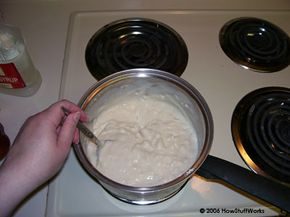
The actual cooking phase is when things get serious. You have to stir the mixture constantly. Don’t look away. It starts as a liquid and then thickens into a heavy, durable mass. It sticks to the pot. It fights the spoon. If your cookware isn’t non-stick, you’re in for a bad time.
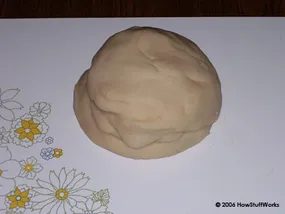
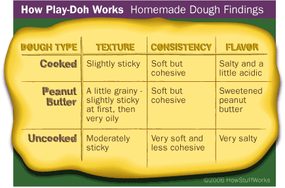
When it cools, the texture is surprisingly fun. It’s stickier than the store bought stuff in the blue jar. But knead it a few times. It yields. It has the same soft, malleable feel. The cream of tartar does the heavy lifting here and stiffens the dough so that it holds its shape without collapsing. Remember: The ingredients are edible, but the salt content is high. It tastes like salt.
We’ll get to the real edible version later. Now let’s talk about colors.
Add color to homemade dough
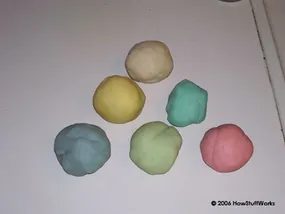
Commercial Play-Doh is available in all shades. With patience you can replicate that range. Mix pink and green to create the floral shade seen in the tutorials. Make your own batch by adding food coloring or sugar-free powdered drink mix. Mix until the color is uniform. In general, powder is disperses easier than gel.
Peanut Butter Dough
Want a snack option? Change the base.
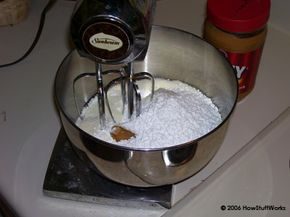
Another version comes straight from Lisa’s Kids Site, which usually recommends easy, kid-friendly snacks. The ingredient list was scary. Peanut butter. Light corn syrup. powdered milk. powdered sugar. It looked like a sugar bomb waiting to happen. We expected a sticky, unmanageable mess that would stick to every surface in the kitchen.
It didn’t happen.
The peanut butter saved it. The natural oils it contains act as a lubricant and combat the possible stickiness of dry powders. Both peanut butter and corn syrup are thick, viscous ingredients. Together they made a cohesive dough. It came together quickly. In fact, it got so thick and heavy that it almost jammed the mixer motor.
The peanut oil contained in peanut butter provides a significant lubricating effect.
We didn’t just mix sugar and nut butter. We balanced the viscosity. Dry materials absorb moisture from wet materials. The result was a dense ball. It settled quickly. Maybe too fast for some tastes. But it worked.
The texture was not rough. It wasn’t liquid. It was solid. You can roll it. You can shape it. You just have to work fast before the mixer gives up.
What happens if you double the powdered sugar? Probably too dry. Triple? brick. It depends on the ratio. Peanut oil is non-negotiable. Without it, the corn syrup and powders would simply clump together into a hard, sweet rock.
This recipe is based on this specific chemical marriage. fat and sugar. Thick and thick. It’s counterintuitive. You might think that adding more dry ingredients will make the dough crumbly. Instead, it gets denser.
Does it taste better than the first time? This is subjective. But it is edible. It’s not a disaster. It’s a ball of peanut butter dough that doesn’t fall apart.
You can leave it in the bowl. You can scoop it out. The choice is yours. But don’t walk away from the mixer. It might stall.
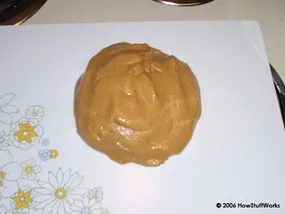
Here’s the twist. The peanut butter dough is not sticky. It’s oily.
At first glance it looks dry. This illusion only lasts a few seconds. As soon as you start kneading, the texture changes. It feels smooth. You cannot add color to this mixture. It’s already brown. Deep brown.
Cooling is not negotiable. The dough hardens into a stiff, cold log.
But there is a catch. It’s edible.
Unless you have a peanut allergy or diabetes. Most people can eat it without any problems. Unlike the other recipes in this series, this one tastes really good. That’s its main selling point. Taste wins.
Oiliness does not make for good playtime. It will be a snack. You are not here to model a statue. You eat dessert.
If you want to customize it, replace the light corn syrup with honey. It works just as well.
No-cook Flour Dough
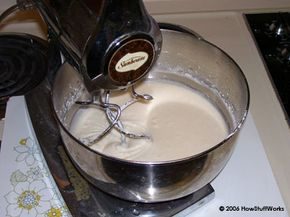
We adapted this particular recipe from Kids’ Central, and while it looks innocent on paper, the chemistry is completely different. As in our first stove-top experiment, pantry staples are familiar. You need water, salt, vegetable oil and flour. There is also a touch of cornstarch, which acts as a thickener and gives it its characteristic clay-like bite.
catch? Cold water. And no heat.
This is not a lazy method. It’s a test of patience. Achieving the right flour-water ratio requires constant vigilance. Without the coaxing heat of a stove, you have to work the dough until it reveals its secrets. These individual ingredients must be thoroughly mixed into a uniform mass.
The big difference is that cold water is used and does not require cooking.
It’s physically demanding. You practically knead the structure by hand. But if you stick with it, the result is undeniable. You can hardly tell the finished ball of dough from the heated ball. Same texture. The same flexibility. Just to get there you have to use a lot more power.
So which method wins? The stove-top version cooks itself. The uncooked version requires effort. If you have a kitchen and five minutes to spare, stick to the heat. If you’re stuck in a classroom or car with a bag of flour and a bottle of oil, this cold water route works. Just prepare to mix until your hands hurt.
It’s a compromise. Convenience for labor. And honestly? Sometimes this work is worth it. At least it keeps the kids busy while the actual cooking takes place somewhere else. The dough doesn’t matter how you made it. It just wants to take shape.
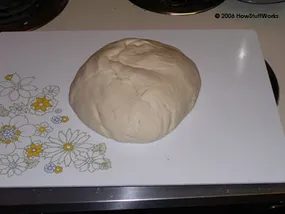
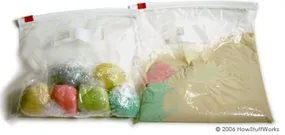
The raw version didn’t sit right. It was sticky. A mess to handle. The cooked dough was different. Firm. Workable. It kept its shape even when put in a plastic bag.
But if you play it too long, it gets tacky. At first we blamed the Georgia summer humidity. Of course we did. Then we sealed the uncooked dough in an airtight bag. It didn’t hold. It spread. Turned into a sticky mush.
The solution could be simple. Add cream of tartar to the recipe. It should make the dough stiff. Make it actually usable. Or at least less of a disaster.
The real ingredients of modeling clay
You may have remembered them in kindergarten, but what really lies behind those colorful, fluffy modeling clay? Checking allergy labels reveals conflicting news. Commercially available formulations are basically a mixture of water, salt and flour. This means that there is no peanut oil or milk derivatives which is a relief for those specific allergies. But wheat is definitely on the menu. If you have a gluten sensitivity, it is best to avoid gluten.
For parents who want to recreate this experience at home without industrial additives, there are several DIY routes. You can change the texture by cooking flour dough, try a peanut butter-based version (if wheat is off the table), or choose an uncooked flour recipe. These homemade options often look different, but scratch that same creative itch.
Is Play-Doh really safe to eat?
Let’s talk about the elephant in the room. Children eat. It is a given. Play-Doh is sold and tested to be non-toxic, and ingesting small amounts of Play-Doh won’t kill you. However, “non-toxic” does not mean “tasty” or “easy to digest”. This compound may contain petroleum-based lubricants. These are not food grade ingredients. Designed to be shaped, not chewed. If it dries and hardens because you left the lid off overnight, that’s a chemistry you don’t want to internalize. Hold it in your hand, not in your mouth.
Is Play-Doh still popular?
Despite the rise of digital toys, trademarked model compounds still moving mountains of product. Hasbro still produces about 95 million cans of product each year. This is not a niche hobby market. It is a mass market staple with over 6,000 retail locations in the US alone. The reach is global and there are sales in 75 countries. They have survived decades of trends and are still the physical touchstones of playtime.
More ways to play and learn
If you’re interested in classic toy construction, the tactile play ecosystem extends far beyond a single brand. Find out how Lego bricks work together so precisely, or how Magna Doodle’s magnetic surface wipes and redraws with a swipe. There are also yo-yo physics, the chaotic mechanics of pinballs, and the fluid mechanics of liquid motion lights. On a more fundamental level, understanding the behavior of water or the preservative salt can give you a deeper understanding of chemistry like Play-Doh.
For those who want to dig deeper into history, resources like the Classic Toy Museum and articles on the 50-year history of Play-Doh provide background information on how Play-Doh evolved from wallpaper cleaner to cultural icon. Designers like Brendan Dawes are inspired by the tactile properties of dough to create digital user interfaces that bridge the gap between physical interaction and screen interaction.
The science behind it is just as interesting. Chemistry is powerful, from the gelatinization of the starch to the work of the surfactants that keep the dough pliable. Patents for starch-based styling products highlight the innovation associated with maintaining their softness over the years. If you’re into technology, you can turn a quick crafting session into a mini science lesson by learning about food starch techniques and the role of tartar in DIY recipes.
Materials such as Lisa Balbach’s craft ideas, Scott Hegenbart’s research on how starch works, and Hasbro’s official documentation form the backbone of these insights. Whether you make your own batch using a recipe from Just Kids Recipes or Kids’ Turn Central or buy a can off the shelf, the interaction of water, salt and starch remains the same. It’s a simple chemistry that has stood the test of time.
The dough dries. It hardens. It disappears under the sofa cushions. But the core formula remains.