Deep in the Martian upper atmosphere something unexpected is squeezing plasma.
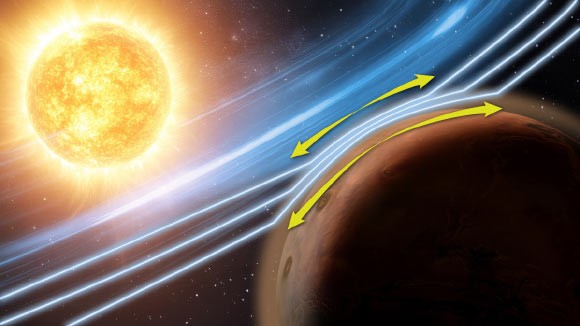
NASA’s MAVEN spacecraft picked up on it. The phenomenon is called the Zwan-Wolf effect. Historically it was strictly an Earth magnetosphere thing. Charged particles getting pushed out of flux tubes like toothpaste from a bent tube. But now we have proof it reshapes Mars’s sky too.
Dr. Christopher Fowler at West Virginia University saw it first. Or rather. He saw a glitch.
“When investigating the MAVEN data I all of a sudden noticed some weird wiggles.”
He didn’t think much of it. Why would he. This effect has never been documented in a planetary atmosphere. Just the magnetic shield around the planet.
The Zwan-Wolf effect dates back to 1976. Earth had it. Mars does not. Mars lacks a global magnetic field. That makes the planet’s interaction with the sun completely different. Solar wind slams into the Red Planet directly. It induces a magnetosphere where there is none. And then it gets ripped apart by space weather.
MAVEN caught one of those rip events.
The data came from deep below 200 kilometers. In the ionosphere. That layer is packed with charged particles. Usually the Zwan-Wolf effect is too faint there to spot. MAVEN’s instruments are precise but they missed it during quiet times. Then came the storm. The solar eruption amplified the squeeze. Suddenly the signal jumped off the charts.
Fowler and his team dug in. They looked at the magnetic field fluctuations. They checked the particle density readings. It wasn’t sensor noise. It wasn’t an instrumental error. After ruling out the boring explanations only one culprit fit. The toothpaste tube.
It explains everything in the data. The weirdness. The spikes. The sudden changes in magnetic structure.
“No one expected that this effect could even occur in the atmosphere.”
That’s the kicker. It means our models of unmagnetized worlds are missing a chunk of physics. We don’t know how the Sun alters the dynamics there as well as we thought.
Does this matter for anything other than pure curiosity. Yes. Space weather hurts hardware. Knowing how the atmosphere moves during these squeeze events helps protect assets on the ground or in orbit. It applies to Venus too. Even Titan.
Observations like this highlight how large space weather events lead to environmental changes around the Red Planet.
Dr. Shannon Curry. Principal investigator. She notes the MAVEN team keeps finding these hidden links between our star and the planet we want to visit. The study hit Nature Communications this week. The data is there. The wiggles are real.
The question isn’t really about Mars anymore. It is about everywhere else where the magnetic field is missing. And where the solar wind wins.
- C.M. Fowler et al. ₂₀₂₆. Detection of Zwan-Wolf effect in ionosphere of Mars. Nat Commun ₁₇. ₄₂₂₄; doi: 10.1₀3₈/s4146₇-0₂6-7₂₂₅₁-₉
So the atmosphere is more fluid than we gave it credit for. Squeezable. Unpredictable. Just like the weather itself.
What else is hiding in the static. 📡