Ice kills cells.
Simple as that.
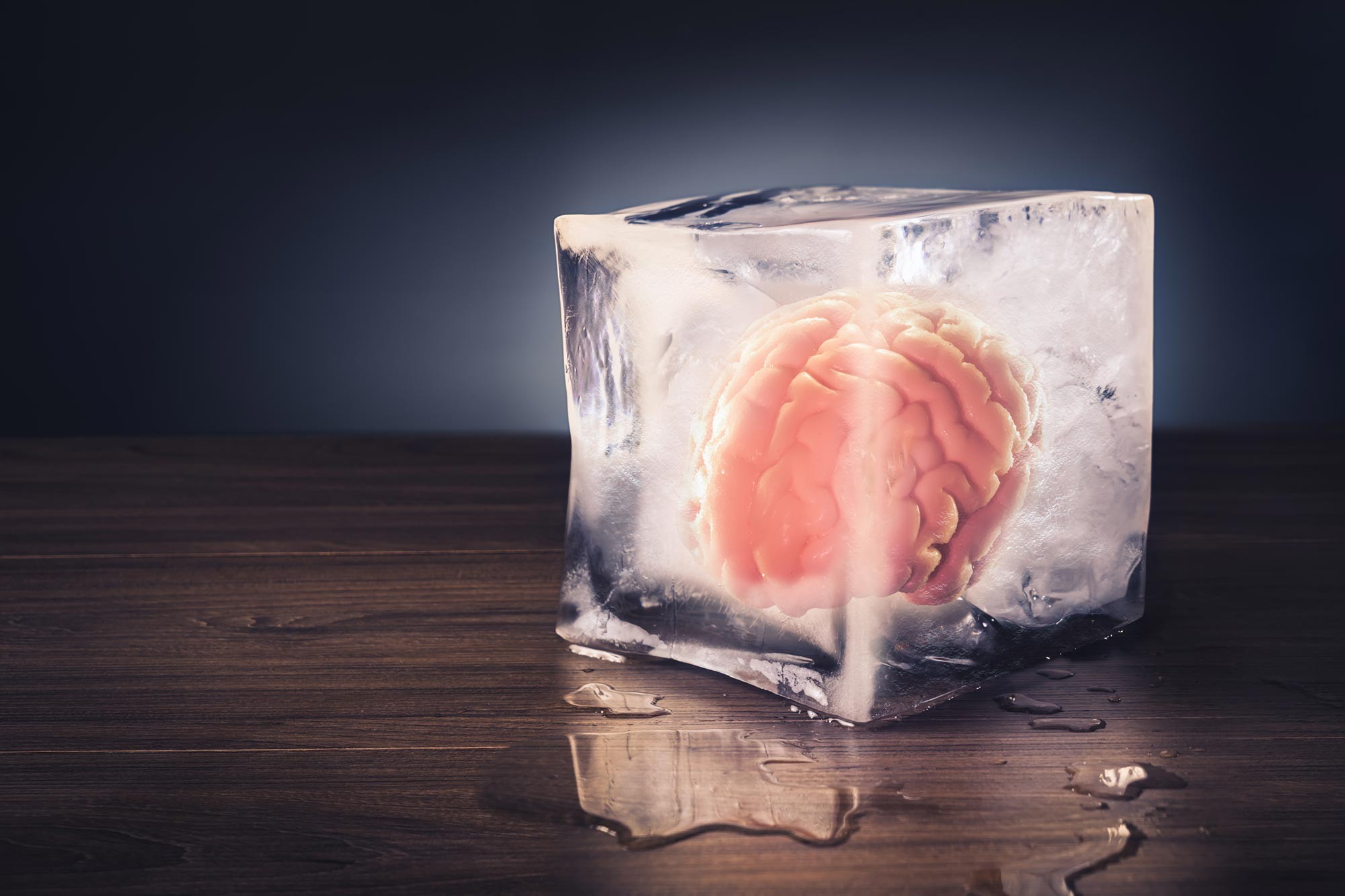
It doesn’t matter how cold your freezer gets, water turns to jagged crystals as it freezes, and those crystals shred the delicate machinery of life. That is why we cannot simply park a human brain in deep freeze, wait out the apocalypse, or perhaps just wait for better medicine. Until now.
“The formation of ice crystals is the reasonwhy extreme cold is usually so harmful.”
— Dr. Alexander German
But nature has tricks.
Specifically, a tiny salamander from Siberia. This amphibian survives decades trapped in permafrost, braving temperatures dropping toward negative 50 Celsius. When spring finally arrives, it shakes off the frost and walks away. No damage. No trauma. Just continuity.
Its secret is glycerol.
Produced in its liver, this alcohol lowers the body’s freezing point and coats the cells. It prevents ice from forming inside the tissues. It’s natural antifreeze. Human medics already use a version of this concept for human embryos, keeping them safe in ultra-low temps for years. But embryos are simple compared to the brain.
The brain is a wiring nightmare.
Hundreds of millions of neurons connected by billions of synapses. You freeze a brain the old way, you kill the structure. The connections snap. The signal dies. Even if the neurons survive the thaw, they can no longer talk to each other. The network is broken.
The team at Uniklinikum Erlangen and FAU thought: why not optimize the mix?
They tweaked the preservative chemistry and the cooling curve. The goal was vitrification —turning the tissue into glass. Glass is solid, sure, but the molecules don’t align into destructive crystal lattices. They stay random. Chaotic. Safe.
They tested it on mouse brains. Specifically the hippocampus, the little seashell-shaped region responsible for memory. They dropped the temp to minus 130 Celsius. Then they turned it back on.
The tissue didn’t just stay alive.
It woke up.
Electron microscopy showed the nanostructure remained pristine. No shrapnel damage from ice. But living is different from working. To prove the point, the team watched the neurons fire. Electrical signals zipped through the network exactly as they had before the freeze. Even better, long-term potentiation —the cellular basis for learning—worked at the synapses. The frozen brain could still learn. It could still store new memories.
Which raises an awkward question: are we building cryo-pods?
Alexander German hints at it. Artificial hibernation. Stash a patient with a terminal diagnosis, keep them suspended, wake them up in 2070 when a cure exists. Or put astronauts into stasis for interstellar flights.
It’s a heavy sell, obviously. But for now, the immediate win is practical. Surgeons removing epilepsy-afflicted brain tissue? Don’t throw it away. Freeze it. Bring it out later. Test drugs on living human brain slices instead of rat analogues.
“At a later date, there may be treatment option that can help the person.”
— Dr. German
We haven’t frozen humans yet. We haven’t woken them up. The gap between a mouse hippocampus and a conscious mind is wide, chasmic, probably unsurmountable for decades. But the glass barrier has been cleared. The ice stays out. The nerves hold fast.
Something works where it once shattered.