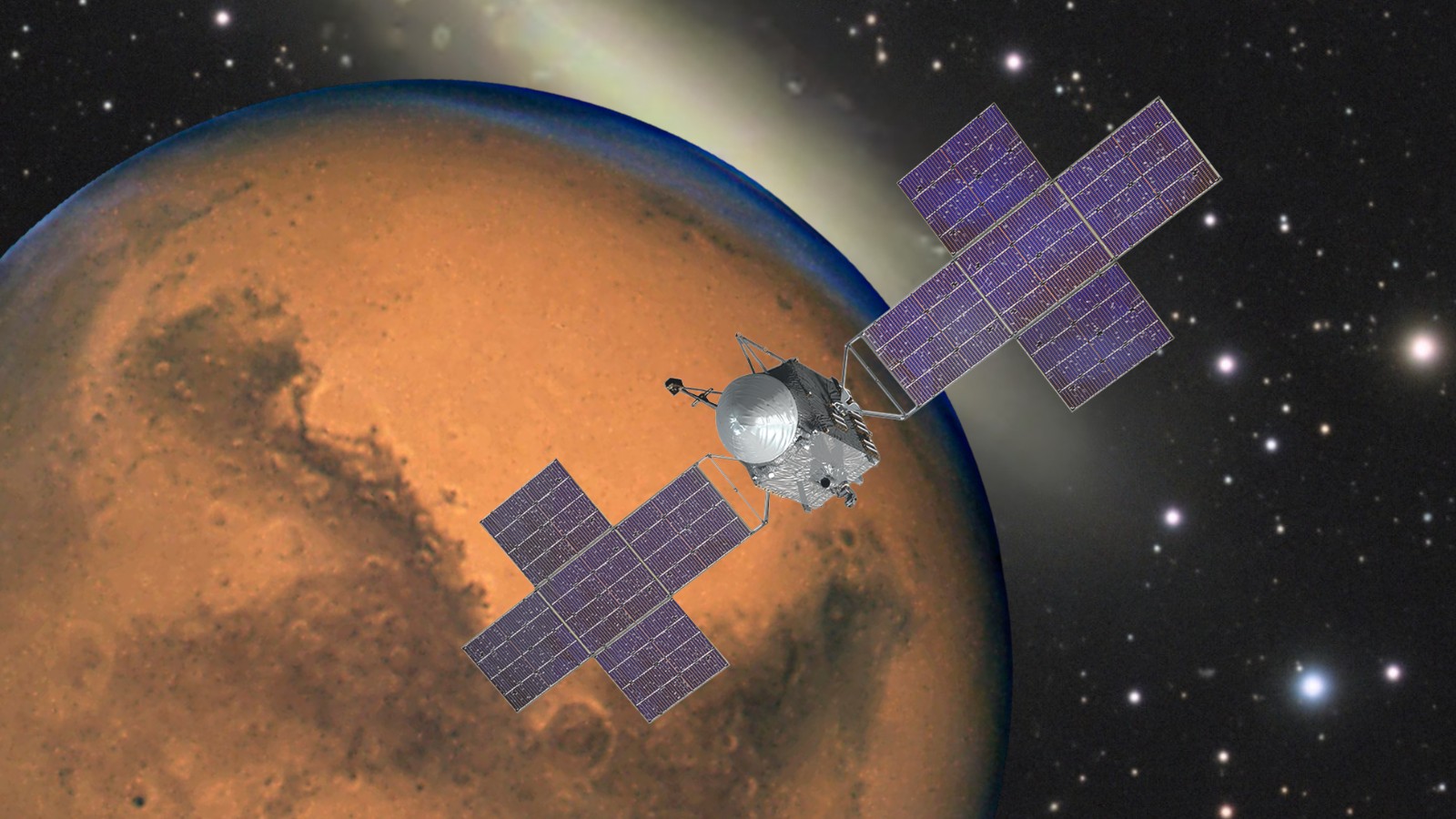
NASA’s Psyche spacecraft is scheduled for a close encounter with Mars on May 15, a pivotal moment in its journey to the metal-rich asteroid of the same name. During this flyby, the probe will pass within approximately 2,800 miles (4,500 kilometers) of the Red Planet. This proximity is not merely a chance meeting; it is a carefully orchestrated maneuver designed to harness Mars’ gravity to accelerate the spacecraft and refine its trajectory toward the main asteroid belt.
The Mechanics of the Gravity Assist
The primary objective of this encounter is to utilize gravitational assist, a technique where a spacecraft gains speed and alters its course by flying close to a massive celestial body. As Psyche swings by Mars, the planet’s gravity will pull on the craft, boosting its already impressive velocity of 12,333 miles per hour (19,848 kph).
This acceleration serves two critical purposes:
1. Trajectory Correction: It steers the spacecraft precisely toward 16 Psyche, a 173-mile-wide (280 km) asteroid located between Mars and Jupiter.
2. Propellant Conservation: By relying on gravity rather than onboard fuel for this speed increase, the mission saves valuable xenon gas propellant, ensuring the spacecraft has enough energy for its final approach and orbital insertion in 2029.
More Than Just a Speed Boost: Instrument Calibration
While the gravity assist is essential for navigation, the Mars flyby offers a unique scientific opportunity. The Psyche mission team is using this close approach to test and calibrate the spacecraft’s instruments before they reach their ultimate target.
“This is our first opportunity in flight to calibrate Psyche’s imager with something bigger than a few pixels,” said Sarah Bairstow, Psyche’s mission planning lead at NASA’s Jet Propulsion Laboratory.
To achieve this, the probe’s multispectral imager has been capturing thousands of observations of Mars. These images help engineers verify that the camera systems are functioning correctly and provide baseline data for future comparisons. The preparation for this phase began months in advance, with a significant trajectory correction maneuver on February 23. During that event, thrusters fired for 12 hours to fine-tune the spacecraft’s approach, ensuring it is now “exactly on target” for the May encounter.
Hunting for a Hidden Ring
Beyond standard instrument checks, the flyby may yield unexpected discoveries. Scientists are particularly interested in detecting a faint dusty ring, or torus, surrounding Mars. This hypothetical ring is believed to be formed by micrometeorites striking Mars’ two moons, Phobos and Deimos, ejecting dust particles into orbit.
The specific alignment of the Sun, Psyche, and Mars during the flyby creates ideal conditions for observation. As sunlight scatters off these dust particles, the spacecraft’s sensitive instruments may be able to detect this elusive ring. Confirming its existence would provide new insights into the dynamic environment of the Martian system and the ongoing erosion of its moons.
Why This Mission Matters
The Psyche mission represents a rare chance to study the exposed nickel-iron core of an early solar system planetesimal. Most rocky planets, including Earth, have their cores hidden beneath thick mantles and crusts. However, asteroid 16 Psyche is thought to be the stripped remnant of a protoplanet whose outer layers were removed by billions of years of collisions.
By reaching this metal-rich world in 2029, scientists hope to unlock secrets about the formation of planetary cores and the early history of our solar system. The upcoming Mars flyby is a crucial checkpoint, ensuring that the spacecraft is not only on the right path but also fully prepared to gather high-quality data when it arrives at one of the most unique objects in the cosmos.