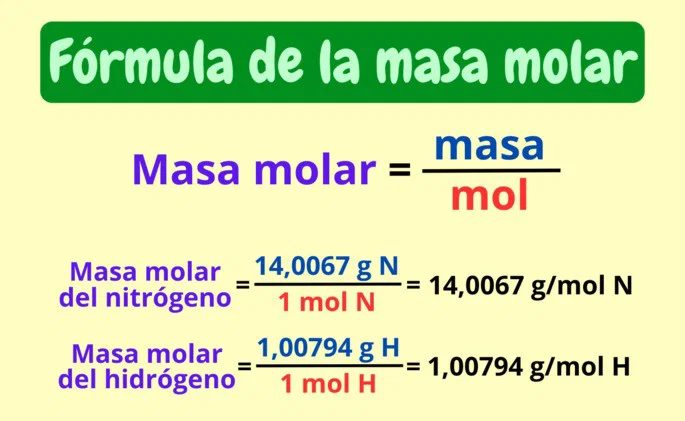
Molar mass is the weight of a mole of a substance. A mole is a specific number of particles. It is 6.022 x 10^23. This number matters. It connects the microscopic world of atoms to the macroscopic world of grams.
Chemists use molar mass to figure out how much a substance weighs. It works for elements. It works for molecules. The standard unit is grams per mole (g/mol). The International System of Units uses kilograms per mole (kg/mol). But most lab work sticks to grams.
You can find these numbers in the periodic table. Look at the atomic mass. It is the same number as the molar mass. Take hydrogen. Its atomic mass is 1.00794. Its molar mass is 1.00794 g/mol. Take nitrogen. It sits at 14.0067 g/mol.
This coincidence makes calculations easier. You do not need to look up two different sets of data. The periodic table gives you the key to converting between atoms and grams.
How to Calculate Molar Mass for Compounds
Calculating the molar mass of a compound is straightforward. It is a sum. You add up the masses of all the atoms in the formula.
First. Identify each element in the chemical formula.
Second. Find the atomic mass of each element on the periodic table.
Third. Multiply that mass by the number of atoms of that element in the formula.
Fourth. Add all the results together.
Let’s look at water. H2O.
Two hydrogen atoms. One oxygen atom.
Hydrogen is 1.00794 g/mol.
Oxygen is 15.999 g/mol.
Calculation:
2 * 1.00794 = 2.01588
1 * 15.999 = 15.999
Total = 18.01488 g/mol.
Rounding matters in science. But the principle is simple. The total weight of the molecule is the sum of its parts. This applies to salts. It applies to complex organic compounds. It applies to polymers.
Why does this matter outside the classroom?
Pharmaceuticals require precise dosages. A milligram difference can change a drug’s effect.
Materials science relies on exact ratios.
Environmental testing measures pollutants in parts per million.
Without accurate molar mass data, none of these fields function correctly. The numbers are not abstract. They are the foundation of quantitative chemistry.
The bridge between the microscopic world of atoms and the macroscopic world we can weigh on a scale is molar mass. It’s not just a number you memorize for a chemistry test. It is the conversion factor that lets you count atoms by weighing them.
The formula is straightforward:
Molar mass = mass / moles
Here is the trick most students miss early on. The molar mass of an element or compound is numerically identical to its atomic or molecular mass, just with different units. You move from atomic mass units (amu) to grams per mole (g/mol).
Take oxygen. The periodic table lists its atomic mass as 15.9994 amu. That means one mole of oxygen atoms weighs exactly 15.9994 grams.
To find the molar mass of a compound, you add up the masses of the individual elements. Multiply each element’s mass by its count in the formula.
Let’s look at ammonia (NH3).
You need the molar mass of nitrogen plus three times the molar mass of hydrogen.
- Nitrogen: 14.0067 g/mol
- Hydrogen: 1.00794 g/mol
So, 14.0067 + (1.00794 x 3) = 17.03052 g/mol.
Once you have that number, you unlock the ability to convert between mass and quantity. Since one mole contains Avogadro’s number of particles (6.022 x 10^23), knowing the molar mass tells you exactly how many particles are in a gram of substance.
If you know the total mass of a sample and the molar mass of the substance, finding the number of moes is simple division.
moles = mass / molar mass
Suppose you have a 100-gram tank of ammonia. To find out how many moles you have, you divide 100 by 17.03052. The result is roughly 5.87 moles.
That’s nearly 6 moles of gas. Or about 3.5 x 10^24 molecules.
“The molar mass is the key that turns weight into count.”
Common Molar Masses You Should Know
You don’t need to calculate everything from scratch every time. Memorizing a few core values saves time and reduces errors.
Oxygen gas (O2) : Since oxygen is diatomic, you double the atomic mass. 15.9994 x 2 = 31.9988 g/mol.
Carbon (C) : The backbone of organic chemistry. 12.011 g/mol.
Carbon monoxide (CO) : Carbon plus oxygen. 12.011 + 15.9994 = 28.0101 g/mol.
Carbon dioxide (CO2) : One carbon, two oxygens. 12.011 + (2 x 15.9994) = 44.0095 g/mol. This is critical for understanding greenhouse gas emissions by weight.
Potassium (K) : An essential electrolyte. 39.0983 g/mol.
Sodium (Na) : The other side of the salt coin. **22.98