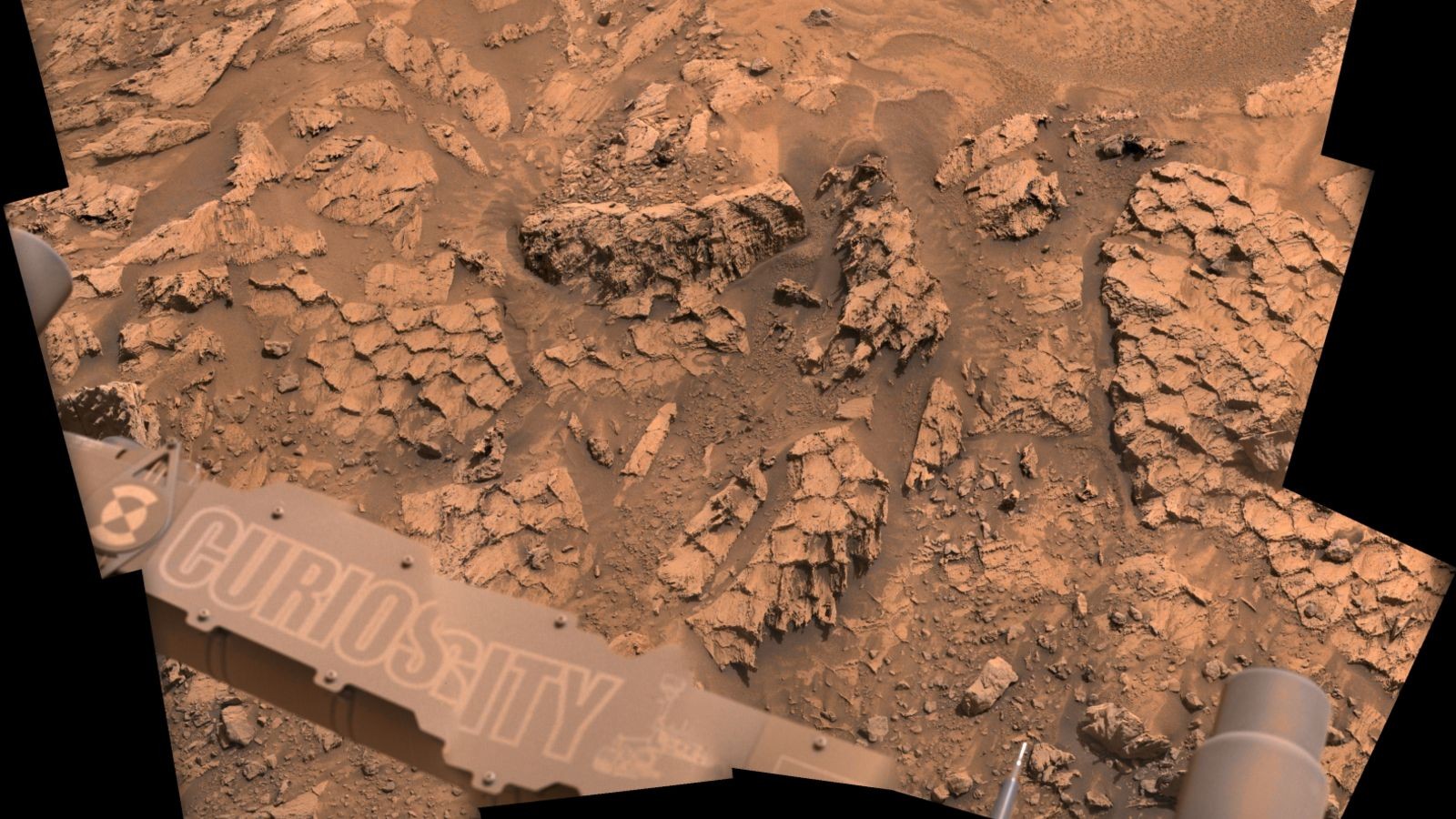
NASA’s Curiosity rover has captured striking images of peculiar rock formations on Mars that bear a startling resemblance to the scales of a giant reptile. While the visual similarity to “dragon scales” has captured public imagination, scientists suggest these structures are actually a window into the planet’s geological and watery past.
The Discovery at Antofagasta
The unusual features were documented as the Curiosity rover traveled toward Antofagasta, a 10-meter-wide impact crater located on the slopes of Mount Sharp within the Gale Crater.
The images, captured in early April (Martian Sols 4859 and 4865), reveal a vast expanse of rocks covered in tightly clustered, multi-faceted patterns. These “scales” appear to stretch across the Martian landscape for several meters, creating a textured, honeycomb-like appearance across the ground.
Deciphering the “Scales”
While the patterns look organic, they are actually polygonal geological structures. Planetary scientists at NASA’s Jet Propulsion Laboratory (JPL) noted that while they have encountered such textures before, the sheer abundance of them in this specific area is unexpected.
“We’ve seen polygon-patterned rocks like these before, but they didn’t seem quite this dramatically abundant,” explained Abigail Fraeman, a planetary scientist at JPL.
How do these patterns form?
In planetary science, such honeycomb textures are typically the result of environmental stresses. Scientists are currently investigating two primary theories:
– Desiccation: The drying out of ancient, wet mud, which causes the surface to crack into geometric shapes.
– Subsurface Movement: The shifting of ice crystals beneath the Martian surface, which can pressure the ground into polygonal patterns.
By analyzing the chemical data and high-resolution imagery collected by Curiosity, researchers aim to determine which of these processes—or perhaps a combination of both—shaped this landscape.
The Science of “Animal Impostors”
The “dragon scale” phenomenon is part of a recurring trend in Mars exploration where rocky landscapes appear to mimic life. Curiosity has previously encountered “egg-like” spheroids and coral-like formations, while the Perseverance rover has photographed rocks resembling turtles.
These sightings are driven by a psychological phenomenon known as pareidolia —the human brain’s tendency to perceive meaningful images, such as faces or animals, in random patterns. While these “creatures” are nothing more than geological coincidences, they highlight the complex and diverse textures of the Martian surface.
Conclusion
The discovery of these widespread polygonal rocks provides Curiosity with a new opportunity to study Mars’ ancient climate and water history. While they may look like the remains of mythical creatures, these “scales” are actually vital clues to understanding how water once shaped the Martian environment.