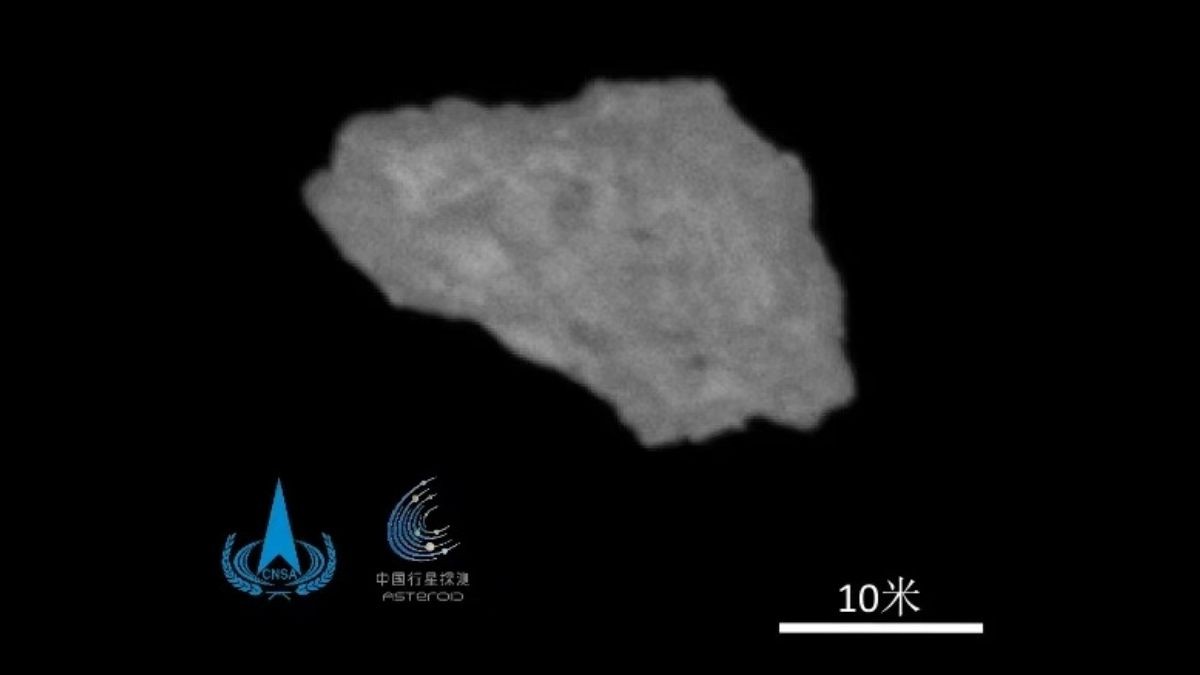
You’ve probably heard the Earth has a “minimoon.” Maybe not by that name, but asteroid 2016 HO3? Yes, it’s real. We call it Kamoʻoalewa too.
A Chinese probe just took the first close-up.
It’s the Tianwen-2 mission. CNSA — that’s China National Space Administration — sent it up on May 29, 2025, from Xichang. It took 13 months to get here, covering nearly 1 billion kilometers of empty void. Now, finally, it has arrived.
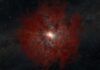
Since July 2 it has been hanging just 20 kilometers off the rock’s surface. Close enough to snap this portrait.
Kamoʻoalewa isn’t exactly our moon. Its orbit circles the Sun, technically. But it skirts our planet every 45 years in a wobbly elliptical dance, which earns it that rare “quasi-satellite” badge. Only seven others like it are known to share Earth’s sky. It’s an Apollo-class asteroid, sharing our solar orbit but sticking around us for longer stints.
We don’t know much yet. Distant observations say it’s roughly 40 to 10 meters across. Small? Very small. It might be the tiniest asteroid humans have ever visited.
The approach was slow. Optical detection started June 6. By mid-June it was within 2,00 km, creeping closer until July when it pulled in to just 20 km. That’s where the photo comes from.
Tianwen-2 isn’t just there for selfies. It’s a sample return mission.
“Among the known near-Earth objects, 2016 HO3 is an exceptionally rare Earth co-rbital object.”
That’s physicist Rongqiao Zhang and his team in Beijing explaining why they picked it. The math works. The orbital period matches Earth’s, which saves fuel on the trip over. It stays stable at 0.1-0.3 AU distance. Easy to track. Easy to control. Good for communication.
Scientists want answers. Is the thing a monolithic rock? A loose pile of rubble? Are there water traces? Solar wind effects? The origins are enigmatic. Its orbit evolved in ways we’re still untangling.
The big question? Is it actually a chunk of the Moon? Telescopes hinted yes, but samples would prove it.
Nine months at the minimoon. That’s the plan.
Then, drop off the samples on an Earth flyby and keep going. The next stop is main-belt comet 31 P, sitting way out past Mars. This comet has a bizarre six-pronged dust tail and we still don’t really know what its shape looks like. It happens to line up with the return trajectory, so it’s a convenient second stop for a flyby.
A huge mission. Two tiny targets. We’re waiting to see what they bring back.